
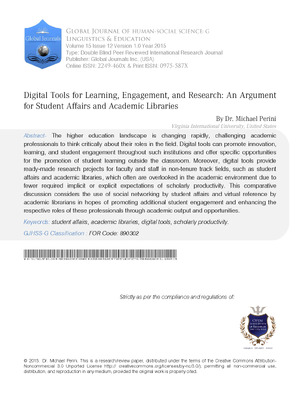
Digital Tools for Learning, Engagement, and Research: An Argument for Student Affairs and Academic Libraries
Keywords:
student affairs, academic libraries, digital tools, scholarly productivity.
Abstract
The higher education landscape is changing rapidly, challenging academic professionals to think critically about their roles in the field. Digital tools can promote innovation, learning, and student engagement throughout such institutions and offer specific opportunities for the promotion of student learning outside the classroom. Moreover, digital tools provide ready-made research projects for faculty and staff in non-tenure track fields, such as student affairs and academic libraries, which often are overlooked in the academic environment due to fewer required implicit or explicit expectations of scholarly productivity. This comparative discussion considers the use of social networking by student affairs and virtual reference by academic librarians in hopes of promoting additional student engagement and enhancing the respective roles of these professionals through academic output and opportunities.
Downloads
How to Cite
References
W. Albrecht (2011) LinkedIn For Accounting And Business Students. 4(10), 39-41.
V. Arcelus (2011) Transforming our approach to education: Cultivating partnerships and dialogue. 3-14.
(2012) Guidelines for academic librarians without faculty status. 73(3), 161-162.
M. Benjamin, F. Hamrick (2011) Expanding the learning environment. 3-14.
Erika Bennett, Jennie Simning (2010) Embedded Librarians and Reference Traffic: A Quantitative Analysis. 50(5-6), 443-457. https://doi.org/10.1080/01930826.2010.491437
Char Booth (2008) Developing Skype-Based Reference Services. 13(2-3), 147-165. https://doi.org/10.1080/10875300802103684
Char Booth (2008) Video Reference and the Library Kiosk: Experimentation and Evaluation. 5(1-2), 47-53. https://doi.org/10.1080/15367960802197731
Shirley Bower, Susan Mee (2010) Virtual Delivery of Electronic Resources and Services to Off-Campus Users: A Multifaceted Approach. 50(5-6), 468-483. https://doi.org/10.1080/01930826.2010.488593
M. Burns (2010) Not too distant: A survey of strategies for teacher support in distance education programs. 11(2), 108-117.
C. Cardina, D. Wicks (2004) The changing roles of academic reference librarians over a ten-year period. 44(2), 133-142.
I. Chan, P. Ly, Y. Meulemans (2012) Extending IM beyond the Reference Desk: A Case Study on the Integration of Chat Reference and Library-Wide Instant Messaging Network. 31(3), 4-23.
J. Chang, C. Yang (2012) Viable or vital? Evaluation of IM services from patrons' perspectives. 30(1), 70-88.
L. Charnigo (2009) Lights! Camera! Action! Producing Library Instruction Video Tutorials Using Camtasia Studio. 3(1), 23-30.
Moon-Heum Cho (2012) Online student orientation in higher education: a developmental study. 60(6), 1051-1069. https://doi.org/10.1007/s11423-012-9271-4
Tiffany Christian, Julie Sprinkle (2013) College student perceptions and ideals of advising: An exploratory analysis. 47(2), 271-291. https://doi.org/10.1037/t64488-000
D. Cordell (2012) Skype and the embedded librarian. 48(2), 8-11. https://doi.org/10.5860/ltr.48n2
Rosie Croft, Corey Davis (2010) E-Books Revisited: Surveying Student E-Book Usage in a Distributed Learning Academic Library 6 Years Later. 50(5-6), 543-569. https://doi.org/10.1080/01930826.2010.488600
Robert Curry, Roger Baldwin, Martha Sharpe (1998) Academic advising in baccalaureate distance education programs. 12(3), 42-52. https://doi.org/10.1080/08923649809527004
Valrie Davis, Michelle Foss (2009) Supporting the Distance Learning Community with Interlibrary Loan and Collection Management at the University of Florida Libraries. 3(2), 55-66. https://doi.org/10.1080/15332900902976701
Christopher Devine, Emily Paladino, John Davis (2011) Chat Reference Training After One Decade: The Results of a National Survey of Academic Libraries. 37(3), 197-206. https://doi.org/10.1016/j.acalib.2011.02.011
S. Dunlap (2002) Watch for the little red light: Delivery of bibliographic instruction by unconventional means. 37, 279-285.
F. Gillette (2011) The rise and inglorious fall of MySpace. http://www.business-week.com/magazine/content/11_27/b4235053917570.htm
Carol Gravel (2012) Student-Advisor Interaction in Undergraduate Online Degree Programs: A Factor in Student Retention. 32(2), 56-67. https://doi.org/10.12930/0271-9517-32.2.56
Jolie Graybill, Tracy Bicknell-Holmes (2013) Location, Location, Location: The Impact of IM Widget Placement. 20(1), 72-86. https://doi.org/10.1080/10691316.2013.761081
Pamela Grudzien, Anne Casey (2008) Do Off-Campus Students Use E-Books?. 48(3), 455-466. https://doi.org/10.1080/01930820802289532
M. Harr, M. Baumhardt (2011) Preparing for jobsearch success. 44(1), 12-15.
Sandra Hawes (2011) Playing to Win: Embedded Librarians in Online Classrooms. 5(1-2), 56-66. https://doi.org/10.1080/1533290x.2011.570560
V. Jeevan (2007) Technology-Enhanced Library Services and the Librarian's Identity Crisis in Academic and Research Libraries of India. 57(2), 100-109. https://doi.org/10.1515/libr.2007.100
Heather Kanuka, Kam Jugdev (2006) Distance education MBA students: an investigation into the use of an orientation course to address academic and social integration issues. 21(2), 153-166. https://doi.org/10.1080/02680510600715578
Robert Kenedy, Vivienne Monty (2011) Faculty-Librarian Collaboration and the Development of Critical Skills through Dynamic Purposeful Learning. 61(2), 116-124. https://doi.org/10.1515/libr.2011.010
Carol Klages, Shana Pate, Peter Conforti (2007) Virtual Literature Circles. 9(1/2), 293-309. https://doi.org/10.1108/978-1-60752-591-220251023
J. Kord, L. Wolf-Wendel (2009) The relationship between online social networking and academic and social integration. 28(1), 103-123.
G. Kuh, J. Kinzie, J. Schuh, E. Whitt, Associates (2005) Student success in college: Creating conditions that matter.
Maria LaPadula (2003) A comprehensive look at online student support services for distance learners. 17(2), 119-128. https://doi.org/10.1207/s15389286ajde1702
Alain Lamothe (2012) The Importance of Encouraging Librarians to Publish in Peer-Reviewed Publications. 43(2), 156-167.
W. Lougee (2002) Diffuse libraries: Emergent roles for the research library in the digital age.
Lili Luo (2007) Chat reference competencies: identification from a literature review and librarian interviews. 35(2), 195-209. https://doi.org/10.1108/00907320710749137
P. Magolda, M. Magolda (2011) Intellectual curiosity and lifelong learning. 3-14.
B. Mandernach, T. Mason (2008) Engaging students beyond the online classroom: Virtual student organizations. 12(7), 5-7.
J. Mahiri (2011) Digital tools in urban schools: Mediating a remix of learning.
C. Marcus, L. Covert-Vail, C. Mandel (2007) NYU 21st Century Library Project: Designing a Research Library of the Future for New York University.
Yvonne Meulemans, Allison Carr, Pearl Ly (2010) From a Distance: Robust Reference Service via Instant Messaging. 4(1-2), 3-17. https://doi.org/10.1080/15332901003667231
National Academic Advising Association (2010) NACADA standards for advising distance learners. https://www.nacada.ksu.edu/Por-tals/0/Commissions/C23/Documents/DistanceStandards.pdf
New Literacies (2013) What is instant messaging?. http://www.newliteracies.com.au/-what-are-new-literacies?/147/
K. O'Connell (2009) Valuing and rewarding academic advising. 13(17), 5-8.
OPSWAT (2011) Security industry market share analysis. http://www.opswat.-com/sites/default/files/OPSWAT-Market-Share-Report-June-2011.pdf
B. Pulliam, S. McMullen (2006) RYT: Are you there?. 13(4), 55-73.
M. Radford, L. Connaway (2013) Not dead yet! A longitudinal study of query type and ready reference accuracy in live chat and IM reference. 35(1), 2-13.
Susan Reilly, Marian Lefferts, Martin Moyle (2012) Collaboration to Build a Meaningful Connection Between Library Content and the Researcher. 17(1), 34-42. https://doi.org/10.1080/13614576.2012.678139
Sara Roberts, Dwight Hunter (2011) New Library, New Librarian, New Student: Using LibGuides to Reach the Virtual Student. 5(1-2), 67-75. https://doi.org/10.1080/1533290x.2011.570552
Julie Robinson, Don Kim (2010) Creating Customizable Subject Guides at Your Library to Support Online, Distance and Traditional Education: Comparing Three Self-Developed and One Commercial Online Subject Guide. 4(4), 185-196. https://doi.org/10.1080/1533290x.2010.524830
Mark Schofield, Andrew Sackville (2010) Student Induction/Orientation: From Event to Entitlement. 17(7), 113-124. https://doi.org/10.18848/1447-9494/cgp/v17i07/47140
J. Schuh, S. Jones, S. Harpers, Associates (2011) Student services: A handbook for the profession, 5th Ed.
Janet Schulenberg, Marie Lindhorst (2008) Advising is Advising: Toward Defining the Practice and Scholarship of Academic Advising. 28(1), 43-53. https://doi.org/10.12930/0271-9517-28.1.43
Barbara Shaffer (2011) Graduate Student Library Research Skills: Is Online Instruction Effective?. 5(1-2), 35-55. https://doi.org/10.1080/1533290x.2011.570546
S. Shiao-Feng, J. Kuo (2010) Design and development of web-based information literacy tutorials. 36(4), 320-328.
B. Smith (2005) Online student support services. 76(2), 26-29.
George Steele, Karen Thurmond (2009) Academic advising in a virtual university. 2009(146), 85-95. https://doi.org/10.1002/he.349
Terrell Strayhorn (2012) Exploring the Impact of Facebook and Myspace Use on First-Year Students' Sense of Belonging and Persistence Decisions. 53(6), 783-796. https://doi.org/10.1353/csd.2012.0078
V. Tinto (1987) Increasing student retention.
Valerie Tucci (2011) Faculty/Librarian Collaboration: Catalyst for Student Learning and Librarian Growth. 30(3), 292-305. https://doi.org/10.1080/0194262x.2011.596792
George Veletsianos, Cesar Navarrete (2012) Online social networks as formal learning environments: Learner experiences and activities. 13(1), 144.
C. Warren (2012) AIM: AOL Instant Message isn't deed...yet. http://mashable.com/-2012/03/14/aim-not-dead-yet/
Kristin Whitehair (2010) Reaching Part-Time Distance Students in Diverse Environments. 4(3), 96-105. https://doi.org/10.1080/1533290x.2010.503166
J. Wolfe, T. Naylor, J. Drueke (2010) The Role of the academic reference librarian in the learning commons. 50(2), 108-113.
P. Wyss (2010) Library School Faculty Member Perceptions Regarding Faculty Status for Academic Librarians. 71(4), 375-388.
Helen Wozniak, Jenny Pizzica, Mary Mahony (2012) Design-based research principles for student orientation to online study: Capturing the lessons learnt. 28(5), 896-911. https://doi.org/10.14742/ajet.823
Z. Yang (2000) University faculty's perception of a library liaison program: a case study. 26(2), 124-129.
P. Young (2006) Textbook add-ons placed on iTunes.
Chris Zirkle (2001) Distance Education Programming Barriers in Career and Technical Teacher Education in Ohio. 29(3), 157-179. https://doi.org/10.5328/jver29.3.157
Published
2015-11-24
Issue
Section
License
Copyright (c) 2015 Authors and Global Journals Private Limited

This work is licensed under a Creative Commons Attribution 4.0 International License.