
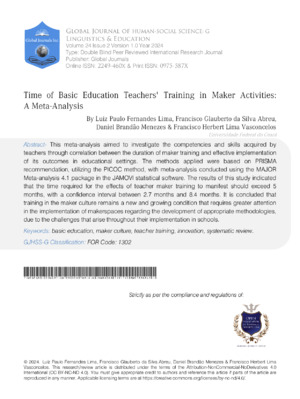
Time of Basic Education Teachers Training in Maker Activities: A Meta-Analysis
Keywords:
basic education, maker culture, teacher training, innovation, systematic review
Abstract
This meta-analysis aimed to investigate the competencies and skills acquired by teachers through correlation between the duration of maker training and effective implementation of its outcomes in educational settings. The methods applied were based on PRISMA recommendation, utilizing the PICOC method, with meta-analysis conducted using the MAJOR Meta-analysis 4.1 package in the JAMOVI statistical software. The results of this study indicated that the time required for the effects of teacher maker training to manifest should exceed 5 months, with a confidence interval between 2.7 months and 8.4 months. It is concluded that training in the maker culture remains a new and growing condition that requires greater attention in the implementation of makerspaces regarding the development of appropriate methodologies, due to the challenges that arise throughout their implementation in schools.
Downloads
How to Cite
References
Hanne Andersen, Kati Pitkänen (2019) Empowering educators by developing professional practice in digital fabrication and design thinking. 21, 1-16.
J Skelton, C Rodgers, L Ellis, A Lyles (2014) Rubrics and Evaluations. 9(4), 7-13.
Brasil (2017) ROBIS -Risk of Bias in Systematic Reviews: ferramenta para avaliar o risco de viés em revisões sistemáticas: orientações de uso.
A Carvalho, D Bley (2018) Cultura Maker e o uso das tecnologias digitais na educação: construindo pontes entre as teorias e práticas no Brasil e na Alemanha. 26(10), 21-40.
M Eisenberg (2013) 3D printing for children: What to build next?. 1(1), 7-13.
T Galvão, T Pansani, D Harrad (2015) Principais itens para relatar Revisões sistemáticas e Meta-análises: A recomendação PRISMA. 24(2), 335-342.
Guilherme Peixoto Da Fonseca, Marcelo Rodrigues Dos Santos, Francis Ribeiro De Souza, Carlos Negrão, Maria-Janieire De Nazaré Nunes Alves (2016) TESTOSTERONA E DOENÇA CARDIOVASCULAR: DO TRATAMENTO AO USO ABUSIVO. 29(4), 393-399.
Anna-Lena Godhe, Patrik Lilja, Neil Selwyn (2019) Making sense of making: critical issues in the integration of maker education into schools. 28(3), 317-328.
D González, M Santiago, M Domínguez González (2021) Mediación tecnológica apoyada en la Cultura Maker para la enseñanza de Ciencia y Tecnología en educación secundaria.
Joshua Gutwill, Nina Hido, Lisa Sindorf (2015) Research to Practice: Observing Learning in Tinkering Activities. 58(2), 151-168.
S Karppinen, V Kallunki, K Komulainen (2019) Interdisciplinary craft designing and invention pedagogy in teacher education: student teachers creating smart textiles. 29, 57-74.
B Kitchenham, S Charters (1051) Guidelines for performing systematic literature reviews in software engineering version 2.3. 45(4ve).
Skúlína Kjartansdóttir, Torfi Hjartarson, Svava Pétursdóttir (2020) Of Women Tech Pioneers and Tiny Experts of Ingenuity. 5, 537697.
B Litts, Y Kafai, D Fields, E Malverso, K Peppler (2016) Connected making.
L Merkle (2016) Perspectivas educacionais FabLearn: conceitos e práticas maker no Brasil.
Iván Milara, Kati Pitkänen, Jari Laru, Megumi Iwata, Marta Orduña, Jukka Riekki (2020) STEAM in Oulu: Scaffolding the development of a Community of Practice for local educators around STEAM and digital fabrication. 26, 100197.
R Orwin (1983) A fail-safe N for effect size in meta-analysis. 8(2), 157-159.
P Perrenoud, M Thurler (2009) As competências para ensinar no século XXI: a formação dos professores e o desafio da avaliação.
Team Core (2022) R: A Language and environment for statistical computing (Version 4.1).
J Sefton-Green (2013) Mapping digital makers: A review exploring everyday creativity, learning lives and the digital.
Neil Selwyn, Selena Nemorin, Scott Bulfin, Nicola Johnson (2017) Everyday Schooling in the Digital Age.
I Shyshenko, O Martynenko, Ya. Chkana, O Udovychenko, T Spas, O Semenikhina (2022) A Mathematics Teacher's Training to Create a Maker Space in Mathematics Lessons by Means of GeoGebra. 632-637.
J Sterne, A Sutton, J Ioannidis, N Terrin, D Jones, J Lau, . Higgins, J (2011) Recommendations for examining and interpreting funnel plot asymmetry in meta-analyses of randomised controlled trials. 343.
B Taylor (2016) Evaluating the benefit of the maker movement in K-12 STEM education. 2.
(2023) The jamovi project.
J Valente, P Blikstein (2019) Maker education: Where is the knowledge construction?. 14(3), 252-262.
Susanne Walan, Niklas Gericke (2023) Transferring makerspace activities to the classroom: a tension between two learning cultures. 33(5), 1755-1772.
S Xiang, W Yang, I Yeter (2023) Making a Makerspace for children: A mixed-methods study in Chinese kindergartens. 36, 100583.
Y Zhao (2017) What works may hurt: Side effects in education. 18(1), 1-19.
Published
2024-04-18
Issue
Section
License
Copyright (c) 2024 Authors and Global Journals Private Limited

This work is licensed under a Creative Commons Attribution 4.0 International License.