
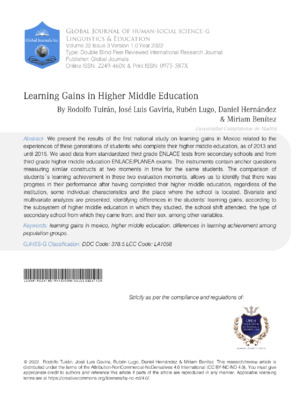
Learning Gains in Higher Middle Education
Keywords:
learning gains in mexico, higher middle education, differences in learning achievement among population groups
Abstract
We present the results of the first national study on learning gains in Mexico related to the experiences of three generations of students who complete their higher middle education, as of 2013 and until 2015. We used data from standardized third grade ENLACE tests from secondary schools and from third grade higher middle education ENLACE/PLANEA exams. The instruments contain anchor questions measuring similar constructs at two moments in time for the same students. The comparison of students´s learning achievement in these two evaluation moments, allows us to identify that there was progress in their performance after having completed their higher middle education, regardless of the institution, some individual characteristics and the place where the school is located. Bivariate and multivariate analyzes are presented, identifying differences in the students' learning gains, according to the subsystem of higher middle education in which they studied, the school shift attended, the type of secondary school from which they came from, and their sex, among other variables.
Downloads
How to Cite
References
(2010) Régions Francophones réels Francophones occasionnels Population Nombre % Nombre % AFRIQUE 30 001 000 4,7 40 617 000 6,3 645 000 000 Afrique du Nord-Est 219 000 0,31 700 000 2 83 400 000 Maghreb 14 455 000 24,7 17 030 000 29 58 400 000 Afrique subsaharienne 13 477 000 3,3 19 745 000 4,8 489 140 000 OCÉAN INDIEN 1 850 000 13,2 2 142 000 15,2 14 060 000 AMÉRIQUE 8 682 000 1,23 565 000 0,5 714 000 000 Amérique du Nord 7 286 000 2,93 2000 000 1,3 247 806 000 Amérique centrale, Caraïbes 1 216 000 0,7 365 000 0,2 176 794 000 Amérique du Sud 180 000 0,06 289 4000 000 ASIE 1 627 000 0,05 810 000 0,03 3 060 000 000 Proche et Moyen-Orient 1 491 000 0,8 800 000 0,4 186 000 000 Extrême-Orient 136 000 0,005 10 000 0,0004 2 874 000 000 EUROPE 63 952 000 8,19 200 000 0,1 789 000 000 Europe de l'Ouest 62 872 000 17,5 5 200 000 1,4 360 000 000 Europe de l'Est et URSS 1 080 000 0,34 000 000 0,9 429 000 000 OCÉANIE 350 000 1,3 33 000 0,1 26 000 000 MONDE 104 612 2 54 225 000 1 5 234 000 000. 219-219.
Audrey Amrein-Beardsley, Clarin Collins, Sarah Polasky, Edward Sloat (2013) Value-Added Model (VAM) Research for Educational Policy: Framing the Issue. 21(4/5), 1-11.
María Castro Morera, José Gaviria Soto (2009) La evaluación educativa desde la perspectiva del valor añadido. 16, 147-166.
A Ceneval (2011) Metodología Ceneval.
A Ceneval (2015) Manual técnico ENLACE Media Superior 2013-2014.
Rubén Cervini, Nora Dari (2008) Algunos problemas metodológicos en los estudios de eficacia escolar: una ilustración empírica. (19), 97-108.
N Chudowsky, J Koenig, H Braun (2010) Getting Value Out of Value-Added : Report of a Workshop.
Flérida Guzmán (2008) Programa Nacional de la Mujer 1995-2000. Diario Oficial de la Federación, 21 de agosto de 1996. 27(106).
(2008) Unknown Title. 444.
Marta Rubio-Codina, Sally Grantham-Mcgregor (2012) Validez predictiva de pruebas cortas comúnmente usadas para medir el desarrollo infantil en estudios a gran escala.
M Du Toit (2003) IRT from SSI: Bilog-MG, Multilog, Parscale, Testfact.
J Gaviria, M Castro (2005) Modelos jerárquicos lineales.
J Gaviria (2006) El valor añadido en educación y la función de producción educativa.
J Gaviria, C Biencinto, E Navarro (2009) Invarianza de la estructura de covarianzas de las medidas de rendimiento académico en estudios longitudinales en la transición de Educación Primaria a Secundaria. 348, 153-174.
J Gaviria, M Castro (2010) Modelos de valor añadido en educación.
H Goldstein (2003) Multilevel Satistical Models.
R Hambleton, H Swaminathan (1985) Item response theory. Principles and applications.
R Hambleton, H Swaminathan, H Rogers (1991) Fundamentals of item response theory.
Michael Kane (2017) Measurement Error and Bias in Value‐Added Models. 2017(1), 1-12.
Michael Kolen, Robert Brennan (2004) Test Equating, Scaling, and Linking.
Ita Kreft, Jan De Leeuw (1998) Introducing Multilevel Modeling.
L Miranda (2008) Factores asociados al rendimiento escolar y sus implicaciones para la política educativa del Perú. En Eficacia escolar y factores asociados en América Latina y el Caribe. 185-207.
Michael Simkovic (2017) A Value-Added Perspective on Higher Education. 1, 123.
T Snijders, R Bosker (1999) Multilevel Analysis. An Introduction to basic and advanced multilevel modelling.
Yeow Thum (2003) Measuring Progress Toward a Goal. 32(2), 153-207.
Meng Yeow, Thum (2009) No Child Left Behind: Measuring Adequate Yearly Progress. 67-90.
(2008) LA EFICACIA DEL SISTEMA DE EDUCACIÓN SUPERIOR. 99-130.
Jorge Barojas-Weber (2009) Formación de profesores y desarrollo de competencias: el caso de la Maestría en Docencia para la Educación Media Superior. 21(4), 332-338.
Published
2022-04-29
Issue
Section
License
Copyright (c) 2022 Authors and Global Journals Private Limited

This work is licensed under a Creative Commons Attribution 4.0 International License.