
Baluchistan: British Rule, an Era of Political Awakeng and Merger
Abstract
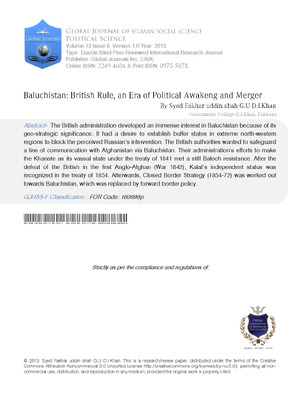
The British administration developed an immense interest in Baluchistan because of its geo-strategic significance. It had a desire to establish buffer states in extreme north-western regions to block the perceived Russian's intervention. The British authorities wanted to safeguard a line of communication with Afghanistan via Baluchistan. Their administration's efforts to make the Khanate as its vassal state under the treaty of 1841 met a stiff Baloch resistance. After the defeat of the British in the first Anglo-Afghan (War 1842), Kalat's independent status was recognized in the treaty of 1854. Afterwards, Closed Border Strategy (1854-72) was worked out towards Baluchistan, which was replaced by forward border policy.
Downloads
How to Cite
References
Riaz Ahmad (2006) The All India Muslim League and the Creation of Pakistan: A Chronology (1906-1947.
M. Afzal (1998) Political Parties in Pakistan, 3 vols.
Syed Ahmad, Iqbal (1992) Balochistan: Its Strategic Importance.
Tahir Amin (1998) Ethno -National Movements of Pakistan.
Ayubbukhsh Awan (1985) Baluchistan: Historical and Political Processes.
Martin Axmann (2008) Back to the Future: Khanate of Kalat and the Genesis of Baloch Nationalism.
K. Aziz (1967) Making of Pakistan: A study in Nationalism. 3rd edn.
Inayatullah Baloch (1987) The Problem of Greater Balochistan. A Study of Baloch Nationalism.
Mir Baloch, Bakhsh Khuda, Marri Bijarani (1985) Search light on Baloch and Balochistan.
Mir Baloch, Yar Ahmad, Khan (1975) Inside Baluchistan.
Mohammad Baloch, Sardar Khan (1984) Baloch, Mohammad Sardar Khan, History of Baloch Race and Balochistan 1958, ript.
Taj Breseeg, Muhammad (2004) Baloch Nationalism: Its Origin and Development.
P. Chopra (2003) A Comprehensive History of India.
Stephen Cohen (2005) The Idea of Pakistan.
Naseer Dashti (2012) A Histirical Account from the Beginning to the Fall of Baloch State.
Malik Dehewar, Saeed (1994) Contemporary History of Balochistan. Quetta: Third World Publication.
Forign policy Centre (2006) Balochis of Pakistan on the Margin of History.
Zulmay Gulzad (1991) The History of the delimitation of the Durand line and the development of the Afghan state (1838-1895). 1838-1895.
Selig Harison (1981) Afghanistan‟s Shadow:Baloch Nationalism and Soviet Temptations.
Janmanhmand (1989) Essay on Baluch National Struggle in Pakistan: Emergence, Dimentions, Repercussion.
Inamul Kausar, Haq (1980) Pakistan Movement in Balochistan.
J. Keltie, Scott (1917) The Statesman's Year-Book.
Gul Nasir, Khan (1982) Tarik Baluchistan.
Syed Pirzada, Sharifuddin (1970) Foundation of Pakistan: All India Muslim League Documents.
(1968) Pakistan Resolution and the Historic Lahore Session.
Tariq Rehman (2006) Language and Politics in Pakistan.
Khalid Sayeed, Bin (1967) Pakistan the Formative Phase Ontario: Queen‟s University.
(1980) ___________Politics in Pakistan: The Nature and Direction of Change.
D. Singhal (1992) India and Afghanistan:A Study in Diplomatic Relations,1876-1907. 1876-1907.
Javed Syed, Haider (2008) Balochistan: The Origin and Development. 23(1).
Ian Talbot (1990) Provincial Politics and Pakistan Movement.
Stanely Wolpert (1998) Jinnah of Pakistan.
Published
2013-11-26
Issue
Section
License
Copyright (c) 2013 Authors and Global Journals Private Limited

This work is licensed under a Creative Commons Attribution 4.0 International License.