
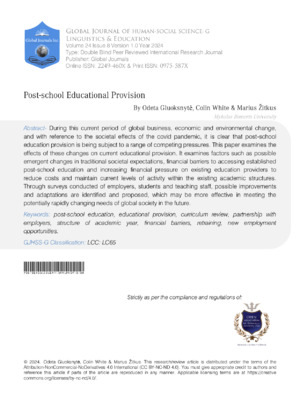
Post-School Educational Provision
Keywords:
post-school education, educational provision, curriculum review, partnership with employers
Abstract
During this current period of global business, economic and environmental change, and with reference to the societal effects of the covid pandemic, it is clear that post-school education provision is being subject to a range of competing pressures. This paper examines the effects of these changes on current educational provision. It examines factors such as possible emergent changes in traditional societal expectations, financial barriers to accessing established post-school education and increasing financial pressure on existing education providers to reduce costs and maintain current levels of activity within the existing academic structures. Through surveys conducted of employers, students and teaching staff, possible improvements and adaptations are identified and proposed, which may be more effective in meeting the potentially rapidly changing needs of global society in the future.
Downloads
How to Cite
References
Capano (2003) Capano, 2003; Howlett & Cashore 2007). https://academic.oup.com/policyandsociety/article/41/1/111/6513365/
A. Alfadala, et (Eds) (2020) Education Disrupted.
P. Bolton (2012) Education: Historical statistics Standard Note: SN/SG/4252.
J. Buchanan 1, et, Al (2020) The futures of work: what education can and can't do. https://unesdoc.unesco.org/ark:/48223/pf0000374435
Allais S, Anderson M, Calvo A, Peter S, Pietsch T (2020) The futures of education for participation in 2050: educating for managing uncertainty and ambiguity. https://www.weforum.org/agenda/2021/01/future-of-education-4-scenarios
Odeta Gluoksnytė, Colin White (2022) Distance Learning: Methods and Factors for Effective Delivery of Educational Experience // International Journal on Lifelong Education and Leadership Dubai: Copernicus ISSN 2278-621X. 8, 1-21.
M. Lauer (2019) The Future of Work weforum. https://www.weforum.org/agenda/2019/12/apprenticeships-future-work-4ir-training-reskilling/
(2019) assets/media/knowledge/knowledge-hub/reports/12 34-over-qualification-and-skills-mismatch-graduatelabour-market_tcm18-10231. https://www.cipd.org/global
P. Cheese (2015) Times Educational Supplement. https://www.timeshighereducation.com/news/too-many-graduates-non-professional-jobs-personnel-body-says
Sh Kak (2018) Will traditional universities and colleges become obsolete?. https://www.smithsonianmag.com/innovation/will-traditional-colleges-universities-become-obsolete-180967788
https://www.edtechlithuania.com/
https://www.bbc.co.uk/news/newsbeat-33991341
E. Sabzalieva (2021) Pathways to 2050 and beyond. https://www.iesalc.unesco.org/en/futures-of-higher-education/pathways-to-2050-and-beyond/
g-loan-entitlement. https://www.gov.uk/government/consultations/lifelon
Open Learn, learning learn, The Open University Open Learn, learning how to learn. https://www.open.edu/openlearn/education-development/learning-how-learn/content-section-0?active-tab=description-tab
Published
2024-09-06
Issue
Section
License
Copyright (c) 2024 Authors and Global Journals Private Limited

This work is licensed under a Creative Commons Attribution 4.0 International License.