
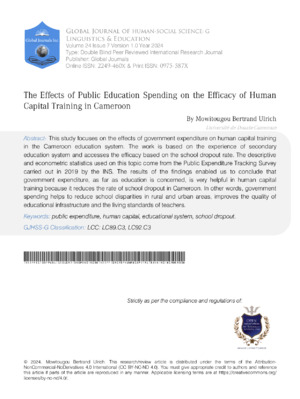
The Effects of Public Education Spending on Human Capital Training in Cameroon
Keywords:
public expenditure, human capital, educational system, school dropout
Abstract
This study focuses on the effects of government expenditure on human capital training in the Cameroon education system. The work is based on the experience of secondary education system and accesses the efficacy based on the school dropout rate. The descriptive and econometric statistics used on this topic come from the Public Expenditure Tracking Survey carried out in 2019 by the INS. The results of the findings enabled us to conclude that government expenditure, as far as education is concerned, is very helpful in human capital training because it reduces the rate of school dropout in Cameroon. In other words, government spending helps to reduce school disparities in rural and urban areas, improves the quality of educational infrastructure and the living standards of teachers.
Downloads
How to Cite
References
T Agasisti, A Bertoletti (2020) Higher education and economic growth : A longitudinal study of European regions 2000-2017. 100940.
B Agboola, J Adeyemi (2012) Analysis of private cost of education in a selected Nigerian university. 3(10), 45-56.
(2017) Indice de développement humain ajusté aux inégalités (IDHI) pour les pays africains. 187-187.
Sajitha Bashir, Marlaine Lockheed, Elizabeth Ninan, Jee-Peng Tan (2018) Perspectives: L'école au service de l'apprentissage en Afrique.
Gary Becker (1964) Investment in Human Capital: A Theoretical Analysis. 70(5, Part 2), 9-49.
James Buchanan, Richard Musgrave (1999) Public Finance and Public Choice.
Richardson Edeme, Chigozie Nkalu, Innocent Ifelunini (2017) Distributional impact of public expenditure on human development in Nigeria. 44(12), 1683-1693.
A Faggian, F Modrego, P Mccann (2019) Human capital and regional development.
(2018) Evaluation de l'efficacité et de l'équité des dépenses publiques : questions clés et possibilités de réforme.
Sanjeev Gupta, Marijn Verhoeven, Erwin Tiongson (2002) The effectiveness of government spending on education and health care in developing and transition economies. 18(4), 717-737.
F Haile, M Niño-Zarazúa (2018) Does social spending improve welfare in low-income and middle-income countries. 30(3), 367-398.
J Hicks (1937) Mr Keynes and the "Classics": a suggested interpretation.
(2019) LA CRISE DES ANNÉES 1980 ET SES RÉPERCUSSIONS SUR LE SYSTÈME SOCIOSANITAIRE. 3, 143-176.
M Kaboré Konkobo (2008) UNE MISE EN CONTEXTE DE LA MIGRATION BURKINABÈ:. 45-84.
Stefan Leiderer, Peter Wolff (2007) Gestion des finances publiques : une contribution à la bonne gouvernance financière. 26(26-2), 175-195.
Iryna Lendel (2010) The Impact of Research Universities on Regional Economies: The Concept of University Products. 24(3), 210-230.
Minepat (2020) Politiques pour une transformation structurelle durable. 30, 107-145.
Issidor Noumba (2008) Un profil de l'abandon scolaire au Cameroun. Vol. 16(1), 37-62.
(1998) L'investissement dans le capital humain.
T Schultz (1962) Investment in human capital. 51(1), 1-17.
G Siakeu (2000) Les enfants en déperdition scolaire au Cameroun.
Published
2024-09-03
Issue
Section
License
Copyright (c) 2024 Authors and Global Journals Private Limited

This work is licensed under a Creative Commons Attribution 4.0 International License.