
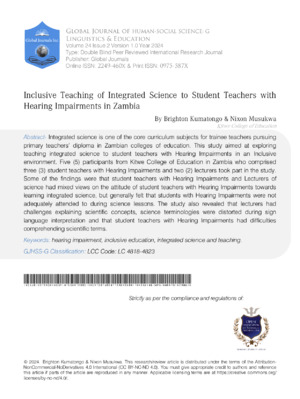
Inclusive Teaching of Integrated Science to Student Teachers with Hearing Impairments in Zambia
Keywords:
hearing impairment, inclusive education, integrated science and teaching
Abstract
Integrated science is one of the core curriculum subjects for trainee teachers pursuing primary teachers' diploma in Zambian colleges of education. This study aimed at exploring teaching integrated science to student teachers with Hearing Impairments in an Inclusive environment. Five (5) participants from Kitwe College of Education in Zambia who comprised three (3) student teachers with Hearing Impairments and two (2) lecturers took part in the study. Some of the findings were that student teachers with Hearing Impairments and Lecturers of science had mixed views on the attitude of student teachers with Hearing Impairments towards learning integrated science, but generally felt that students with Hearing Impairments were not adequately attended to during science lessons. The study also revealed that lecturers had challenges explaining scientific concepts, science terminologies were distorted during sign language interpretation and that student teachers with Hearing Impairments had difficulties comprehending scientific terms.
Downloads
How to Cite
References
O Adigun, D Nzima (2020) Digitalized Versus Interpreted Biology Instructions for Deaf Learners: Implications for a Technosociety. 10(5), 265-272.
O Abosi, T Koay (2008) Attaining Development Goals of Children with Disabilities: Implications for Inclusive Education. 23(1), 1-10.
M Åström (2008) Defining Integrated Science Education and Putting it to test.
J Bransford, S Donovan (2005) Science in the classroom.
Wanida Chatwirakom (2018) A Study of Chemistry Teaching and Learning for Hearing Impaired Students by Using Multimedia. 24-28.
Thomas Mtonga, Kalisto Kalimaposo, Joseph Mandyata (2013) Classroom Experiences of Learners with Albinism in Selected Regular and Special Education Schools in Zambia. 03(01).
P Crume, N Moran, S Shiekh (2001) Barriers to effectively educating the deaf in Kenya.
A Drigas, D Kouremenos, S Kouremenos, J Vrettaros (2005) An e-Learning System for the Deaf people. 2-17.
Susan Easterbrooks, Brenda Stephenson, Donna Mertens (2006) Master Teachers' Responses to Twenty Literacy and Science/Mathematics Practices in Deaf Education. 151(4), 398-409.
A Flores, V Rumjanek (2015) Teaching Science to Elementary School Deaf Children in Brazil. 6, 2127-2135.
S Foster, G Long, K Snell (1999) Inclusive instruction and learning for deaf students in postsecondary education. 4(3), 225-235.
S Graham (2012) Deaf Education Pre-service Teachers' Perceptions of Scientific Inquiry and Teaching Science to Deaf and Hard of Hearing Students.
S Graham, C Solomon, A Marchut, R Kushalnagar, R Painter (2012) Experiences of students in STEM. 13-19.
D Washington (2014) GALLAUDET UNIVERSITY PRESIDENTS. 152-155.
G Greco (2016) Accessibility as a Human Right, with an Application to Media Accessibility. Researching Audio Description. 11-33.
C Grooms (2015) Interpreter Competencies in Science, Technology, Engineering, and Mathematics as Identified by Deaf Professionals.
Bender Am, Cusick Eh, Plovanich Me, Train Mk (2011) Atypical Presentation of Vitamin C Deficiency Manifesting as Petechial Hemorrhaging. 8(4).
L Kigotho (2016) Barriers Faced by Students with Hearing Impairment in Inclusive Learning Environment: A Case of the University of Nairobi.
Harry Lang, Fred Dowaliby, Hugh Anderson (1993) Critical Teaching Incidents: Recollections of Deaf College Students. 139(2a), 119-127.
M Lee (2015) Implementing the Sociocultural Theory While Teaching ESL. 1(1), 28-35.
T Lee, O Kamisah (2014) Development of Interactive Multimedia Module with Pedagogical Agent (IMMPA) in the Learning of Electrochemistry: Needs Assessment. 7(18).
Lena Levander, Minna Mikkola (2009) Core Curriculum Analysis: A Tool for Educational Design. 15(3), 275-286.
J Mandyata, K Kamukwamba (2018) Stakeholders' Views on Use of Sign Language Alone as a Medium of Instruction for the Hearing Impaired in Zambian Primary Schools. 33(1), 62-76.
Fred Mangrubang (2004) Preparing Elementary Education Majors to Teach Science Using an Inquiry-Based Approach: The Full Option Science System. 149(3), 290-303.
F Mangrubang (2005) Issues and trends in science education: the shortage of qualified science teachers. 150(1), 42-46.
Carol Hlela, Lehlohonolo Ntlatlapo, Rannakoe Lehloenya, Christine Ile (2015) Paeds in a pinch: a practical guide for students, by students with a specialist review.
V Martins (2006) Implications and triumphs of the actions of sign language interpreters in higher education. 7(2), 157-166.
Myung Koh (2015) Development for Mother-Child Health Improvement Teaching Contents for the Community of Ugandaa. 99-103.
Haradhan Mohajan (2018) QUALITATIVE RESEARCH METHODOLOGY IN SOCIAL SCIENCES AND RELATED SUBJECTS. 7(1), 23.
Alice Kabwe, Kenneth Muzata, Magdalene Simalalo (2021) How Teachers' perceptions shape the provision of support to Learners with Mild Attention Deficit Hyperactivity Disorder in Inclusive Primary Schools of Lusaka. 05(03).
Kenneth Muzata, Francis Simui, Dikeledi Mahlo, Phydes Ng'uni (2019) Inclusive Education Status through the Lenses of Teachers in Zambia. 10(1), 1-20.
A Namukoa (2014) Teacher Practices in Science Literacy Instruction for Learners who are Deaf or Hard of Hearing in Kenya.
Park Gyung- Chul (2012) A Study on the National Assembly Act(so-called "National Assembly Advancement Act"), revised on May 2. 2012.. 48(null), 307-349.
J Napier, R Barker (2004) Accessing university education: Perceptions, preferences, and expectations for interpreting by deaf students. 9(2), 228-238.
R Ndhlovu, B Matafwali (2020) Teaching Integrated Science to Junior Secondary School Learners with Hearing Impairment: Teachers' Perceptions in Selected Special Schools of Chipata and Lusaka District. 3(3), 73-91.
Kaiko Mubita, Lillian Chipatu, Matilda Nakazwe (2017) An Assessment of the Safety of Transport Modes Used By Pupils to and from School in Selected Schools of Western, North Western and Copperbelt Provinces of Zambia. 03(05), 15556-15562.
Kimberly Neuendorf (2019) Content analysis and thematic analysis. 211-223.
I Pekeberg (2012) Inclusive Education in Ghana: An Analysis of Policies and the Practices in One Mainstream School and One Inclusive School in the Greater Accra Region.
F Pinto-Silva, P Martins, V Rumjanek (2013) Rousing Interest in Science among Secondary School Deaf Students. 2, 104-108.
S Powers (2002) From concepts to practice in deaf education: A United Kingdom perspective on inclusive. 7(3), 230-243.
S Prakash (2015) Attitude towards science.
S Preston (2023) Understanding the Relationship between Inclusion and Achievement. 19-35.
J Richardson, M Marschark, T Sarchet, P Sapere (2010) Deaf and hard-of-hearing students' experiences in mainstream and separate postsecondary education. 15(4), 358-382.
L Saowalak (2015) Study on Learning Achievement and Attitude. Science by Using Knowledge-Based Learning (5E) With Multimedia .The nervous system and sensory organs.
Samuel Supalla, Jody Cripps, Andrew Byrne (2017) Why American Sign Language Gloss Must Matter. 161(5), 540-551.
Brenda Schick (2004) How Might Learning through an Educational Interpreter Influence Cognitive Development?. 73-88.
Jessica Schultz, Lauren Lieberman, M Ellis, Linda Hilgenbrinck (2013) Ensuring the Success of Deaf Students in Inclusive Physical Education. 84(5), 51-56.
Michael Skyer (2016) Power in Deaf Pedagogy and Curriculum Design: Multimodality in the Digital Environments of Deaf Education (DE2). (3 (53)), 345-381.
A Sobel, J Hill (1999) Enhancing the Learning Environment of Deaf Students. 31(2), 71-72.
C Ting, L Gilmore (2012) Attitudes of preservice teachers toward teaching Learners with Hearing Impairments. 37(12), 46-56.
Hamed Taherdoost (2016) Sampling Methods in Research Methodology; How to Choose a Sampling Technique for Research. 5(2), 18-27.
(1994) The Salamanca Statement World Conference on Special Needs Education.
Anna Lawson (1993) The European Union and the Convention on the Rights of Persons with Disabilities: Complexities, Challenges and Opportunities. 61-76.
Coomara Pyaneandee (2013) Right to Education. 141-159.
(2014) Convention on the Rights of Persons with Disabilities. 9.
B Urquhart, C Jean-Baptiste (2009) Zambian Sign Language. A Beginner's Guide.
Melissa Wallang (2016) Barriers in d/Deaf Pedagogy in the North Eastern States in India. 1-22.
L Wang, C Bruce, H Hughes (2011) Sociocultural Theories and their Application in Information Literacy Research and Education. 42(4), 296-308.
Published
2024-04-18
Issue
Section
License
Copyright (c) 2024 Authors and Global Journals Private Limited

This work is licensed under a Creative Commons Attribution 4.0 International License.