
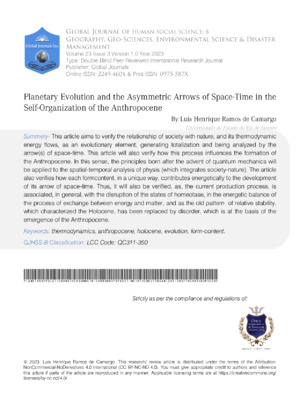
Planetary Evolution and the Asymmetric Arrows of Space-Time in the Self-Organization of the Anthropocene
Keywords:
thermodynamics, anthropocene, holocene, evolution, form-content
Abstract
Summery-This article aims to verify the relationship of society with nature, and its thermodynamic energy flows, as an evolutionary element, generating totalization and being analyzed by the arrow(s) of space-time. This article will also verify how this process influences the formation of the Anthropocene. In this sense, the principles born after the advent of quantum mechanics will be applied to the spatial-temporal analysis of physis (which integrates society-nature). The article also verifies how each formcontent, in a unique way, contributes energetically to the development of its arrow of space-time. Thus, it will also be verified, as, the current production process, is associated, in general, with the disruption of the states of homeotase, in the energetic balance of the process of exchange between energy and matter, and as the old pattern of relative stability, which characterized the Holocene, has been replaced by disorder, which is at the basis of the emergence of the Anthropocene.
Downloads
How to Cite
References
Isaac Asimov (1992) INTRODUCCIÓN.. 11-24.
J Ayoade (1986) Introdução à climatologia para os trópicos.
Ludwig Bertalanffy, Von (1968) Teoria geral dos sistemas.
David Bohm (1980) A totalidade e a ordem implicada: Uma nova percepção da realidade.
Luís Camargo, Henrique Ruptura (2005) do Meio Ambiente. Conhecendo as mudanças ambientais do planeta através de uma nova percepção de ciência: a geografia da complexidade.
André Junior Braga, Ronei Coelho De Lima (2012) CARACTERIZAÇÃO AMBIENTAL DA BACIA HIDROGRÁFICA DO RIO TADARIMANA EM RONDONÓPOLIS-M.
Luis Camargo (2021) A FLECHA DO ESPAÇO-TEMPO E A TOTALIDADE EM TOTALIZAÇÃO. 7(14), 79-97.
Horácio Capel, Ângela Endlich (1981) ENTREVISTA: HORÁCIO CAPEL. 31(3), 139.
Frijof Capra, Steindl-Rast, David (1991) Fronteiras da tecnologia: Explorando o futuro da Ciência e da Inovação.
A Cearreta (1999) El cambio climático durante el Antropoceno. 739.
R Dutra-Gomes, A Vitte (2017) Geossistema e complexidade: sobre hierarquias e diálogos entre os conhecimentos. Ra'ega: o espaço geográfico em análise. 4, 149-164.
M Figueiredo, F Marquesan, J Imas (2020) Development": Intertwined Trajectories Since the Beginning of The Great Acceleration of invited reviewers until the decision. 24(5), 401-413.
Antonio Guerra, Teixeira (1969) Dicionário geológicogeomorfológico.
Trevor Letcher (2021) Why discuss the impacts of climate change?. 3-17.
Alane Martins Andrade, Julya Da Silva Rodrigues, Barbara Monteiro Lyra, Jessica Da Silva Costa, Mariana Nunes Do Amaral Braz, Márcia Amaral Dal Sasso, Helaine Carneiro Capucho (1996) Evolução do programa nacional de segurança do paciente: uma análise dos dados públicos disponibilizados pela Agência Nacional de Vigilância Sanitária. 8(4), 37-46.
João Mendes (2020) O "Antropoceno" por Paul Crutzen & Eugene Stoermer. 1, 117-119.
João Mendes (2020) The Anthropocene: scientific meaning and philosophical significance. 1, 71-89.
Edgar Morin (1977) O método I: A natureza da natureza.
Alexandre Nascimento (2020) Reflexões sobre o Antropoceno, o paradigma da espécie humana e seu domínio ilusório sobre a Terra. 1, 55-69.
S Paula, L Mello (2019) As mudanças ambientais e suas dimensões no Antropoceno e no Capitaloceno.
A Peloggia (2015) Os registros geológicos da ação humana e o Antropoceno -tecnógeno: a estratigrafia da arqueosfera. XV congresso brasileiro de estudos do quaternário: ecodiversidade e seu estudo no Quaternário. 2(1), 12-13.
Franciney Ponte, Claudio Szlafsztein (2019) UMA INTERPRETAÇÃO GEOGRÁFICA CONECTADA AO ANTROPOCENO. 20(70), 347-366.
Prigogine (2008) Unknown Title. 70.
Ilya Prigogine, Isabel Stengerls (1984) Order out of chaos: mans new dialogue with nature.
Maria Salgado-Lauboriau, Léa (1994) História Ecológica da Terra.
Friedrich Schelling, Joseph Von (2015) Schelling: aforismos para introdução à filosofia da natureza e aforismos sobre filosofia da natureza.
Stephan Schineider (1998) Laboratório Terra: o Jogo planetário que não podemos nos dar ao luxo de perder.
Cássio Silva, Roberto (2008) As fortificações do Rio de Janeiro entre passado, presente e futuro. (28 especial).
Erik Trinkaus, Pat Shipman (1993) The Neandertals: changing the image of Mankind.
José Veiga, Eli (2019) O Antropoceno e a ciência do sistema Terra. 34.
Raphael Vianna (2017) Retornar à Terra no Antropoceno: estamos atrasados?. 42, 385-397.
Published
2023-07-14
Issue
Section
License
Copyright (c) 2023 Authors and Global Journals Private Limited

This work is licensed under a Creative Commons Attribution 4.0 International License.