
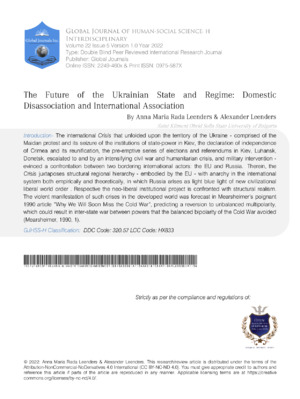
The Future of the Ukrainian State and Regime: Domestic Disassociation and International Association
Keywords:
Abstract
Abstract not found
Downloads
How to Cite
References
Thomas Ambrosio (2008) Russia's Ukraine Intervention and Changes to American Perceptions of the Russian Threat: Executive Branch Testimony to the House and Senate Armed Services Committees. 2.
Robert Art (1980) To What Ends Military Power?.
Alexei Bogaturov (2005) The Sources of American Conduct // Russia in Global Affairs. http://www.globalaffairs.ru
Alexei Bogaturov (2005) The Syndrome of "Absorption" in International Politics. 2005, 291-310.
Conrad Black US and Russia: A Permanent Confrontation?.
Russell Bova (1991) Political Dynamics of the Post-Communist Transition: A Comparative Perspective. 44(1), 113-138. https://doi.org/10.2307/2010425
Rodric Braithwaite (2017) How to Bring the Ukraine Crisis to a Successful End.
Stephen Brooks, William Wohlforth (2016) Introduction," America Abroad: The United States' Global Role in the 21st Century. 1-13.
Brooks Assessing America's Global Position. 14-47.
Zbignew Brzezinski (1997) The Grand Chessboard: American Primacy and Its Geostrategic Imperatives.
Michael Burgess (2006) Conclusion: Comparative federalism in theory and practice. 295-301. https://doi.org/10.4324/9780203015476-22
Thomas Carothers (2002) The End of the Transition Paradigm" Journal of Democracy. 5-21.
Glen Chaftez (1996) The Struggle for a National Identity in Post-Soviet Russia. 111(4), 661-688.
Gosta Esping-Andersen (1990) The Three Political Economies of the Welfare State.
Alexander Gabuev (2014) Xi Jinping: Strong Leader, Weak Institutions. http://carnegie.ru/eurasiaoutlook/?fa=54446
Frieden (2012) World Politics: Interests, Interactions, Institutions.
Robert Gilpin (1981) War and Change in World Politics.
Fiona Hill, Steven Pifer (2016) Dealing with a Simmering Ukraine-Russia Conflict. 2016, 349-356.
Meadwell Hudson (2008) The Political Dynamics of Secession and Institutional Accommodation.
Indexmundi November (2014) Indexmundi (accessed November, 30 2014). http://www.indexmundi.com/ukraine/public_debt.html
Robert Jervis (1986) From Balance to Concert: A Study of International Security Cooperation.
Robert Jervis (1999) Realism, Neoliberalism, and Cooperation: Understanding the Debate.
Mark Kesselman, Joel Krieger (2009) European Politics in Transition.
Robert Keohane, Lisa Martin (1995) The Promise of Institutionalist Theory. 20, 39-51.
Henry Kissinger (2014) To Settle the Ukraine Crisis, Start at the End. http://www.washingtonpost.com/opinions/henry-kissinger-to-settle-the-ukraine-crisis-start-at-the-end/2014/03/05/46dad868-a496-11e3-8466-d34c451760b9_story.html
Arend Lijphart (1989) Democratic Political Systems. 1(1), 33-48. https://doi.org/10.1177/0951692889001001003
Lenny Martin, Georg Vanberg (2004) Policing the Bargain: Coalition Government and Parliamentary Scrutiny. 48, 13-37.
John Mearsheimer (1995) The False Promise of International Institutions. 19, 5-49.
John Mearsheimer (2001) The Tragedy of Great Power Politics.
John Mearsheimer (1993) Case for Ukrainian Nuclear Deterrent.
John Mearsheimer (2014) Why the Crisis in Ukraine is the West's Fault.
John Mearsheimer (1990) Why We Will Soon Miss the Cold War.
Andrew Moravcsik (1997) Taking Preferences Seriously: A Liberal Theory of International Politics. 51, 513-533.
Dieter Nolan, P. Stover Elections in Europe: a Data Handbook.
Robert Powell (1991) Absolute and Relative Gains in International Relations Theory. 85(4), 1303-1320. https://doi.org/10.2307/1963947
Robert Putnam (1988) Diplomacy and domestic politics: the logic of two-level games. 42(3), 427-460. https://doi.org/10.1017/s0020818300027697
Thomas Risse-Kappen (1994) Ideas do not float freely: transnational coalitions, domestic structures, and the end of the cold war. 48(2), 185-214. https://doi.org/10.1017/s0020818300028162
Joseph Nye (2004) Soft Power: The Means to Success in World Politics.
N. Shapovalova (2014) The Politics of Regionalism and Decentralization in Ukraine. http://fride.org/download/PB_183_The_politics_of_regionalism_and_decentralisation_in_Ukraine.pdf
Randall Schweller (1994) Bandwagoning for Profit: Bringing the Revisionist State Back In. 19, 72-107.
Stephen Walt (1987) The Origins of Alliances.
Kenneth Waltz (1959) Man, the State, and War.
Kenneth Waltz (2012) More May Be Better.
Kenneth Waltz (1988) The Origins of War in Neorealist Theory.
Alexander Wendt (1995) Constructing International Politics. 20(1), 71. https://doi.org/10.2307/2539217
Alexander Wendt (1994) Collective Identity Formation and the International State. 88, 384-396.
Alexander Wendt (1992) Anarchy is what states make of it: the social construction of power politics. 46(2), 391-425. https://doi.org/10.1017/s0020818300027764
Andrew Wilson (2014) The Ukraine Crisis: What it Means for the West.
C. Zhiltsov (2015) Ukraine in Geostrategic Triangular Relations: Russia, EU and Ukraine" in Contemporary World and Geopolitics.
Published
2022-08-04
Issue
Section
License
Copyright (c) 2022 Authors and Global Journals Private Limited

This work is licensed under a Creative Commons Attribution 4.0 International License.