
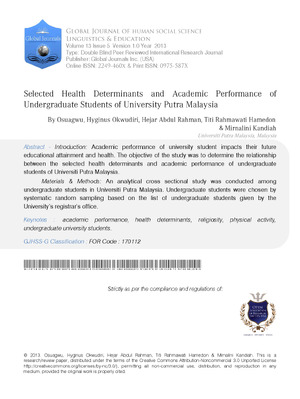
Selected Health Determinants and Academic Performance of Undergraduate Students of University Putra Malaysia
Keywords:
Academic Performance, health determinants, physical activity, religiosity, undergraduate university students
Abstract
Academic performance of university student impacts their future educational attainment and health. The objective of the study was to determine the relationship between the selected health determinants and academic performance of undergraduate students of Universiti Putra Malaysia. Materials & Methods: An analytical cross sectional study was conducted among undergraduate students in Universiti Putra Malaysia. Undergraduate students were chosen by systematic random sampling based on the list of undergraduate students. A self-administered pre-tested questionnaire was used to collect data on health related behavior and academic performance. Results: There were 9,852 undergraduates' population for 2011 and all the entire 1314 students completed the questionnaire (672 females and 642 males).The response rate was 100%, the mean age of the respondents was 21.89 and standard deviation is 2.208 years. The sample comprised of 76.7% Malays, 9.8% Chinese and 13.5 % Indians. In terms of academic performance, measured through CGPA showed that 40.7% of the respondents gained below 3.00, 39.5% obtained 3.01 to 3.50 only 19.6% have good CGPA ranging from 3.51 to 4.00. The majority of the respondent (79.5%) agreed that having good grades is very important. Based on body mass index (BMI) 54% or (709) respondents have normal body weight and only 6.2% respondents were obese. There is no significant difference in the mean of academic performance score for males (M=3.22, SD=.371) and female students (M=3.23. SD=.62). There was significant relationship between religiosity, subjective health status, socio economic perception and academic performance (r=.123, P .001), health status (p < .007) and physical activity (p < .0.20). Conclusion: This research seeks to contribute to the evidence based on the importance of health on academic performance of the particular
Downloads
How to Cite
References
John Schulenberg, Jennifer Maggs (2002) A developmental perspective on alcohol use and heavy drinking during adolescence and the transition to young adulthood. 63(s14), 54-70. https://doi.org/10.15288/jsas.2002.s14.54
Zapata. L.B, Forthofer. MS, Eaton. DK (2004) Cigarette Use in 6th Through 10th Grade: The Sarasota County Demonstration Project. 28(2), 151-165. https://doi.org/10.5993/ajhb.28.2.6
Chomitz VR, Slining MM, Mc RJ, Mitchell SE, Dawson GF, Hacher KA (2009) Is there relationship between physical fitness and academic achievement? Positive results from public schools children in the northeastern United State. 79(1), 30-37. https://doi.org/10.1111/j.1746-1561.2008.00371.x
W. El Ansari, R. Oskrochi (2006) What matters most? Predictors of student satisfaction in public health educational courses. 120, 462-473.
John Kerridge, Brian Mathews (1998) Student Rating of Courses in HE: further challenges and opportunities. 23(1), 71-82. https://doi.org/10.1080/0260293980230106
Walid El Ansari, Christiane Stock (2010) Is the Health and Wellbeing of University Students Associated with their Academic Performance? Cross Sectional Findings from the United Kingdom. 7(2), 509-527. https://doi.org/10.3390/ijerph7020509
R. Crum, M. Ensminger, M. Ro, J. Mccord (1998) The association of educational achievement and school dropout with risk of alcoholism: a twenty-five-year prospective study of inner-city children. J. Stud. 59(3), 318-326. https://doi.org/10.15288/jsa.1998.59.318
Raudsepp, R. L.; Viira (2000) sociocultural correlates of physical activity in adolescents. Pediatr. Exerc. 12, 51-60.
Amanda Daley, Jason Ryan (2000) academic performance and participation in physical activity by secondary school adolescents. Percept. Mot. 91(2), 531-534. https://doi.org/10.2466/pms.2000.91.2.531
Marsha Dowda, Russell Pate, Stewart Trost, M. Almeida, John Sirard (2004) Influences of Preschool Policies and Practices on Children's Physical Activity. 29(3), 183-196. https://doi.org/10.1023/b:johe.0000022025.77294.af
Kevin Finn, Bonny Specker (2000) Comparison of Actiwatch?? activity monitor and Children???s Activity Rating Scale in children. 32(10), 1794-1797. https://doi.org/10.1097/00005768-200010000-00021
Trosh SG, Sirard JR, Dowda M, Pheiffer KA, Pate RR (2003) Physical activity in overweight and nonoverweight preschool children. 27(7), 834-839. https://doi.org/10.1038/sj.ijo.0802311
Russell Jago, Tom Baranowski, Debbe Thompson, Janice Baranowski, Kathryn Greaves (2005) Sedentary Behavior, Not TV Viewing, Predicts Physical Activity among 3- to 7-Year-Old Children. 17(4), 364-376. https://doi.org/10.1123/pes.17.4.364
Moore LL, Bradlee Di Gao AS, Sundarajan-Ramamurti Cupples LA, et Proctor MH (2003) Does early physical activity predict body fat change throughout childhood?. 37(1), 10-17. https://doi.org/10.1016/s0091-7435(03)00048-3
Ministry of Health (2006) National Health and Morbidity Survey. http://www.moh.gov.my/
Mark Regnerus (2003) Linked Lives, Faith, and Behavior: Intergenerational Religious Influence on Adolescent Delinquency. 42(2), 189-203. https://doi.org/10.1111/1468-5906.00172
Sigfusodottir. D, Kristjansson. A.I, Allergrante.J.P (2007) Health behaviour and academic achievement in Icelandic school children. 22(1), 70-80. https://doi.org/10.1093/her/cyl044
Organisation for Economic Cooperation and Development (2004) learning for tomorrows' world: First results from PISA 2003.
U.S. Department of Education (2003) No Child Left Behind & Adequate Yearly Progress. https://doi.org/10.1037/e499132006-003
M. Carlson, M. Corocoran (2001) Family Structure and Children's Behavioral and Cognitive Outcomes. 63(3), 779-792. https://doi.org/10.1111/j.1741-3737.2001.00779.x
U. Bronfenbrenner (2006) Making human beings human. Thousand Oaks. 9-42.
D. Neumark-Sztainer, S. French, P. Hannan, M. Story, J. Fulkerson (2005) School lunch and snacking patterns among high school students: Associations with school food environment and policies. 2.
Published
2013-04-05
Issue
Section
License
Copyright (c) 2013 Authors and Global Journals Private Limited

This work is licensed under a Creative Commons Attribution 4.0 International License.