
The Relationship of Multiple Intelligence and Effective Study Skills with Academic Achievement among University Students
Abstract
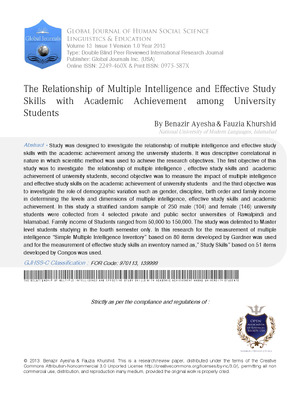
Study was designed to investigate the relationship of multiple intelligence and effective study skills with the academic achievement among the university students. It was descriptive correlational in nature in which scientific method was used to achieve the research objectives. The first objective of this study was to investigate the relationship of multiple intelligence , effective study skills and academic achievement of university students, second objective was to measure the impact of multiple intelligence and effective study skills on the academic achievement of university students and the third objective was to investigate the role of demographic variation such as gender, discipline, birth order and family income in determining the levels and dimensions of multiple intelligence, effective study skills and academic achievement. In this study a stratified random sample of 250 male (104) and female (146) university students were collected from 4 selected private and public sector universities of Rawalpindi and Islamabad. Family income of Students ranged from 50,000 to 150,000. The study was delimited to Master level students studying in the fourth semester only. In this research for the measurement of multiple intelligence "Simple Multiple Intelligence Inventory" based on 80 items developed by Gardner was used and for the measurement of effective study skills an inventory named as," Study Skills" based on 51 items developed by Congos was used.
Downloads
How to Cite
References
Ramin Akbari, Kobra Hosseini (2008) Multiple intelligences and language learning strategies: Investigating possible relations. 36(2), 141-155. https://doi.org/10.1016/j.system.2007.09.008
S. Cottrell (2003) Study skills handbook.
H. Gardner (1999) Intelligence reframed: multiple intelligences for the 21st century.
Howard Gardner (2006) The Development and Education of the Mind. https://doi.org/10.4324/9780203019689
P. Gray (2007) Psychology. (5th Ed.).
W. Weiten (2001) Psychology themes and variations. (5th ed.).
D. VanBlerkom (1994) College study skills becoming a strategic learner.
H. Maddox (1988) How to study.
SQRW (2001) (2001). In Wikispaces. Retrieved January 25, 2011, from. http://studyskills6.wikispaces.com/SQRW
Published
2013-02-21
Issue
Section
License
Copyright (c) 2013 Authors and Global Journals Private Limited

This work is licensed under a Creative Commons Attribution 4.0 International License.