
The Importance of Ethics and Morals: Their Foundations, their Differences, their Values and Applications within all Human Actions as a Necessity and Ideal, Despite Human Adversities and Limitations, in the Search for Hope for a Better Future
Keywords:
Ethics, Morality, Human Dignity, Bioethics, Responsibility, Technoscience, Vulnerability, Human Acts.
Abstract
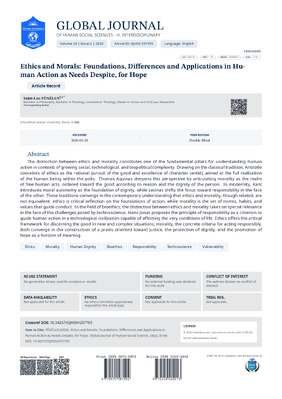
The distinction between ethics and morality constitutes one of the fundamental pillars for understanding human action in contexts of growing social, technological, and biopolitical complexity. Drawing on the classical tradition, Aristotle conceives of ethics as the rational pursuit of the good and excellence of character (areté), aimed at the full realization of the human being within the polis. Thomas Aquinas deepens this perspective by articulating morality as the realm of free human acts, ordered toward the good according to reason and the dignity of the person. In modernity, Kant introduces moral autonomy as the foundation of dignity, while Levinas shifts the focus toward responsibility in the face of the other. These traditions converge in the contemporary understanding that ethics and morality, though related, are not equivalent: ethics is critical reflection on the foundations of action, while morality is the set of norms, habits, and values that guide conduct. In the field of bioethics, the distinction between ethics and morality takes on special relevance in the face of the challenges posed by technoscience. Hans Jonas proposes the principle of responsibility as a criterion to guide human action in a technological civilization capable of affecting the very conditions of life. Ethics offers the critical framework for discerning the good in new and complex situations; morality, the concrete criteria for acting responsibly. Both converge in the construction of a praxis oriented toward justice, the protection of dignity, and the promotion of hope as a horizon of meaning. In a world marked by technological acceleration, inequality, and uncertainty, the articulation between ethics and morality proves indispensable for sustaining a humanity capable of responding to others, protecting life, and orienting technology toward the common good.
Downloads
How to Cite
References
(1949) Grundgesetz für die Bundesrepublik Deutschland [Basic Law of the Federal Republic of Germany]. Art. 1.
Thomas Aquinas (1888) Sancti Thomae Aquinatis Doctoris Angelici Opera Omnia (ed. Leonina), vol. 4-12: Summa Theologiae. 4-12.
Thomas Aquinas (1950) Summa Theologiae.
Thomas Aquinas (1964) Summa Theologiae (60 vols.). 60.
Thomas Aquinas (2001) Summa Theologica (9 vols.). 9.
T. A. Araujo, D. D. Lima (2020) The principle of responsibility of Hans Jonas and the repercussions on bioethics. https://revista.uepb.edu.br/revistainstante/pt_BR/article/download/206/142/722
J. I. Arias-Krause (2021) Contributions to a critical bioethics. (53), 81-96. https://doi.org/10.1344/rbd2021.53.32833
Aristóteles (1831) Ethica Nicomachea.
Aristotle (1994) Nicomachean Ethics.
Aristotle (1894) Ethica Nicomachea.
World Medical Association (1964) Declaration of Helsinki: Ethical Principles for Medical Research on Human Subjects.
T. L. Beauchamp, J. F. Childress (2019) Principles of biomedical ethics. (8th ed.).
Brazil (1988) Constitution of the Federative Republic of Brazil. Art. 1, III.
J. Choza (2016) Manual of Philosophical Anthropology. (2nd ed.). https://elibro-net.eu1.proxy.openathens.net/es/lc/anahuac/titulos/59912
Concilio Vaticano II (1966) Constitutio pastoralis de Ecclesia in mundo huius temporis: Gaudium et spes. 58, 1025-1120.
Congregation for the Doctrine of the Faith (1987) Donum vitae.
Congregation for the Doctrine of the Faith (1988) Donum vitae: Instruction on respect for human life in its origin and on the dignity of procreation. 80, 70-102.
Inter-American Court of Human Rights (2006) Case of Ximenes Lopes v. Brazil. Judgment of July 4, 2006. Series C No. 149.
Inter-American Court of Human Rights (2009) Case of González et al. ("Campo Algodonero") v. Mexico. Judgment of November 16, 2009. Series C No. 205.
N. Daniels (2008) Just health: Meeting health needs fairly.
Spain (1978) Spanish Constitution. Art. 10. (Official State Gazette No. 311).
(2009) Ethics and Morals [video]. https://youtu.be/dm3WCZud0UQ
(2014) What Ethics Is Really For. Part 1 [video]. https://youtu.be/F3LXHC6CMyc
Francisco (2019) Litterae apostolicae motu proprio datae Vos estis lux mundi. 111, 757-770.
C. Gilligan (1982) In a different voice: Psychological theory and women's development.
J. Habermas (2003) The future of human nature.
(2020) What is ethics and morals? [video]. https://youtu.be/dH8zoyLMlRk
Italy (1947) Constitution of the Italian Republic. Art. 2. (Official Gazette no. 298).
Hans Jonas (1995) The Principle of Responsibility: An Essay on an Ethics for Technological Civilization.
Paul II John (1995) Litterae encyclicae Evangelium vitae. 87, 401-522.
Paul II John (1983) Codex Iuris Canonici auctoritate Ioannis Pauli PP. II promulgatus. 75.
I. Kant (1785) Grundlegung zur Metaphysik der Sitten.
E. Levinas (1961) Totality and infinity.
A. MacIntyre (1981) After virtue: A study in moral theory.
N. Noddings (1984) Caring: A feminine approach to ethics and moral education.
United Nations Organization (1948) Universal Declaration of Human Rights.
United Nations Organization (1989) Convention on the Rights of the Child.
United Nations Organization (2003) United Nations Convention against Corruption.
United Nations Organization (2006) Convention on the Rights of Persons with Disabilities.
United Nations Organization (1966) International Covenant on Economic, Social and Cultural Rights.
G. Ortiz Millán (2016) On the distinction between ethics and morality. (45), 113-139.
V. R. Potter (1971) Bioethics: Bridge to the future.
J. Rawls (1971) A theory of justice.
P. Ricoeur (1990) Yourself as another.
L. Rosa (2011) Bioethics: Singer's critique of the traditional ethics approach. 10(1), 1-15.
J. Second (2023) Ethics and morals: What they are, their similarities and differences. https://humanidades.com/etica-y-moral/
A. Sen (1999) Development as freedom.
P. Singer (2011) Practical ethics. (3rd ed.).
E. V. Souza-Junior, R. S. Rosa, T. P. Guedes, C. S. Silva, D. B. Ribeiro, F. S. Balbinote, D. F. Souza, R. B. Teixeira, B. F. Silva-Filho, N. O. Sawada (2020) Ethics and bioethics in the scientific world: an integrative review. 24(2), 151-165. https://doi.org/10.5294/pebi.2020.24.2.3
V. B. Souza-Junior, R. P. Silva, L. M. Santos (2020) Dehumanization and ethics in scientific practice: tensions between technical efficiency and human dignity. 28(3), 412-420. https://doi.org/10.1590/1983-80422020283440
R. Spaemann, D. Gracia (2011) Ethics: Fundamental issues.
UNESCO (2005) Universal Declaration on Bioethics and Human Rights.
European Union (2016) Regulation (EU) 2016/679 on the protection of natural persons with regard to the processing of personal data and on the free movement of such data. L 119, 1-88.
(2014) Pilar Calva. Acts of man and humans [video]. https://youtu.be/FrRHelu-AzM
G. Varela Fregoso (2010) Ethics. https://elibro-net.eu1.proxy.openathens.net/es/lc/anahuac/titulos/74754
C. H. Vieira Nina, M. M. Costa Macêdo (2020) Ethics, bioethics and technology: The risks of dehumanization. 4, 1-15.
Published
2026-02-17
Issue
Section
License
Copyright (c) 2026 Authors and Global Journals Private Limited

This work is licensed under a Creative Commons Attribution 4.0 International License.