
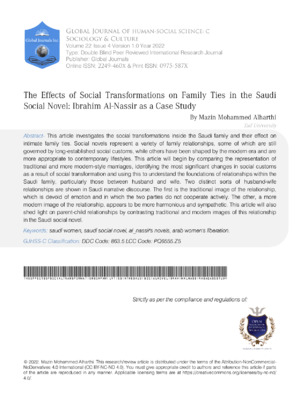
The Effects of Social Transformations on Family Ties in the Saudi Social Novel: Ibrahim Al-Nassir as a Case Study
Keywords:
saudi women, saudi social novel, al_nassir's novels, arab women's liberation
Abstract
This article investigates the social transformations inside the Saudi family and their effect on intimate family ties. Social novels represent a variety of family relationships, some of which are still governed by long-established social customs, while others have been shaped by the modern era and are more appropriate to contemporary lifestyles. This article will begin by comparing the representation of traditional and more modern-style marriages, identifying the most significant changes in social customs as a result of social transformation and using this to understand the foundations of relationships within the Saudi family, particularly those between husband and wife. Two distinct sorts of husband-wife relationships are shown in Saudi narrative discourse. The first is the traditional image of the relationship, which is devoid of emotion and in which the two parties do not cooperate actively. The other, a more modern image of the relationship, appears to be more harmonious and sympathetic. This article will also shed light on parent-child relationships by contrasting traditional and modern images of this relationship in the Saudi social novel.
Downloads
How to Cite
References
Primary.
I Al-Nassir (1961) Dār al-Islām wa dār al-ḥarb.
I Al-Nassir (1978) Unknown Title.
I Al-Nassir (1988) Kashf Al-Zunūn 'An Asāmī Al-Kutub Wa Al-Funūn.
I Al-Nassir (1989) Unknown Title.
I Al-Nassir (1994) Raʿshat Al-Ẓil.
I Al-Nassir (2001) Laylat al-Barāʾa.
I Al-Nassir (2008) O. 020 - ʿUnwān al-sharaf al-wāfī fī al-fiqh wa-al-naḥw wa-al-tā'rīkh wa-al-ʿarūḍ wa-al-qawāfī..
I Al-Nassir (2004) Al, n..
(2009) Oxford English dictionary.
Al-ʿarābi, F (2005) O. 020 - ʿUnwān al-sharaf al-wāfī fī al-fiqh wa-al-naḥw wa-al-tā'rīkh wa-al-ʿarūḍ wa-al-qawāfī..
Al-ʿinazi, S (2010) Ṣwrat al-ʿUnf al-Syāsi fi al-Riwaya al-Jazaʾiria: Dirāsa Naqdiyya.
Al-Gharīb, A (2009) Al-Zawaj Al-Ṯabaqi fi Al-Mujtamaʿ Al-Suʿūdi.
Al-Jabur, K (2007) ʾAkādimi ʾUrduni: al-ḥukum al-Dīni ʾAsahal Aḥyanan min baʿḍ al-ʿAdāt wa Al-Taqālīd.
Al-Khatīb, S (2010) Al-Tghiwrāt al-ʾIjtmaʿia wa ʾAthārwha ʿAla al-ʾUsra al-Suʿūdiya.
Al-Khishiban, ʿa (2010) Fi Mujtamaʿ Al-Suʿūdi Limatha Binana man Ywfakir bi Hathihi Al-ṭariqa.
Azzah Al-Jabarti, Kholod Babkair, Ali S Al-Shareef, Rawan Al-Thobaiti, Abdu Al-Sayed (2009) COVID-19 ONLINE CROSS-TRAINING PROGRAM. 10(02), 369-381.
R Assaad, F Roudi-Fahimi (2007) Youth in the Middle East and North Africa: Demographic Opportunity or Challenge? Washington: Population Reference Bureau.
M Fakhry (1997) Read, Reading.
B Ḫalawa (2011) Dawr Al-Waledain fi Takwin Al-Shakhṣia Al-ʾIjtimaʿia ʿInda Al-ʾAbnaʾ: Dirāsa Maidania fi Madinat Dimashq, Mjalat Jamiʿat Dimashq. Syria: Mjalat Jami.
H Metz, Library, Congress (1993) Saudi Arabia: a country study.
Al-ʿamal Fi Al-Mamlaka Al-ʿarabia Al-Suʿūdiya Wzarat (2011) Unknown Title.
M Yamani (2000) Changed identities: the challenge of the new generation in Saudi Arabia.
Shady Mohammad Raji Al-Hussayni, Sami Oudah Eid Al-Harbi, Omar Hassan Amer (2012) CUTANEOUS LEISHMANIASIS INFECTION AMONG PATIENTSIN AL-MADINA AL-MUNAWARAH, KSA. 9(10), 146-156.
Published
2022-08-16
Issue
Section
License
Copyright (c) 2022 Authors and Global Journals Private Limited

This work is licensed under a Creative Commons Attribution 4.0 International License.