1. Introduction
oday, the environmental quality of human life is deteriorating due to improper operation. Uncontrolled growth of cities limits access to the suitable, free places and providing services in the cities. The improper establishment of different Industries, water pollution, air pollution, noise pollution, visual and motor vehicle traffic have sped the process of environmental destruction and pollution. We can to these problems the population growth, lack of resources which have caused severe problems in human life. Quarter is a geographical, key and social place which includes interpersonal network and the individual relationship with the other residents of the quarter (Nooriyan and Rezaei, 2006, p. 36). According to Lynch city is composed of five elements, namely, road, nodes, landmarks, quarter and edge and he believes that the quarter is an extensive place which can be identified based on some common and special properties which everybody can understand and realize it mentally (Chappman.2007, p. 19). The quarter is defined in Iranians context as a residential body with capacity of 700-1250 neighborhood with the accessible radius of pedestrian (Habibi and Massaeli, 2007, p. 13). According to Ziari (2009, p. 40), the quarter has cultural element such as mosque and educational element such as elementary school.
In the past, there was not a sharp separation between the rich quarters and the poor ones, and the residents of quarters were from different people with various socio-economic status such as rich, middle class, scholar, trader and the other kinds of the existing professions in the society (Imani Jajarmi, 2007, p.19).
In fact, the trend of establishment of old quarters was in such a way that it was able to meet different individual and social needs of its residents, but changes in different factors such as economic, social, environmental and body of the cities in general, and in quarters especially, has had a negative impact on usability and capacity of quarters to meet different needs of its residents (Azizi, 2006, p. 36). According to Zarabi and Musavi (2009, p. 5), the development of small cities is an accepted way of spatial and economic growth and social balance.
In fact, rapid changes in in the spatial body of different citifies in recent decades, the rapids growth of urban population and uncontrolled growth of quarters which is based on economic framework have caused to prevent the participation of residents and has caused the quarters to be ineffective and improper for social life. Investigating the concept of quarter and its related effective factors need several comprehensive studies which some of them are discussed as following:
According to Rafiyan and et al, (2007), investigated the mental understanding of Jolfa quarter participants and concluded that the design of social public space is the main reason of people cooperation (p.55).
Feruzesh (2010) considers the quarter as the main productive element of the city and emphasizes that the proposal of the quarter bases model, which is based on people cooperation and participation on their daily life and affairs should be considered as an acceptable and suitable model in city planning and management (p. 10).
Franzini and et al (2005) have investigated the low-income quarters in Texas based on the characteristics of social and economic processes. Ellen and Orgean (2011), have investigated the process of changing conditions in low-incoming quarters (p.89). Flint (2009) studied the society and quarter and considered the quarter and society as different forms of human organizations which have some commonalities and are classified as urban residential areas (p. 354).
2. II. Research Question and Hypothesis
Question: do biosocial factors in various times of formation of Dehdasht city quarters (new, relatively new, middle and old) differ? Hypothesis: Based on the long trend of formation of the old quarters of Dehdasht city the conditions of biosocial in theses quarters is superior to the other quarters.
Since the present study is based on the quarter research, a cluster sample method was employed in which among the eleven quarters from different parts of the city (old, middle, approximately new and new quarters) four quarters were chosen and investigated. In order to fill the questionnaire, based on the population of the city and general formula of Kuchran the rate of the sample was calculated as following (Hafeznia, 2008, p.167).
These questionnaires were distributed among the quarters based on the population of the city. Based on the given definitions and concepts and according to those principles suggested by Azizi and et.al for assessing the social features of quarters on one hand, and those principles related to assessing the life capacity of quarters on the other hand the following factors were chosen in order to complete the decision making matrix: dynamisms and lively as a result of communication between neighbors, security, participation, identity and belonging, social diversity and increasing in density.
3. III.
4. Scope of Research
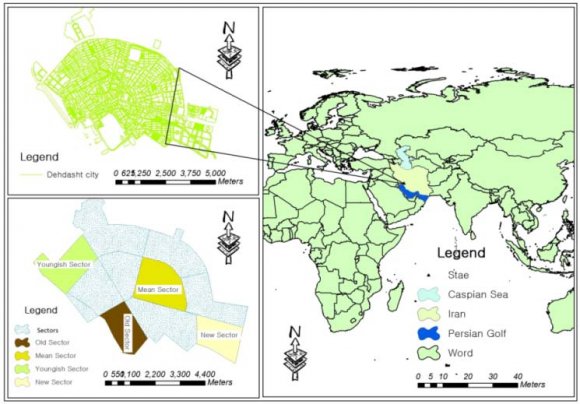
Dehdasht is the center of Kohgiluyeh district in Kohgiluyeh va Boyer Ahmad province south-west of Iran. Based on its population it has the third place in the province. The city of Dehdasht is located in a plain under the same name at the distance approximately 60 kilometers from Behbahan city Khuzestan province). Among the above mentioned plain, the Dehdasht city is located with geographical longtitude"50 ° 33 '12 and geographical latitude 30 ° 47' 41" and a height of 810 meters above sea level. In the plains, there are high mountains which the height of the highest one reaches to 2330m in Seyah Mountains (Rashidi Fard et al, 2011).
5. Concepts and Definitions a) Habitable space
The habitable space with a suitable quality for living is a section of new trend which considers the health of the quarters with different factors and its relation with density (Polentz, 2004, p. 3). The factors such as cooperation, control assessment of public factors and place belonging leads the environmental life to a livable place for all (Timmer and Seymour, 2006, pp. 4-6). On the other hand, Azizi (2006) considers the principles and criteria in sustaining of the quarters such as identity and vitality, dynamic, variety, accessibility, density and sustainable capacity of environment. He considers the issue of density in the capacity of quarter life and continues that understanding of low or high density in the quarters with various characteristics can be different. For example, in a calm, green and attractive quarter the density can be high apparently, but in the view of people and residents it may be considered as low density (Azizi, 2006: 39). b) Electre Model ELECTRE is a decision making model with several features which for the first time was considered as the best model in decision making in the late 1980s (Momeni, 2008, p. 30). Considering the usability of choices and coordinate and uncoordinated matrices classifies the options based on the preferences, this model has been applied for different purposes such as decision making for assessment the danger of greenhouse gases. ( Brito, 2010, p. 815). This model has also been used for decision making in international conventions and functions (Almeida, 2007, p. 3516 Based on these scales the qualitative criteria of measurement were changed into the quantitative criteria as shown in Table 3: After obtaining the quantitative matrix, for the sake of comparison of the scales of measurement, we should use a dimensionless scale by which different features can be compared easily.
Step one: the process of dimensionless of the matrix (N)
There are different ways for the process of dimensionless of decision making matrix, among them is the method of dimensionless of Norm. In this method, each element of the matrix is divided by the square sum of the squares of each column.
6. Relation 1:
Table 4 : The process of dimensionless of the assessment and decision making matrix using the Norm
C 6 C 5 C 4 C 3 C 2 C 1 C 6 C 5 C 4 C 3 C 2 C? = = n i ij ij ij a a n 1 2The second step: obtaining the coordinate dimensionless matrix.
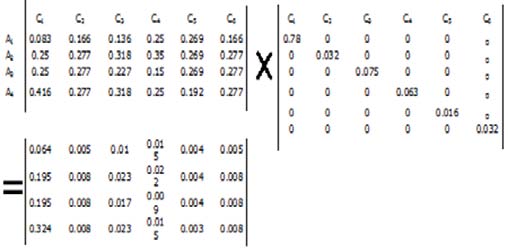
Every issue may have several features which its relative importance, is worth knowing. Accordingly, every feature is given a weight which theses weights identify the relative importance of every feature in relation to the other feature. For assessing the weights of theses feature according to Table ( Now, based the relations 3, 4, 5, and 6 obtain the coordinate dimensionless matrix. For this purpose, the dimensionless matrix should be multiplied in square matrix (wn*n) which the main element of its radius are the weights of features and the other elements are zero the result is called the coordinate dimensionless matrix(V). We have shown this operation as following: Relation 7 :
Step Four: Determine the coordinate matrix This matrix is obtained according to the coordinate following relations: According to this operation, for obtaining the preference of the first choice in relation to the second, we add the weights of the square matrix, and at the end we will have the following matrix Step Five: Determine the uncoordinated matrix In this stage the uncoordinated matrix is obtained according to V matrix with the use of the following formula:
n n w N V × × = © 2013 Global Journals Inc. (US)Relation 9 :
This criterion, measures the unsuitability of the overall incoordination in features and uncoordinated I and k. the overall results of this matrix are as following:
1 1 1 - A 1 1 0 - 0 A 2 ?? ???? = 1 - 0.046 0.046 A 3 - 0.007 0.046 0.007 A 4Step Six: Effective coordination matrix (H):
For establishing this matrix, we should have a low threshold greater than I and if each element of the matrix be one, and H equals to it, that element will be either one or zero in the matrix.
Relation 10: ?? = ??????ï®?"? ???????? ???????? ?????????ï®?"? ???????? ??????? ???????? = 6.429 12 = 0.535 ? onsidering the obtained threshold, the larger values will be considered as one and the smaller ones as zero, so we have the following matrix:
0 0 0 - A 1 0 1 - 1 A 2 ?? ???? = 0 - 1 1 A 3 - 1 1 1 A 4Step Seven: Effective inconsistent matrix (G)
Relation 11 : NI = ? H ? N h ? NI = 5.152 12 = 0.429Since this is uncoordinated matrix, the smaller values than threshold which show the rate of incoordination with the whole of the complex are considered one and the larger values than the threshold value which show the coordination of the whole ccomplex are considered zero, so we have the following matrix.
1 1 1 - A 1 1 1 - 0 A 2 ?? ???? = 1 - 1 0 A 3 - 0 0 0 A 4Eighth step: determining the overall matrix (F)
In this stage we combine the coordinate effective matrix with the uncoordinated effective matrix to form te general matrix, and based on the obtained matrix we have the following matrix:
0 0 0 - A 1 0 1 - 1 A 2 ?? ???? = = ?? 4 > ?? 2 > ?? 3 > ?? 1 0 - 1 0 A 3 - 1 1 1 A 4 V.7. Conclusion
The existing facilities and capacities in urban quarters have developed during the recent years. Absolutely, the appearance of these facilities and capacities has been facilitated through consumption of financial, human and environmental costs. Mere attention to physical, skeletal and population and ignoring the social factors in the past studies in these areas, have caused the failure of many of these studies and they have not been enforced successfully. The capacity of biosocial, or in the other words, the capacity to dwell the residents based on the social, economic, environmental and skeletal conditions in a given time and according to the trend in which the social life has been completed can distinct the quarters and different parts of the cities from each other. The appearance of mental security, the quality of life, the appearance of socio-cultural and cooperation centers are among the factors which have effect on the liveliness and happiness of the quarter residents.
In the present study, based on the dynamicity, importance of security, cooperation, identity and place belonging, the variety of the society and increase of density which were chosen as the factors for assessing the capacity of biosocial of Dehdasht city quarters based on the above-perspectives, four different quarters of in the old, middle and new parts of the city were studied. Based on the results and the process of data analysis, the old quarters with the total value of 3 in the coordinate matrix and inordinate effective matrix was the most harmonious social principles of life and has the capacity for residents to live with each other. The second place was given to the approximately new quarters with the total value of 2in the coordinate matrix and inordinate effective matrix which showed a better results in the field studies. The middle quarters with the value of 1 in coordinate matrix and 2 in inordinate was given the third place. Finally, the new quarters shoed a weak conditions regarding cooperation, place belonging, and the variety of social factors which necessitate the attendance of all the socio-economic levels in the quarters for variety and dynamicity was give the last rank.
Based on the obtained results, and unequal rank of the quarters according to bio-social factors, the hypothesis of the research tested and approved the long trend of formation of Dehdasht city old quarters and proved this fact that these quarters have high conditions for biosocial. It necessary to consider those factors which can be very effective in promoting the quality and conditions of the these quarters and try to improve their facilities to prepare them for life conditions like the old quarters.
8. Suggestions
In order to have a city with dynamic and secure quarters, the following principles and suggestions are proposed:
? Conducting comprehensive studies in order to know and identify the susceptible and suitable facilities based on the city divisions in the quarters of Dehdasht city. ? Doing more comprehensive studies in order to know borders of the new quarters to act based on new divisions and hierarchical principles. ? The low rate of vitality and dynamicity in the new quarters of Dehdasht city refers to this fact that these quarters are somehow new and need more facilities and careful planning to be more effective and prepared for life. ? Through a careful planning for social life in the quarters of Dehdasht city and considering the viewpoints of the quarter residents which pay attention to quarter as social body and try to involve the residents in the process of quarter management are the best strategies for improving the quality of life and increase the place belonging in the quarters of Dehdasht city. ? Regarding the low participation in the middle-body quarters of Dehdasht city, the ways of interaction cab be improved effectively through establishing the suitable public places, designing new recreational sites. These facts cause much participation and cooperation on the part of the quarter residents and increase their responsibility in the quarter affairs.

![EJ = ?K ? [pij li pij] n i=1 , ? j Example: E 3 = ?0.721[0.318 × ln 0.318 + 0.227 × ln 0.227 + 0.318 × ln 0.318 + 0.136 × ln 0.136 ] = 0.963 Relation 5 : ?? ??=????? ?? d 3 = 1 -0 .963 = 0](https://socialscienceresearch.org/index.php/GJHSS/article/download/871/version/102921/5-On-Investigation-an-Assessment-of-Social_html/42262/image-5.png)
| Indices | Density | Identity | and | Dynamism | Participation | Security | Social |
| increase | belonging | and | diversit | ||||
| Sectors | d | locality | Liveliness | y | |||
| New sector | Very low | low | low | Medium | High | low | |
| Youngish sector | low | Medium | High | High | High | Medium | |
| Mean sector | low | Medium | Medium | low | High | Medium | |
| Old sector | Medium | Medium | High | Medium | Medium | Medium | |
| Source: Authors, 2013. | |||||||
| The above-mentioned features which are | features in a matrix, we should change them to | ||||||
| qualitative are considered as very high, high, medium, | quantitative features as following: | ||||||
| low and very low. In order to assess theses qualitative | |||||||
| Indices | ||||||||||||
| 1 | ||||||||||||
| Sectors | ||||||||||||
| A 1 | 1 | 3 | 3 | 5 | 7 | 3 | 0/15 | 0/327 | 0/261 | 0/481 | 0/533 | 0/545 |
| A 2 | 3 | 5 | 7 | 7 | 7 | 5 | 0/452 | 0/545 | 0/609 | 0/673 | 0/533 | 0/545 |
| A 3 | 3 | 5 | 5 | 3 | 7 | 5 | 0/452 | 0/545 | 0/435 | 0/288 | 0/533 | 0/545 |
| A 4 | 5 | 5 | 7 | 5 | 5 | 5 | 0/754 | 0/545 | 0/609 | 0/481 | 0/381 | 0/327 |
| Source: Authors, 2013. |
| Relation 2 : | ||||||||||||
| ?? ???? = | ?? ???? ? ?? ???? ?? ??=?? | |||||||||||
| Indices | ||||||||||||
| C 1 | C 2 | C 3 | C 4 | C 5 | C 6 | C 1 | C 2 | C 3 | C 4 | C 5 | C 6 | |
| Sectors | ||||||||||||
| A 1 | 1 | 3 | 3 | 5 | 7 | 3 | 0/083 | 0/166 | 0/136 | 0/25 | 0/269 | 0/166 |
| A 2 | 3 | 5 | 7 | 7 | 7 | 5 | 0/25 | 0/277 | 0/318 | 0/35 | 0/269 | 0/277 |
| A 3 | 3 | 5 | 5 | 3 | 7 | 5 | 0/25 | 0/277 | 0/227 | 0/15 | 0/269 | 0/277 |
| A 4 | 5 | 5 | 7 | 5 | 5 | 5 | 0/416 | 0/277 | 0/318 | 0/25 | 0/192 | 0/277 |
| 12 | 18 | 22 | 20 | 26 | 18 | |||||||
| Source: Authors, 201 |
| A 1 | - | 0.016 | 0.079 | 0.079 | |
| ?? ???? = | A 2 | 0.998 | - | 0.998 | 0.218 |
| A 3 | 0.218 | 0.86 | - | 0.08 | |
| A 4 | 0.982 | 0.919 | 0.982 | - | |
| Year 2013 | |||||
| 2 20 2 38 | |||||
| Volume XIII Issue VIII Version I | |||||
| ( ) B | |||||
| Global Journal of Human Social Science |