Leptochloa Fusca Cultivation for Utilization of Salt-Affected Soil and Water Resources in the Cholistan Desert

Table of contents

1. Introduction

Author : Department of Geography, University of the Punjab, New Campus, Lahore, Pakistan. E-mail : [email protected] salt-affected soil is feasible and is the only viable method when the soil is sodic and sweet water is not available for irrigation (Abdullah, 1985;Ahmad, 2010).

2. II.

Research Design and Methods he Cholistan Desert (Figure 1) lies within the southeast quadrant of Punjab province between 27 o 42' and 29 o 45' North latitude and 69 o 52' and 73 o 05' East longitude (FAO/ADB, 1993; Arshad et al., 1995;Jowkar et al., 1996;Ahmad, 1998;1999a;1999b;1999c;2003;Ahmad et al., 2004;Ahmad, 2005a;2005b;Ahmad et al., 2005;Ahmad, 2007a;2007b;Ahmad and Farooq, 2007;Ahmad, 2010;2011;2012a;2012b; and covers an area of 2,580,000 ha (Ahmad, 2002;2010), out of which 1.13 million ha comprising stable as well as non-stable sand dunes, 0.95 and 0.06 million ha consist of sandy and loamy soils respectively, while 0.44 million ha are clayey in nature, locally known as 'dhars'. About 17% of the Cholistan Desert consist of such 'dhars' (Table 1) having flat and hard surface with salt incrustation and surrounded by sand dunes. Dhars are shallow to moderately deep, poorly drained with low vegetation, calcareous and having saline sodic fine to medium textured clayey soils. Except Haloxylon recurvum, other plant species can't survive due to salinity, compaction of soil and complete inundation during rainy season. The ponded rainwater in 'dhars' stagnates for a period until the water evaporates (Khan et al., 1990;Ahmad, 2010). It is judicious to utilize the land using ground saline and surface rainwater resources for growing palatable grasses. Biological approach for economic utilization of T The purpose of this paper is to assess the available evidence and published arguments and to provide a constructive working synthesis of evidence about Leptochloa fusca in the literature. L. fusca is a promising grass for economic utilization and better management of sodic, high pH, saline soil and saline water resources of the Cholistan Desert. The plants respond to salinity stress in part by modulating gene expression, which ultimately leads to the restoration of cellular homeostasis, detoxification of toxins and recovery of growth (Ashraf and Harris, 2004). Salinity in soil or water is one of the major stresses and, especially in arid and semi-arid regions, can severely limit crop production (Shannon, 1997; Mansour, 2000; Ashraf and Harris, 2004;Ashraf and Foolad, 2005;Ashraf and Foolad, 2007). Several physiological responses to salinity that differ qualitatively or quantitatively between salt tolerant and sensitive species (Ashraf and Harris, 2004), and that are candidate indicators, it has not yet proved possible to find any sensitive criterion that could reliably be used by breeders to improve salt tolerance of plants (Kumar et al., 1994;Ashraf and Harris, 2004;Hamdia and Shaddad, 2010). Although the groundwater is saline but it can be used for saline agriculture to grow salt tolerant trees, vegetables, crops and fodder grasses in non-saline-non-sodic coarse textured soils with minimum adverse effects due to rapid leaching of salts Leptochloa fusca is high tolerant to saline and sodic conditions even irrigated by saline groundwater or ponded rainwater. After the successful cultivation of L. fusca in the Cholistan Desert, other palatable grasses like para grass (Brichiaria mutica), Rhodes grass (Chloris gayana), Bermuda grass (Cynodon dactylon) and Sporobolus grass species can be tested (Abdullah et al., 1990; Ahmad, 2010). The cultivation of salt tolerant grasses would not only provide much needed palatable forage for livestock but also improve the physical properties of the soil due to biological activity of grass roots.

3. Growth Characteristics of Leptochloa Fusca

Leptochloa fusca is also known as Diplachne fusca, widely spread in salt affected regions of Pakistan. This forage plant is locally known as "Kallar grass" (salt grass). Being a grass of sub-tropical climate, the plant follows the photosynthetic CO 2 fixation process of C 4 -NAD-malice enzyme metabolism (Gate, 1972;Zafar and Malik, 1984;Ahmad, 2010). It is native of saline soil which gives clear indication of its halophytic character; the plant is perennial or biennial in nature (Rao and Arshad, 1991;Arshad and Rao, 1993). It has been regarded as good quality forage especially in saltaffected and waterlogged areas where other superior forage species may not grow successfully.

Leptochloa fusca can be easily propagated and established through seed, stem cutting, root stumps or rhizomes. The grass can grow to a height of 1 to 1.5 meter with a high leaf production rate and can be grazed directly or cut for stall-feeding. This fodder appears highly palatable to sheep, goats, buffaloes and cattle alike and no toxic effects of this grass during long-term consumption have been diagnosed. Moreover, it is similar to other conventional fodder regarding its nutritional status and 3-4 cutting within 3 months may be easily harvested, producing 20-40 tons of green fodder per ha per year or 5-10 tons per ha per cutting in saltaffected soils (Sandhu et al., 1981;Qureshi et al., 1982;Sandhu, 1993;Ahmad, 2010). The grass grows well during the hot season from March to September with peak yields during rainy season i.e. July and August in Pakistan, indicating a strongly thermophilic character. The development of extensive and dense fibrous root system has been observed even in highly sodic soils (Joshi et al., 1981;Ahmad, 2010). The penetration of roots in such soils can enhance hydraulic conductivity, microbial activity, organic matter and ultimately leaching of salts. Joshi (1981) noted a decline of L. fusca growth due to decrease of soil sodicity, while Haq and Khan (1971) observed that L. fusca has a general tendency to decrease EC e (electrolyte conductivity), SAR (sodium adsorption ratio), pH (soluble ions) and even ESP (exchangeable sodium percentage) of artificially salinized soils. Malik (1986) confirmed the utility of L. fusca not only as a primary colonizer of salt-affected Leptochloa Fusca Cultivation for Utilization of Salt-Affected Soil and Water Resources in the Cholistan Desert lands but also as ameliorative plant for the soil (Ahmad, 2010).

IV.

4. Nutritional Requirements

V.

5. Role in Soil Reclamation

Leptochloa fusca behaved as a typical crypnoeu-halophyte having both accumulating and excreting properties (Abdullah, 1986

6. VI. Use of Ground Saline Water for Irrigation

Dense saline-sodic soils of the Cholistan Desert (Baig et al., 1975) can be used for growing such palatable grasses, which is salt tolerant and capable of surviving in soils having poor properties (Baig et al., 1980). The sandy and loamy soil that is about 1 million ha can be brought under agriculture using underground saline water and harvested rainwater. Experiments showed that under certain conditions plant could not only survive but also even vast area of land could be irrigated with water of such high concentration. Moderately saline irrigation water stimulates vegetation, assists the benevolent bacteria of the soil and improves yield and quality (Akram et al., 1995) It has been observed that 3-4 cuttings of this grass could be easily taken without the addition of nitrogen (N) fertilizer in salt-affected and less fertile soils. Malik (1980) demonstrated a high activity of nitrogen, which indicates strong associative symbiotic relationship of N 2-fixing bacterium (Bacillus gram negative) in the rhizosphere of L. fusca. Moreover, the nitrogen fixation through the growth of blue green algae and Azolla under flooded conditions may partly contribute to the nitrogen supply and economy of the specie. It was also observed that L. fusca contribute more stable organic matter fraction due to its slow decomposition as compared to succulent plant species like Sesbania aculeata. Kumar (1980) reported an abrupt increase in the yield of L. fusca from 24-26 tons per ha per year without N application to 41-46 tons per ha per year, when only 40 kg N per ha was applied in a sodic soil. Abdullah (1985) showed a definite ameliorative effect of phosphorus (P) on the growth of L. fusca under saline environment (Hanson and Scott, 1980;Agboma et al., 1997a;Agboma et al., 1997b;Díaz-Zorita et al., 2001). The application of P at the rate of 50 kg per ha gave significantly higher fresh and dry matter yield at EC e 10 dS m -1 than all other treatments, which was followed by 75 and 25 kg P per ha at EC e 20 dS m -1 . The synergistic P x salinity effect was obvious at the highest P level of 75 kg per ha. Thus, the specie is responded favourably to P application at all salinity levels studied i.e. EC e 3.5 to 30 dS m -1 , indicating higher P requirements. In general, the specie is capable to accumulate trace elements (Zn, Cu, Fe, Mn) in a sufficient amount to meet the dietary requirements of the livestock under saline soil conditions (Abdullah et al., 1990;Ahmad, 2010). The germination capacity of different varieties of tomato, ladyfinger (bhindi), spinach (palak), cowpea and zucchini (tori) at different levels EC e 3 to 18 mmho/cm was studied in sand culture (Akbar et al., 1996;Akbar, 2002;PADMU, 1986;Ahmad, 2010). The germination was delayed and decreased with the increase in salinity. Significant vegetables were found to fall in the order of salt tolerance: Spinach > Zucchini > Cowpea > Tomato > Ladyfinger (Abdullah et al., 1988;Abdullah et al., 1990;Abdullah et al., 1991;Ahmad, 2010). List of some salt tolerant grasses and forages cultivated in the Cholistan Desert using saline water is given in table 5.

7. VII.

8. Conclusions

The growth factors such as easy propagation, high spreading rate, colonizing ability, vigorous growth, yield, palatability, nutritional value, long term survival and high adaptability to environmental stress make L. fusca an excellent and versatile specie that can be cultivated using brackish water and salt-affected land of the Cholistan Desert for economic exploitation. L. fusca develop succulence, which dilute the level of salt in the plant and stores water for use during dry period. The specie has great promise for the economic utilization of sodic, high pH, waterlogged and saline soils. Similarly, high saline-sodic water can be used for successful cultivation of L. fusca.

VIII.

Figure 1.
zone and flushing of salts from root zone by rains(Abdullah et al., 1990;Ahmad, 2010).
Figure 2. Figure 1 :
1Figure 1 : Location map of the Cholistan Desert
Figure 3.
Journals Inc. (US)
Figure 4. Forage
-Pakistan Desertification Monitoring Unit (1986).
Figure 5.
-Pakistan Desertification Monitoring Unit (1986).
Figure 6. Figure 2 :Figure 4 :Figure 3 :Figure 5 :
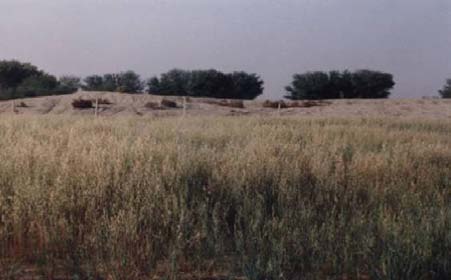
2435Figure 2 : Wild oats grown by highly saline irrigation at PCRWR research station at the Cholistan Desert (Pakistan). Ahmad, Farooq 2008
Figure 7. Table 1 :
1
Soil Types Extent (Ha) Percentage
Sand dunes 1,133,900 44.0
Sandy soils 945,500 37.0
Loamy soils 58,700 2.0
Saline sodic clayey soils (Dhars) 441,900 17.0
Total 2,580,000 100.0
Note: Source: PADMU -Pakistan Desertification Monitoring Unit (1986).III.
Figure 8.
Figure 9. Table 2 :
2
Fodder grass Biomass Fresh (kg) Biomass Dry (kg) Camel Carrying capacity per year Goat Sheep Cattle
Cenchrus ciliaris 16811 15012 2 14 16 3
Panicum antidotale 22191 12407 1 11 14 3
Lasirus sindicus 25217 18247 2 17 20 4
Napier Bajra 43710 38780 4 35 42 9
Leptochloa fusca 13449 11445 1 10 13 3
Figure 10. Table 3 :
3
Green matter Dry matter Green matter Dry matter yield Plants/ha
Species yield (tons/ha) (tons/ha)
(kg/plant) (kg/plant)
Atriplex amnicola 949 4.31 1.99 2.7 1.24 625
Atriplex amnicola 971 5.37 2.39 3.4 1.49 625
Atriplex amnicola 573 6.73 3.43 4.2 2.14 625
Atriplex amnicola × Atriplex nummularia 5.13 2.15 3.2 1.34 625
Atriplex buburyana 1205 (Carnarvan) 3.11 1.6 7.8 4.0 2500
Atriplex buburyana 1200 (Leonora) 2.0 1.2 5.0 3.0 2500
Atriplex cinerea 524 5.0 2.35 3.1 1.46 625
Atriplex lentoformis 5.45 3.19 3.4 2.0 625
Maireana aphylla 1062 2.53 1.2 6.3 3.0 2500
Source: PADMU -Pakistan Desertification Monitoring Unit (1986).
Figure 11. Table 4 :
4
Name of Tree / Shrub / Bush Age (months) Survival (%) Min. Height (cm) Mean Max. Canopy Cover (cm) Min. Mean Max.
Eucalyptus (Camddulensis) 24 76 90 156 223 66 113 161
Tamarix 24 48 59 106 154 52 112 173
Acacia 24 67 66 125 193 55 126 197
Beri (Zizyphus) 24 43 55 118 181 38 82 126
Jojoba (Simmondsia chinensis) 18 76 20 60 110 08 48 89
Atriplex halimus (Local) 11 65 -- 77 --- -- 45 ---
Atriplex amnicola 573 11 40 -- 48 --- -- 08 ---
Atriplex amnicola 197 11 80 -- 74 --- -- 15 ---
Atriplex amnicola 223
1
2

Appendix A

Appendix A.1 Acknowledgements

The author wishes to thank Dr. Mohammad Arshad (Late), Cholistan Institute of Desert Studies, The Islamia University of Bahawalpur, Pakistan for providing technical assistance during the field study of the Cholistan Desert and valuable comments on a draftversion of this paper.

Appendix B

  1. , Plant, Cell & Environment 4 (2) p. .
  2. Betaine synthesis from radioactive precursors in attached, water-stressed barley leaves. A D Hanson , N A Scott . Plant Physiology 1980. 66 (2) p. .
  3. Rainwater harvesting in Cholistan desert. A D Khan , M Akram , M Abdullah . Proceedings of the National Seminar on Water Resources Development and its Management in the Arid Areas, (the National Seminar on Water Resources Development and its Management in the Arid AreasQuetta, Pakistan
    ) 1990. 6-8 October 1990. p. .
  4. Karnal grass grows well in sodic soils. A Kumar , I P Abrol , K S Dargan . Indian Farming 1980. 30 (3) p. .
  5. Forage yield of sorghum and winter clovers as affected by biological and chemical reclamation of a highly alkaline soil. A Kumar , L Batra , R Chhabra . Experimental Agriculture 1994. 30 (3) p. .
  6. Proceedings of seminar: People's participation in the management of resources in arid lands, Altaf-Ur-Rehman Rao , Arshad , M . 1991. Pakistan. p. . Cholistan Institute of Desert Studies, The Islamia University of Bahawalpur (Perennial grasses of Cholistan desert and their distribution)
  7. Brazil for publication. The Revista Sociedade & Natureza is not on the list of approved journals of Higher Education Commission, Pakistan. The author obtained N.O.C. from the editor Revista Sociedade & Natureza, Prof. Dr. Sílvio Carlos Rodrigues and re-submitted the revised and modified text alongwith the N.O.C. to the Editor-in-Chief Dr. The author submitted the text of the paper to Revista Sociedade & Natureza, Instituto de Geografia, Universidade Federal de Uberlândia (Vivek Dubey, Global Journals Inc., USA for republication)
  8. Ecological response of Australian native species Acacia harpophylla and Atriplex mummularia to soil salinity, effect on water content, lead area and transpiration rate. C T Gate . Australian Journal of Botany 1972. 20 p. .
  9. Desertification process in Cholistan desert, PADMU 7/86. 1986. PCRWR Publication. p. . PADMU
  10. Combating desertification: Role of rainwater harvesting in Cholistan. F ; P R Ahmad , China . Proceedings of an International Symposium & 2nd Chinese National Conference on Rainwater Utilization, (an International Symposium & 2nd Chinese National Conference on Rainwater UtilizationXuzhou
    ) 1998. 8-14 September 1998. p. .
  11. Ecological restoration in Cholistan. F Ahmad . Journal Geographic 1999a. 2 (1) p. .
  12. Eco-regeneration and runoff collection in Cholistan. F Ahmad . UNEP: Desertification Control Bulletin 1999b. 35 p. .
  13. Rainwater utilization and ecological restoration in Cholistan. F Ahmad . Proceedings of VI International Rangeland Congress, (VI International Rangeland CongressTownsville, Australia
    ) 1999c. 19-23 July 1999. p. .
  14. Socio-economic dimensions and ecological destruction in Cholistan, F Ahmad . http://eprints.hec.gov.pk/801/01/517.html.htm 2002. May 08. 2013. Pakistan. Department of Geography, University of Karachi (Ph.D. dissertation)
  15. GIS application for range development in Cholistan. F Ahmad . Proceedings of VII International Rangelands Congress, (VII International Rangelands CongressDurban, South Africa
    ) 2003. 26 July to 1 August 2003. p. .
  16. Leptochloa Fusca: A high yielding grass for utilization of salt-affected soil and water resources in Cholistan. F Ahmad , F Gulzar , S A Shirazi , S Farooq , Z Ali . Fourth International Conference on Land Degradation, (Murcia, Spain
    ) 2004. September 2004. p. 434.
  17. Agropastoral systems in Cholistan. F Ahmad , F Gulzar , S A Shirazi , S Farooq , Z Ali . Proceedings of Silvopastoralism and Sustainable Land Management International Congress, (Silvopastoralism and Sustainable Land Management International Congress) 2005. p. .
  18. Agro-pastoral systems in Cholistan. F Ahmad . Pakistan Geographical Review 2005a. 60 (2) p. .
  19. Historical and archaeological perspectives of soil degradation in Cholistan. F Ahmad . Journal Geographic 2005b. (10) p. .
  20. Role of rainwater harvesting in reducing rural poverty in Cholistan Desert. F Ahmad , S Farooq . Abstract in 12th All Pakistan Geographical Conference, (Lahore, Pakistan
    ) 2007. 19-21 March 2007. p. 24.
  21. Geoinformatics application to investigate agricultural potential in Cholistan desert. F Ahmad . Journal of Food, Agriculture & Environment 2007a. 5 (2) p. .
  22. Archaeo-historical environ of Cholistan and significance of ancient agriculture in Pakistan. F Ahmad . Journal of Food, Agriculture & Environment 2007b. 5 p. .
  23. Leptochloa Fusca cultivation for utilization of salt-affected soil and water resources in Cholistan desert. F Ahmad . Revista Sociedade & Natureza 2010. 22 (1) p. .
  24. Soil classification and micromorphology: A case study of Cholistan desert. F Ahmad . Journal of Soil Science and Environmental Management 2011. 2 (11) p. .
  25. Spectral vegetation indices performance evaluated for Cholistan Desert. F Ahmad . Journal of Geography and Regional Planning 2012a. 5 (6) p. .
  26. Landsat ETM+ and MODIS EVI/NDVI data products for climatic variation and agricultural measurements in Cholistan Desert. F Ahmad . Global Journal of Human Social Science: Geography & Environmental Geo-Sciences 2012b. 12 (13) p. .
  27. Run-off farming in reducing rural poverty in the Cholistan Desert. F Ahmad . Global Journal of Human Social Science: Geography, Geo-Sciences, Environmental Disaster Management 2013. 13 (5) p. .
  28. Cholistan area development project. Fao/Adb . No. 59/53 ADB-PAK 58. Food and Agriculture Organization (FAO), (Rome, Italy
    ) 1993. (Report) (Final version)
  29. Socioeconomic dimensions of resource management in Cholistan. F Jowkar , M A Khan , M Khan . Institute for Development Anthropology (IDA), (Binghamton, New York
    ) 1996.
  30. Effect of root temperature on plant response functions for tomato: comparison of static and dynamic salinity stress indices. F N Dalton , A Maggio , G Piccinni . Plant and Soil 1997. 192 (2) p. .
  31. Cholistan desert. G Akbar , T N Khan , M Arshad . Pakistan. Rangelands 1996. 18 (4) p. .
  32. Feasibility of silvo-pastoral model for saline -sodic soils in arid climate. G Akbar . Science Vision 2002. 8 (1) p. .
  33. The effect of salinity on the yield and composition of Diplachne Fusca, G R Sandhu , Z Aslam , M Salim , A Sattar , R H Qureshi , N Ahmad , Wyn Jones , RG . 1981. (Kallar grass)
  34. Sustainable agriculture: A Pakistan National Conservation Strategy Sector Paper No. 2. Environment and Urban Affairs Division, Government of Pakistan and IUCN -The World Conservation Union, G R Sandhu . 1993. Pakistan.
  35. Effect of kallar grass growth on water transmission characteristics of salt-affected lands. J Akhtar , R A Waheed , K A Malik , M I Haq . Proceedings of First National Congress on Soil Sciences, (First National Congress on Soil SciencesLahore, Pakistan
    ) 1988. 6-8 October 1985. p. .
  36. Nitrogenase activity in the rhizosphere of kallar grass Diplachne Fusca. K A Malik , Y Zafar , A Hussain . Biologia 1980. 26 (1-2) p. .
  37. Kallar Grass -A plant for saline land. K A Malik , Z Aslam , M Naqvi . Nuclear Institute for Agriculture and Biology 1986. NIAB. p. 93.
  38. , Lugo , Spain . April 2004. United Kingdom. p. .
  39. Salt tolerance studies on Leptochloa Fusca, M Abdullah . 1985. Faisalabad, Pakistan. p. 286. University of Agriculture (Ph.D. dissertation)
  40. Responses of Leptochloa Fusca to various types of substrate salinities. M Abdullah , R H Qureshi , N Ahmad . Proceedings of Pak.-US. Biosaline research Workshop, (Pak.-US. Biosaline research WorkshopKarachi, Pakistan
    ) 1986. September 1985. p. .
  41. Salt tolerance mechanisms in desert plants. M Abdullah , R H Qureshi , M Akram . Pakistan Journal of Water Resources 1988. 41 (1) p. .
  42. Internal water resources management by plants under various root environment stresses with special reference to kallar grass Leptochloa Fusca. M Abdullah , M Akram , A D Khan , R H Qureshi . Proceedings of the National Seminar on Water Resources Development and its Management in Arid Areas, (the National Seminar on Water Resources Development and its Management in Arid AreasQuetta, Pakistan
    ) 1990. 6-8 October 1990.
  43. Leptochloa Fusca: A high yielding candidate grass for utilization of salt-affected soil and water resources in Cholistan desert, M Abdullah , M Akram , A Majeed , M A Butt , R H Qureshi , M Arshad . 1991. Pakistan. p. . Cholistan Institute of Desert Studies, The Islamia University of Bahawalpur (Proceedings of seminar: People's participation in the management of resources in arid lands)
  44. Rehabilitation of Cholistan desertified lands for sustained production. M Akram , W A Khan , B A Sheikh , M Abdullah , A D Khan . Proceedings of the 6th All Pakistan Geographical Conference, (the 6th All Pakistan Geographical ConferencePakistan
    ) 1995. 26-29 December 1993. p. . The Islamia University of Bahawalpur
  45. Plant genetic resources of Cholistan desert and their utilization, M Arshad , Rao , Altaf-Ur-Rehman . 1993. Pakistan. Cholistan Institute of Desert Studies, the Islamia University of Bahawalpur
  46. Cholistan desert in a state of flux. M Arshad , Rao , Altaf-Ur-Rehman , G Akbar . UNEP: Desertification Control Bulletin 1995. 26 p. .
  47. Potential biochemical indicators of salinity tolerance in plants. M Ashraf , P J C Harris . http://nhjy.hzau.edu.cn/kech/ssyy/qysd/njsl/21.pdf.(Accessedon Plant Science 2004. July 20. 2013. 166 (1) p. .
  48. Pre-sowing seed treatment-A shotgum approach to improve germination, plant growth, and crop yield under saline and non saline conditions. M Ashraf , M R Foolad . Advances in Agronomy 2005. 88 p. .
  49. Roles of glycine betaine and proline in improving plant abiotic stress resistance. M Ashraf , M R Foolad . Environmental and Experimental Botany 2007. 59 (2) p. .
  50. Applications of foliar fertilizers containing glycine betaine improve wheat yields. M Díaz-Zorita , M V Fernández-Canigia , G A Grosso . Journal of Agronomy and Crop Science 2001. 186 p. .
  51. Salt tolerance of crop plants. M Hamdia , M A K Shaddad . Journal of Stress Physiology & Biochemistry 2010. 6 (3) p. .
  52. Reclamation of saline and alkaline soil by growing kallar grass. M Haq , M F A Khan . The Nucleus 1971. 8 (4) p. .
  53. Nitrogen containing compounds and adaptation of plants to salinity stress. M M F Mansour . Advances in Agronomy 2000. 1997. 43 (4) p. . (Biologia Plantarum)
  54. Reconnaissance soil survey of Cholistan. M S Baig , E H Khan , M R Zaheer , M Ahmad . Soil Survey of Pakistan 1975.
  55. Possibilities for range development in Cholistan desert as reflected by its physiography and soils. M S Baig , M Akram , M A Hassan . The Pakistan Journal of Forestry 1980. p. .
  56. Effect of foliar application of glycine betaine on yield components of droughtstressed tobacco plants. P C Agboma , P Peltonen-Sainio , R Hinkkanen , E Pehu . Experimental Agriculture 1997a. 33 (3) p. .
  57. An evaluation of the effect of exogenous glycine betaine on the growth and yield of soybean: timing of application, watering regimes and cultivars. P C Agboma , T R Sinclair , K Jokinen , P Peltonen-Sainio , E Pehu . Field Crops Research 1997b. 54 (1) p. .
  58. Diplachne Fusca: An Australian salt tolerant grass used in Pakistan. R H Qureshi , M Aslam , M Abdullah , M G Pitman . Journal of Australian Institute for Agricultural Science 1982. 48 (4) p. .
  59. Developing Cholistan desert -a perspective. T F Ahmad , G Akbar , M B Tahir , I Ahmad . Progressive Farming 1992. 12 (6) p. .
  60. Cholistan Institute of Desert Studies, The Islamia University of Bahawalpur, Pakistan. and glycophytes. Annual report for, Y C Joshi , A Qadir , S K Sharma . Arshad, M. (ed.) 1981. 1980. Karnal, India. p. . Central Soil Salinity Research Institute (People's participation in the management of resources in arid lands)
  61. Y Zafar , K A Malik . Photosynthetic system of Leptochloa Fusca, 1984. 16 p. .
Notes
1
© 2013 Global Journals Inc. (US)
2
© 2013 Global Journals Inc. (US) Year
Date: 2013-01-15