1. INTRODUCTION
eb 2.0 has become an essential component for today's technology-based organisations and for individuals. Web 2.0 applications are starting to make a big impact on users with respect to their interac-applications is the SNS, such as LinkedIn, Myspace, Twitter and Facebook, which have attracted millions of users, including specialists across many disciplines. On sites such as Facebook, users reveal a lot of information about themselves in their profiles to order to introduce themselves to others (Acquisti & Gross, 2006). SNSs also provide users with abundant information posted by others. They are becoming a platform for information sharing and distribution. With the emergence of specialized SNSs for specific user groups, users can now practise various activities either related to their work or personal.
Not only do individuals use these sites for selfpromotion, but business organizations have also started creating their own pages to promote their services. As such, information institutions such as libraries have started to use SNS applications. According to Boss (2009), there are a number of public libraries that have a presence on Myspace, such as the Orleans Public Library, the Omaha Public Library, the St. Paul Public Library, the Salt Lake City Public Library and the Toledo Public Library, and a number of them have a presence on Facebook, such as the Chicago Public Library, the Hennepin County Library, the Houston Public Library and the Los Angeles Public Library. Other libraries have a presence on other SNSs. The SNSs have provided these libraries with opportunities for marketing and selfpromotion. In an academic library, Facebook and Myspace are good outreach tools as well as marketing tools (Chu & Meulemans, 2008) and they are very popular among students (Chu & Meulemans, 2008). Ecademy, Friendster, Friendzy, LinkedIn, Meetup, orkut, Ryze, Spoke, Tickle and Tribe are popular SNSs among business organizations (O' Murchu, Breslin, & Decker, 2004) that can be used for different purposes such as marketing and communication. For example, "LinkedIn is most commonly used for generating sales leads, finding potential hires, and in general, leveraging the contact lists of fellow colleagues" (Salz, as cited in Di Micco et al., 2008, p. 712). SNSs foster new marketing strategies on the Internet and support organisations to market themselves. They are considered a space for people to present themselves to others (marketing their profile) (O' Murchu, Breslin, & Decker, 2004). W applications, including SNSs such as Face book and Myspace, in the library environment. However, the topics of the role of SNSs as a strategy in the marketing of library services and the new role of LIPs have not yet been addressed. In addition, it is not yet clearly understood what types of activities are being used in this regard. "The usefulness of libraries using online advertisements on social networks to promote their Facebook pages, or indeed to promote any library service, is not a topic that has been addressed by the existing library science literature" (Chan, 2010, p. 364). The focus of this research is on understanding the role of SNSs in marketing library and information services and the main activities of libraries through using SNSs.
In addition, the research will explore the roles of LIPs as well as the users in these activities. Given the different types of activities of libraries on SNSs, the research will also involve an analysis of the particular way that libraries interact with their users and the role of the user in this marketing process.
2. II.
3. Research Questions and Objectives
The research questions are:
1. What are the various marketing activities of libraries on SNSs?
2. What are the roles of LIPs in marketing activities?
3. How can users contribute to the marketing process?
The main objectives of this research are as follows:
? To adopt the new concept of library and information marketing within Web 2.0 applications.
? To understand the main activities of libraries on SNSs.
? To identify the role, if any, of library users in the marketing process.
? To identify the new role of LIPs within SNSs.
? To propose an instructional framework to integrate SNSs in information marketing, involving LIPs and library users.
4. III.
5. Study Significance
This study is significant for the following reasons:
? It explores the main activities of the library in terms of marketing library and information services. ? It provides new definitions of marketing within the use of these applications in LIS. ? It explores the use of SNSs as a marketing strategy in which information services can be enhanced by using SNSs applications and features. ? The results draw an instructional framework of library marketing activities on SNSs.
? The analysis of these activities indicates the new roles of LIPs as well as users within marketing. ? The results introduce several issues related to library marketing in new era.
IV.
Review of the Literature a) Definition of SNSs SNSs have grown tremendously in popularity among individuals as well as organizations over the past few years. The concept of SNSs has been examined by a number of authors and scholars across diverse fields. Some researchers have described SNSs as a type of virtual community (Dwyer, Hiltz, & Passerini, 2007), while others describe as communication channel. SNSs are spaces that "enable users to articulate and make visible their social networks" (Boyd & Ellison, 2008, p. 112). They are considered as sites where a user can create a profile and build a personal network, and then can share and exchange information with others (Lenhart & Madden, 2007). They "enable communication among ever-widening circles of contacts, inviting convergence among the hitherto separate activities of email, messaging, website creation, diaries, photo albums and music or video uploading and downloading" (Livingstone, 2008, p. 394). In their view, SNSs are Webbased services which allow users to connect with others, share information and show their interests to others. They are a type of site in which people have the ability to share and create their own content. Another description of the term is given by Ahn (2008), who describe SNSs as private spaces for individuals, which allow them to establish a forum for discussion, to share news and exchange photos. They support people in establishing an online presence, building social networks and maintaining their relationships with others. Ellison, Steinfeld, and Lampe (as cited in Cain, 2008) define SNSs as "online spaces that allow individuals to present themselves, articulate their social networks, and establish or maintain connections with others" (p. 2). Boyd and Ellison (as cited in Jones, Gaffney-Rhys, & Jones, 2011) supplied another key definition of SNSs when they described them as:
Web based services that allow individuals to 1) construct a public or semi-public profile within a bounded system, 2) articulate a list of other users with whom they share a connection and 3) view and traverse their list of connections and those made by others within the system (p. 202).
In this study, SNSs are defined as an online communication and marketing tool in which individuals as well as organizations can build online profiles in order to share information, exchange messages with others,
? The results can help in a rethinking of, or a redefining of, some services within the applications of Web 2.0. maintain relationships in social networks and to communicate with the majority of SNS members.
b) The Concept of Library and Information Services Marketing within Web 2.0 With the emergence of new technologies and increasing competition in the digital age, marketing within Web 2.0 is a vital factor for survival. Scholars have started to explore the concept of marketing with new technologies and tools. The term marketing has many meanings, depending on the discipline and the area in which the term is being used. "Marketing is planning and managing the organization's exchange relations with its clientele. It consists of studying the target market's needs, designing appropriate products and services, and using effective pricing, communication, and distribution to inform, motivate, and serve the market" (Jestin & Parameswari, 2002, p. 2). Marketing is a comprehensive term and it is very important to clarify what marketing means in the library and information science/information studies fields, with the emergence of new technologies. The term is related to the marketing of information and the promotion of library services. "Marketing is not so much about 'selling' information products to researchers, as it is more about spreading the word about potentially useful new tools. It is also about keeping users informed about library activities and involving them in collection development" (Noel & Waugh, 2002, p. 2). Gupta (2006) describes the term in relation to several points: establishing relationships with users, providing information services and competing with others, using the Internet to provide services and to reach their users. Marketing also helps to contribute to building a relationship with the users that begins and ends with awareness (Kaur, 2009).
This study defines the term "library marketing" as the distribution and provision of awareness of the existence of the library, and its resources and services, using different tools and technologies in order to get users to use those resources and services. It is about reaching the users and informing them of library services and activities by using existing technologies that fit in with users' needs in this new era. Effective marketing can be done by looking at digital world requirements, understanding users' needs and behaviour, and their expectations when dealing with these technologies. Web 2.0 brought many advantages that can be used for innovative marketing techniques. So, library and information marketing within Web 2.0 can be defined as follows: It is a term that has developed within Library 2.0 applications with an emphasis on communication and collaboration and user-generated content, together with the use of different social media software and applications, intended to raise users' awareness of the library services and resources and to enhance the effective use of these services and resources in order to improve their learning.
6. c) The Importance of SNSs in Library Marketing
Marketing through SNSs might be a good strategy for delivering and promoting library services.
"Marketing using SNSs can be a time and budget saving way to reach out to library users" (Landis, 2007). Research shows that libraries seek to take advantage of the most superficial aspects of these applications. Libraries' major goal is to attract more users to utilize their materials and services. Academic libraries have recognized the important of using SNSs in enhancing library services. Therefore, some of the libraries have responded to the rapid development of the Internet in order to fulfil users' needs in the new era. SNSs are one of the high Web 2.0 technologies that have been integrated into library marketing efforts. Many LIPs have started to contact users and students by using SNSs (Steiner, 2008;Graham, Faix, & Hartman, 2009). For example, "Brian S. Mathews, a librarian at the Georgia Institute of Technology, sent out more than 1,500 Facebook messages to undergraduate and graduate mechanical engineering students in his liaison area" (Connell, 2009, p. 27). Matthews (2006) posed an important question when he wrote:
Could Facebook be used to promote resources and services? With the undergraduate enrolment for mechanical engineering around 1,700 students, I was surprised to discover that more than 1,300 of them were on Facebook. This is presented an intriguing opportunity to directly market the library to more than 75 precent of my target audience. (p. 306). Deyrup (2010) shows in his study that Web 2.0 applications can be used for marketing purposes. He concludes that librarians are using SNSs like Myspace and Facebook "to promote library affiliation and community building; the virtual environment; Second Life, to create alternative library spaces; and RSS feeds, wikis, and blogs to post announcements and post other information" (p. 149). In addition, Facebook groups can be used as a platform for communication and marketing of library services (Xia, 2009).
Chan (2010), in his study of the use of online advertising to increase the impact of a library Facebook page, concludes that Facebook allows the performance of an advertisement to be tracked in great detail. The library is using Facebook pages for advertising purposes and to reach many students. A similar study by Jacobson (2011) concludes that Facebook appears to be a useful tool for announcements and library marketing. As such, Twitter can be used for information exchanging and librarians can be encouraged to use it for conversation (Milstein, 2009). Through this conversation, LIPs can market their libraries by showing new books, new events, systems, electronic services and so on. Horn (2011), in his article "Online Marketing Strategies for Reaching Today's Teens", states that Web 2.0 applications like SNSs are the best tools for marketing library collections, marketing the library itself - Volume XIII Issue II Version I Social Networking Sites as Marketing and Outreach Tools of Library and Information Services by posting different photos inside the library of computers, books, rooms and so on, and marketing library programmes. Another study, by Kroski (2007), finds that "Libraries are utilizing social networking communities as marketing platforms, tools for outreach, and networking venues" (p. 15). In his view, with respect to marketing, libraries use SNS features to provide "descriptive information along with photos, videos, and audio files within their profiles, making them customizable marketing vehicles" (p. 15).
7. Global
8. d) Library Marketing Activities on SNSs
A number of studies describe many activities of libraries on SNSs that lead to improvement of the library's reputation and services. Boss (2009) argues that "Many of the libraries that have a presence on social networking sites focus on one-way communication" (p. 6). He adds that there are a few libraries that add links to authors on SNSs, and some create music videos to be shown on YouTube. He suggests that libraries can add new features such as library calendars and "asks a librarian" links. Suraweera et al (2010) find that the use of SNSs by libraries is increasingly prevalent for providing services to users. SNSs can be used as a place to provide news, general information, links to recommended Internet resources, entertainment or amusement, research tips, book discussions and communication among librarians. Another study by Barsky and Purdon (2008) suggests that libraries can use SNSs to create Internet subject guides by using social bookmarking. LIPs can participate on SNSs by adding new features to their library and information resource centres, such as advertising new books and journals.
Many studies describe the use of SNSs for enhancing library services. Roncaglia (2009) identifies three main activities: information literacy; the active promotion of reading, writing and researching; and support for learning and educational activities. SNSs can help LIPs in doing these activities effectively. Libraries can use SNSs as a platform for these activities. He also mentions that SNSs can be used as book recommendation sites such as Facebook's Visual Bookshelf and Goodreads. SNSs are powerful tools for the active promotion of reading, and for marketing library services. Steiner (2008) states that academic libraries use SNSs, particularly Facebook, to announce updates promoting library services, events and resources, and to send librarians' messages to users. A recent study by Riza Ayu and Abrizah (2011) that explores the usage of Facebook applications among academic libraries in Malaysia shows that most Malaysian academic libraries use Facebook pages as a marketing tool. The activities include informing users of library services, communicating with their users anytime and anywhere. The study recommends that libraries consistently update their Facebook pages to attract users' involvement and participation. Another study, by Sachs, Eckel, and Langan (2011), explores the effective use of Facebook in an academic library. Users reported that they like libraries to post information about events, library services, research tips and information about specific resources on Facebook. The libraries should consider users' needs when they plan to market on SNSs in order to attract more users.
A study by Secker (2008) provides a list of some library applications on Facebook, including: ? LibGuides Librarian, which allows librarians to display their guides in their Facebook profiles and also provides a search of their library's catalogue.
? Librarian, which provides links to books and other resources.
? Books iRead, which lets users and librarians share a virtual bookshelf of titles they are currently reading or not reading. They can also rate titles and list books they own, and highlight their favourite books and so on.
? COPAC Search, which gives librarians the ability to search the COPAC's union catalogue from within Facebook.
All of these services can be used to market library services and materials to users. The libraries can benefit from these tools by raising their profiles or promoting specific services (Riza Ayu & Abrizah, 2011). Facebook provides LIPs with the opportunity to use these features in marketing, promoting their services and enhancing the role of the library in the digital world. Through these applications, LIPs can produce marketing plans. Landis (2010) suggests some sort of services that can be provided by librarians on SNSs, including subject guides, instructions, acquisition suggestions, marketing, catalogue/database searches, chat services, references discussion, online book clubs, outreach and reader advisory. All of these activities can be used to market library services to users and, at the same time, they can be used to enhance the library's reputation. It can be clearly seen that most libraries should start to invest in SNSs and to develop marketing plans for SNSs. This will support information institutions in promoting their services and facilities. Linh (2008) conducted a study of the application of Web 2.0 in Australasian university libraries. The study provide a list of different activities academic libraries are using through Web 2.0 applications: RSS, blogs, podcast, wikis and instant messaging for general news, university news, library news and events, announcements about new books, databases and journals, research tools, suggestions and so on. Public libraries might use SNSs for the same activities and to market their collections, for example, events, a list of e-journals and e-resource databases, announcements about workshops and exhibitions, help for catalogue searching, research tips, book reviews/ discussions and reference services.
Burkhardt (2010) suggests a few ideas for activities that libraries can post in their Facebook pages, such as library news and events, new additions to their collections, links to articles, videos, community information, the soliciting of feedback and responses to people. He also suggests several strategies for marketing the library's social media presence, such as linking the library to social media, talking with people, mentioning the social media to students in class, print advertising in the library about social media and advertising through Facebook.
In this way, libraries can exploit the features of SNSs to market their services. They can produce marketing plans based on user needs and features provided by SNSs. The adoption and use of SNSs as an online information marketing strategy is a new way to enhance library services and to increase the library's reputation on the Internet where the people meet and discuss different issues and/or social issues. Libraries can use SNSs as promotional tools to inform users of new library services.
With respect to these uses of SNSs, it is unclear how effectiveness they are and whether they have a potential to shift the popularity of library services (Dickson and Holley, 2010). Additionally, the role of SNSs in marketing library services and the activities on SNSs as a type of marketing tool needs to be discussed further. Therefore, this research will attempt to address these points.
V.
9. Methodology a) Objectives
The main purpose of this research is to explore the main activities of public libraries on SNSs with respect to the marketing of library and information services. The study also intends to explore information services that can be developed by using these applications. It attempts to explore the new roles of LIPs within marketing of the library on SNSs, and the role of users in the marketing process
10. b) Methods
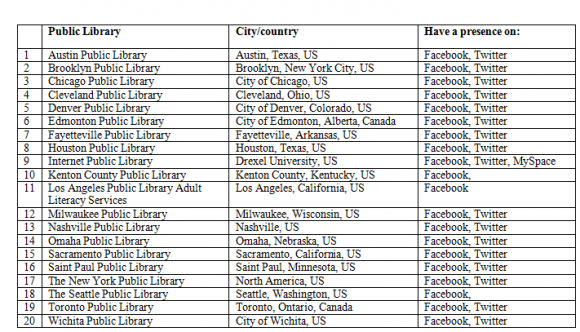
A qualitative method is used to address the main question and to achieve the research objectives. Web content analysis was used in gathering information from libraries' Facebook pages. A total of 20 public libraries' pages were selected at random, through searching on Facebook, using "public library" as a keyword in searching. Then, the study browsed the content of every library's profile page, which is called a "wall" on Facebook. The analysis took around eight weeks to complete. The researcher browsed the content posted by library Facebook page administrators-not by users to explore the various types of library activities and how they use this space for marketing the library and information. From these activities, the study identified the roles of LIPs as well as the users in library marketing. Table 1 shows the number of public libraries included in this study.
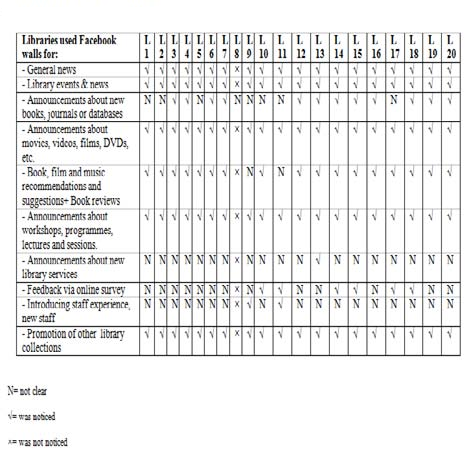
It should be noted that this research did not take into consideration branches of these libraries. Moreover, this study analyses only the first five pages for each library wall on Facebook. Additionally, the study ruled out all the libraries that had an inactive page on Facebook, where only a link to the library home page was provided. In other words, these libraries had no activities of any kind on their Facebook pages. After browsing and analysing the sampled public libraries' Facebook pages (walls), the study created a list of library activities (Table 2). These activities were reformulated in clear points to reflect the specific activities relating to library and information marketing. The researcher also analysed the content with respect to the way in which LIPs, as well as library users, post content and reply to each other, in order to explore their roles in the marketing process.
11. c) Findings
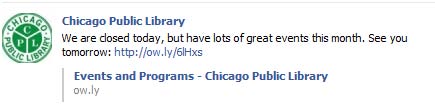
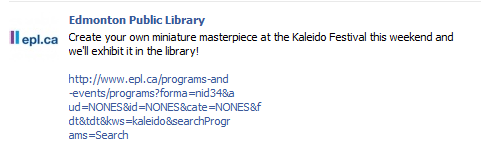
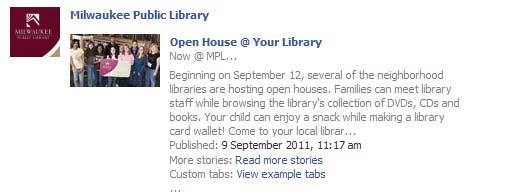
There were 11 main activities of public libraries found on their Facebook walls. The descriptions of these activities were adapted from and based on the analysis of the libraries' Facebook pages. Most of the public libraries used Facebook walls for library news and events or for general news. These included book awards, festivals, new visitors, library events, opening hours and so on. Figures 1 to 6 show several examples of this type of activity as they appeared on the libraries' Facebook pages. In addition to these activities, all the libraries provided a link to their homepage on their Facebook walls. Librarians also used their Facebook walls to introduce new services at the library. An example is provided in the Figure 26. A noticeable point is that most of the libraries were creating an account on Twitter as an additional communication channel. The libraries used Twitter to follow other libraries and to enable followers on Twitter. In addition, each of these activities was followed by a link to the library's home page.
12. VI.
13. Discussion
14. a) The Main Activities of Libraries on SNSs
According to Table 2, most public libraries use their Facebook walls to post their news and to inform users about coming events in the library or in the community. The news includes library news, news about people, festivals and exhibitions, and events at the library or in the community (Figures 1 to 5). Announcements about library news and events are an essential way to increase the library's reputation in the community and among other libraries, while showing the library's activities. Facebook is making it easy for LIPs to reach their users and deliver library events and news. The users are passing this news to other users via SNSs, so librarians are guaranteeing that the news and events will reach the majority of users as well as nonusers. It should be noted that Facebook walls can support and enhance "custom news alerts". These support users in keeping up with the day-to-day operations of the library. By using them, LIPs are marketing the library itself in the community and updating community members with new information.
There are several types of activities that concern information sources (books, CDs, DVDs, etc.), for example:
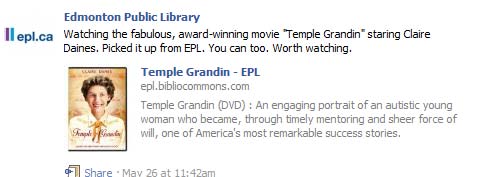
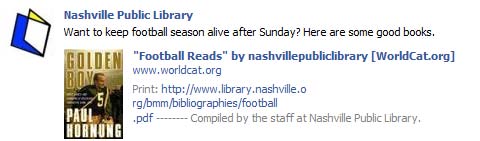
? New books: According to Table 2, most libraries are using Facebook walls to inform their users about new books. They are announcing new books by listing them on the walls and linking this to the library website, which gives more details about the books. In libraries, this type of information service is called "current awareness services", and is intended to alert users to recently published literature such as books and articles in their field of specialization. It can therefore be concluded that SNSs are valuable sources of current awareness service and this service can be developed by SNSs. This result is similar to the findings of Cook and Wiebrands (2010), who concluded that the "current awareness tool should be able to deliver current, relevant information without a huge burden in time and effort for the client or adding to their information overload.
Online social networks do seem to meet these criteria." (p. 22). Another noticeable point is that full descriptions with pictures of the books are provided for these materials.
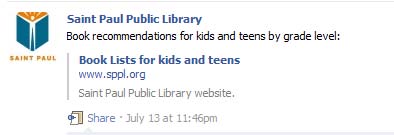
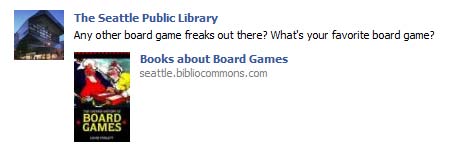
? Book recommendations and/or suggestions: One of libraries' objectives is to make users aware of their services. This can be achieved by marketing the services; otherwise, users will not be informed about them. It is very important to use the available applications to support marketing information services. However, there are some libraries using Facebook to inform users about the new services provided and how they can use them. By doing so, they are able to achieve one of the goals of library marketing. Facebook can facilitate this kind of service.
According toIt is necessary to understand online users' behaviour in order to market and promote library services effectively. For this purpose, some libraries create an online questionnaire via Facebook to gain users' feedback and then to promote their services (see Figures 27 and 28). LIPs should understand users' requirements and their activities, and this can be achieved by using SNS applications. Additionally, Facebook can support the understanding of users' needs by providing LIPs with applications for designing online surveys for gaining user feedback. By doing that, libraries can market their services effectively based on their users' needs. Some of the public libraries tended to use Facebook as a place for marketing their employees' experience and knowledge. It can be noted that libraries are using a new strategy to attract their users by showing that their staff is qualified and has varied experience. This helps LIPs to improve their reputation within their community.
From the above discussion, it can be concluded that there are four main marketing activities that public libraries practise on Facebook pages and/or on Facebook walls: ? Basic information about library news and events (marketing the library itself or self-promotion).
? Basic information about the library collection (marketing information sources and resources). ? Basic information about library services (marketing information services). ? Basic information about community services and people (marketing people knowledge).
The first and second categories of marketing are used widely by LIPs, whereas the third and fourth are used less often.
SNSs such as Facebook are taking information services beyond the traditional information services. This can be concluded from the number of services which can be facilitated by using these sites, for example, book talk services (by creating a video to introduce a new book), current awareness services and custom news alerts. It can be noted that LIPs are not creating new library services but rather are using these applications to enhance existing services.
15. b) Library Users and the Marketing Process
In the case of books, CDs, journals, newspapers, music suggestions and/or recommendations, it has been shown that these recommendations and/or suggestions can be displayed by staff as well as library users via messages and content creation, which can be sent directly between members as well as nonmembers. This means that the users play an important role in marketing library collections with these applications. This is illustrated as framework below.
One of the big ideas behind Web 2.0 as identified by Anderson ( 2007) is "user-generated content". By allowing users to create, produce and manipulate information and/or content, they can share this content with others. Each user can participate by posting such contents. SNSs allow users to do this and librarians and information professionals can benefit from these activities by posting content that recommends or suggests an item. Their intention is to market and promote their library collection. The users can play a role in passing the information and/or messages to others, which facilitates the marketing process.
Another idea related to the Web 2.0 concept is collaboration and communication. When user posts content, other users-either library members or nonmembers who can also access and participate in the site-will be informed about the library's collections (books, CDs, etc.) They can search for this item from their own library branches or through the library interloan system. This facilitates communication and collaboration between the library branches or with other libraries. The collaborative effort leads to better marketing, thanks to SNSs. Another important point, LIPs could involve in above diagram in "member/nonmembers', they may participate and follow what other libraries do.
16. c) The New Roles of LIPs within SNSs
Through the analysis of the libraries' Facebook pages, it has been shown that LIPs are involved in:
? Creating new content, and contributing and revising, including updating content for users, and posting new content and information.
? Coordination of SNSs (e.g. Facebook, Twitter), including controlling the library profile, updating information, controlling the use of applications (e.g. Lib Guides Librarian), etc.
? Site management, including managing library home pages within SNSs, transferring information, controlling all links and hyperlinks, hypertext, etc.
? Promoting social events including all activities related to the community.
? Controlling online discussions and cooperation, including managing discussions and making sure all content is relevant to the topic under discussion, etc.
? Creating reports (e.g. statistical about page usability and accessibility)
All these new roles can be observed in the analysis of the sites; however, they require several important skills, such as marketing experience, ICT skills, social networking literacy (e.g. diverse methods of communicating, searching and navigating, applications for the library, etc.) and languages. The library can do marketing by using several types of applications provided by SNSs, such as Facebook applications. These applications can be used to improve library services in order to attract users and provide them with the best services possible. These applications can support the best use of library collections by users and at the same time enhance some services to facilitate the use of information resources. The roles of LIPs as indicated above involve many tasks. They need to have professional skills in order to market the library and information services effectively on SNSs.
17. e) Issues Raised in this Study
The first issue raised in this study is that all of the libraries' advertising efforts were under a single slogan or icon, which is called a "brand". This makes them different and valuable; however, there are many issues that arise with the use of a brand and their use by libraries for effective marketing. This needs to be fully discussed.
The second issue raised is the measurement of effectiveness of marketing communications in the marketing of information on SNSs. According to the experiences and studies cited above, the number of libraries with a presence on SNSs is rapidly increasing. Most of the libraries looked into marketing their services and found SNSs to be a good tool to reach the majority of users. However, LIPs need to have marketing skills as well as be familiar with SNSs applications. Very little research has discussed this issue and this need to be addressed.
18. VII. Conclusion and Recommendations
It has been shown that most public libraries are using Facebook as a place for marketing themselves and their services and to promote their collections. However, there are many applications offered by Facebook that could support libraries further in marketing their services and resources that were not found in some libraries' Facebook pages. In addition, several points can be observed from this study: users can play an important role in marketing library collections, the concept of information marketing within Web 2.0 has been changed and SNSs can be used as an effective strategy for marketing the library.
This study drew a framework of using SNSs in library marketing that indicated the main activities of libraries. This framework can provide descriptions of marketing library's' services by adoption SNS applications. For example, Facebook applications can be used to promote library services and support library marketing.
The study recommends the following points:
? The exploration and use of SNS applications to enhance library services and support library marketing (e.g. LibGuides Librarian, Facebook Librarian, Books iRead, COPAC Search and JSTOR Search). These applications can be found at: http://onlinesocialnetworks.blogspot.com/2007/08/t op-ten-facebook-apps-for-librarians.html.
? The teaching of marketing in LIS. There are different types of marketing and it should be noted that library marketing differs from business marketing. A better understanding of marketing will support LIPs in enhancing library services (Kavulya, 2004).
? The teaching of social media literacy. This will support LIPs by giving them knowledge about these applications and how they can use them in library and information services.
? Providing LIPs and LIS students who will work in libraries with ICT skills. These skills should include computer programming, which will help them to enhance and promote their services (Noel & Waugh, 2002).
? A combination of marketing methods (traditional and new technology) to promote library services and resources.
Global Journal of Human Social Science ( D D D D )












| LIPs can reach a majority of their members and |
| non-members at the same time, whereas this is |
| limited with traditional marketing methods. |
| ? Announcements about workshops, programmes, |
| lectures and sessions: According to Table 2, around |
| 95% of the libraries are using Facebook as a place |
| to announce workshops, programmes, lectures and |
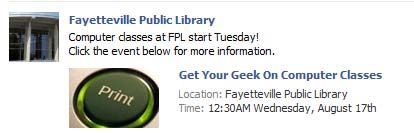
| sessions (see Figures 20 to 24). Facebook supports |
| libraries by reducing advertising time and effort, and |
| helping to reach people quickly and easily. |
| Facebook is being used as a platform for updating |
| community members about such activities and this |
| can promote society's knowledge by enabling |
| people's involvement and participation in these |
| activities. |