1. I. Introduction
Similarly, this perspective was echoed by the Deputy Prime Minister and Education Minister, Tan Sri Muhyiddin Yassin who emphasized that the transformation of the school curriculum should be based on creativity and innovation, and learning should be fun and not exam-oriented (New Straits Times. 24.
Author : Universiti Tenaga Nasional Malaysia. Feb 2010. p.1). He stressed that the learning process should no longer be dominated by teachers. In fact, the learning process should give priority to interaction between students and teachers as well as their classmates. Concurrently, his interaction would nurture creativity and innovative ideas. The transformation is significant as it will involve not only the curriculum, but also approaches to the teaching and learning. On the same note, teachers have to move away from the traditional classroom to student-centered teaching methods.
With this view in mind, the researchers had embarked on a study that carried the following four Objectives. a) Research Objectives 1. To provide insights and understandings of students' ability in generating ideas using visual aids. 2. To write grammatically correct sentences using a model of sentence patterns. 3. To evaluate students' ability to organize systematically using the writing process approach. 4. To develop a teaching model that can prompt students to speak and write confidently and proficiently.
2. b) Research Questions
This study was to answer the following research questions:
1. Can visual aids assist students to generate ideas in their speaking and writing? 2. Can sentence patterns act as a model in guiding students to write grammatically correct sentences? 3. Can the writing process approach guide students to write systematically? 4. Do students learn from their mistakes when writing using the writing process approach?
Expected Outcomes 1. To develop human capital, in specific, workforce who can communicate proficiently and confidently in English. 2. To construct a model of teaching that will facilitate students' speaking and writing in English. 3. To foster students to work cooperatively as a team in project work.
3. E
Year he participants of this study are a group of first year Business Communication English students who struggled to speak and write. In helping them to improve, it was decided that the students should he equipped with authentic and meaningful experiences with the language. Activities that enabled students to create and present language issues from their own texts were proposed. These activities were not focused on skills in isolation and word drills disconnected from real world needs, but things that students were familiar with. In this study, the students were instructed to work in pairs and then to identify one product and one service, which they had to discuss and present to the class. Simultaneously, these activities required them to speak and write a description of the product and service proposed, within a process writing approach. At the end of the program, they were noted to be extroverts in speaking and writing. 5. To create a work force that has the ability to work in groups and this can lead to more efficient outcomes.
4. II. Literature Review
Writing is one of the four language skills that all language learners are required to master in order to communicate ideas, thoughts and feelings in written form. However, writing can be difficult for students who have vague idea of what to write and to those who lack confidence in their writing abilities (Davis, 1997). Thus, writing activities are often described as ill-defined problem-solving tasks (Wenger, 2009). The dilemma these students faced can be overcome with the help of visual images which they can use as a tool to generate ideas based on prior knowledge, interest and the five senses -sight, smell, touch, hearing and taste. Visual aids can assist students to think with clear ideas and provide a sense of direction; in addition, group writing can be used to assist students in their writing process. Rogoff (1990) defines the writing process as the engagement among students during group writing session in a naturalistic social context that shifts the writing methodology from product to process. Group writing in this study is conducted using the process writing approach (PWA) as proposed by Flower and Hayes (1981) and cooperative learning skills (Chiang, 2002). The participants of the study were 40 first year students from the college of Information Technology and Engineering. They were mostly in their early twenties, and have completed nine years of formal English Language education in government sponsored schools. Majority of the participants were Malay students with 69.4% (27), followed by international students from Iraq with 13.9% (5), Chinese and Indian with 5.6% (2) each, and international students from Bangladesh and Sudan each with 2.8% (1). Two of the participants dropped from the course, resulting in only a total of thirty eight respondents.
5. c) Purpose and Description of Project
This project was initiated by implementing a package of public speaking presentation skills and writing process, for a class project in a Business Communication course class. Two goals were delineated for this project; (1) to improve students' writing by incorporating pictures from product and service promotions designed to inspire more varied and creative perspectives, and (2) to enhance students' public presentation skills.
First, students were randomly paired up to discuss on products and services promotions. Concurrently, each pair wrote an essay using the writing process approach focusing on the visual and verbal These are stages of activities such as brainstorming, group discussion, and rewriting of drafts, to promote and develop the use of grammatically correct target language. elements in the product and service they were promoting. In addition, they were taught basic sentence pattern techniques. The features that our strategy shared with cooperative learning included the organizing
6. Global Journal of Human Social Science
Volume XII Issue X Version I
7. Year
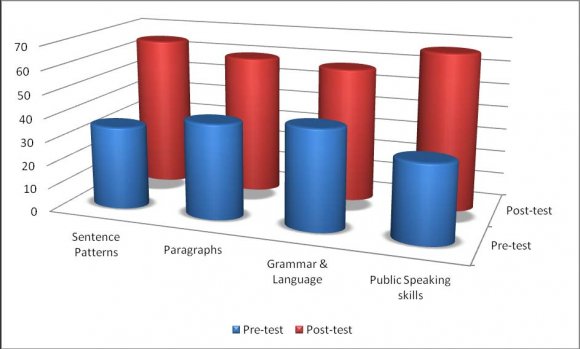
of pair interaction to support learning and the change in the lecturer's role to that of facilitator. However, our illustration of the teaching method relates specifically to a speaking and writing subject, not an entire context of support across a curriculum, so we would not expect our teaching model, by itself, to radically influence students' entire cognitive and social development. was to analyze the respondents' competencies in the area of sentence patterns, paragraph skills, grammar and language, and public speaking skills. Then, after the training session, a post-test was conducted to evaluate the effectiveness of the teaching model. With reference to Figure 1, it is shown that there is an overall improvement in the students' performance with regards to sentence patterns writing; paragraph writing skills, grammar and language, and public speaking skills. Feedback: Sabiha (Bangladesh) "To be honest, at the beginning of the semester we didn't know how to present something in front of the class or audiences. I can remember very well that at the first day some of my friends came to present but they didn't use the power point for the slide and they started to read their notes. So, Madam Mariam taught us how to make slides by using the power point, how to stand, how to dress up during presentation and how to present smartly. During presentation, she stopped us several times when we did mistakes and she tried her best to improve us. Sometimes some of my friends got angry with her because she always tried to correct our tiniest mistakes. After two months, I noticed that there was a miracle change among us. For example, we have improved our speaking style, we have corrected our pronunciations and we all are very confident. Now I have no problem to establish eye contact with the audiences which is the most important achievement from my Business English class. I want to thank my lecturer because she gave me a chance to present about a very important topic in front the students from Kazakhstan which was a chance to prove myself. After that presentation, I was surprised because I was very confident. That day I understand that our lecturer Feedback: Nuranashatul "The course has taught me many things especially when do the presentation and writing process. It helps me in the terms of confidence, communication and writing skills. In the class, I have presented about products, services and also topic covered in the text book. The presentations help me improve the confidence level in myself. Before this, I am really nervous when come out and standing in front of people to talk. I afraid if I said something wrong and can't face with the audiences. However, when I continue to present and present in the class, I became braver and not feel too nervous to talk in front of people anymore. In communication skill, I think I have know now how to begin and what to say when communicate such as use simple word and how to control our voice when speak." Feedback: Dinesh "I think the presentations that I have done in the class are really good, because it helps me to gain experience in giving speech in front of many people. I manage to overcome my fear that is fear of talking in front of many people, by doing a lot of presentations in the class. This technique is really effective, and I really enjoyed it. My lecturer has done a great job. Even my friends in other classes, are still scared to talk in front of many people, because their lecturers didn't ask them to do presentations. More than that, my confidence level has increased after I gave speech in front of Kazakhstan students.
8. III. Research
Feedback: Hani Safinaz "About the presentation that you asked us to do at the beginning of this semester, at first I feel scared and nervous. Because I'm not really good in gaining confidence when talking in front a lot of people. Besides that, I have a very tiny voice, so I'm afraid that people can't hear the words I say. When I stand in front of the class for the first time to present about the product, I was really nervous. But then, after a few weeks listen to your feedback about the other student's presentation, I started to feel more relax and try to apply all the tips that you said about the voice projection and such. It is a good practice. When I have to do the presentation in front of the Kazakhstan students, I don't feel nervous anymore." Feedback: Tibenval Murugesan "I feel that getting the students to go up on stage in front of the entire class and present is conducive to the learning of the students themselves. I have always believed in proactive styles of both teaching and learning, and involving the students directly is the best way to go when it comes to this. When students prepare for the presentations, they will take the initiative to actually 'know' their facts on the related topics. If they were to simply read it off a white board in class, chances are they would forget very easily. Giving constructive criticism on their presentation skills also helps build confidence and communication skills in preparation for the future." Feedback: Joanne "I think the many presentations that you have asked us to do has helped us in reading the textbook I do believe that not many of us would actually start to read or own the textbook if it's not for the presentations. It has improve my communication skills such as establishing eye contact, knowing the body language of my audience when I presented in front of the class, and it has also exposed me to know something about the business life, the formality and such. I feel that the presentations had helped us to build our self confidence and also improve our way of presenting. These skills are very important to every student to be able to express ourselves better." Feedback: Nor Liana "First of all I would like to thank you for giving such a good experience for this semester. From my point of view, I think the presentation that we do in class is a very helpful for me as it raise my confidence level to talk in public. Before this, I feel very shy to talk in front of the class and it is very difficult to me. But, after so many practices in this class, I think it is not as hard as I think."
Most noticeable, based on the students' feedback, the presentations conducted using visual aids madam Mariam did a great and this presentation skill will help us through our life." (product and services presentations) had assisted in making the students more confident to speak in public. For instance, it was proven that the use of visual aids had assist students to generate ideas in their speaking and writing.
9. Research Question 2
Can sentence patterns act as a model in guiding students to write grammatically correct sentences?
The students' feedback recognized that the teaching model works to the benefit of the students. Feedback: Sabiha "During special semester usually the students are very lazy to study. Madam Mariam used a unique method to keep us busy with homework and assignments. It has really improved our writing skill. We had to write about many products, services, news release and various kinds of letters. It is not only useful to improve writing skill, it also increases general knowledge. For example, when we did our assignment about product, we did a lot of research about the recent and new products. In
10. Global Journal of Human Social Science
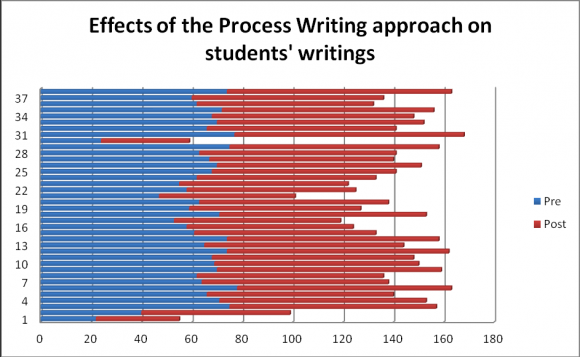
Volume XII Issue X Version I taught us is unique. In my future life, when I will write or present something I will follow her tips. Above all, I will never forget her." "About writing, at first after seeing so many grammatical errors on my essay I feel a bit down. I know my writing was a bit messed up here and there because sometimes I just ramble on all point and did not follow the techniques given. But then, day by day after doing all the correction, I learned from mistakes. I cannot just take everything for granted. Before writing, I must plan and follow all the techniques given. Can the writing process approach guide students to write systematically? Figure 2 : Effects of the Writing Process Approach on students' writing. addition, Business English is a subject which is directly related to our daily life and the way madam Mariam Figure 2 shows a significant improvement in the students' writing performance after undergoing the process writing approach. This is reflected in the students' responses.
Feedback: Toh Seng Lee. "I feel that writing process is a way to let me have more improvement. Through writing process in class, I knew mistake that I make and how is the correct ways that I should write for my article. Writing process improve my skills to prepare a script for a presentation, talk and also speech. Practice more in writing ensures I improve more." Feedback: Hani Safinaz "About the essay and the writing process, I think it is also a good practice. The way that you wanted us to Research Question 4 write several drafts and returned it back to us, we can see where we made mistakes and try to correct it. Also what I got from this exercises is to identify the 5WH which really useful to mostly all writing types. " Do students learn from their mistakes when writing using the writing process approach? Feedback: Dinesh "The writing process that I have to do in my class is really good. I think it is the best way to improve our writing skills This is because we can know the mistakes that we have done when we write some essays for many times. My lecturer will mark our writings, and will Feedback: Tibennal Murugesan Therefore, our skills will become better. So, whenever I write a new essay or any letters, I will always think about the mistakes that I have done before this, so that I won't repeat the same mistakes again. Therefore, I feel that the writing process in my class is really effective. I don't know what the other students think about it, but for me, it is really helpful. All the lecturers should follow this technique." "As for the writing, it is indeed a very good way to teach. Letting the students make their mistakes, and then correcting them again and again will surely make them remember the mistakes. This way, they will know the correct ways of writing On analyzing the students' writings, the researchers found that many of their writing errors were beyond the structures found in the native language. For instance, Malay second language learners of English have the following fossilization in their target language.
as they have made mistakes before and would not want to repeat the same mistake."
11. Tense aspects-regular and irregular verbs
He played He goed to school.
tennis.
12. He putted He
the bag in the car. taked They the pencil just now. catched 2. Confusion in using the present, past and future tense.
the thief.
3. Omission and insertion of the articles a, an or i. We are from ? Drum Circle community. the ii. Additionally, we provide first class tutors graduated from establish English schools with an 4. Confusion on when to use experience in ? music industry.
who and Some of our students that had graduated officially working as music tutors. that 5. The use of '?ing' after the auxillary is, are, was and were.
One of the courses that we are offers 6. The verb forms after infinitive 'to' is Young courses for children.
You have the ability to be able to playing 7. The word form after the 'would and could' a musical instrument.
Music book would be providing 8. The use of verb forms after singular and plural nouns.
to the students.
13. The studio provide
Another notion that should be introduced at this point is that fossilization, which, according to Ellis (1997), is the cessation of the language learning process somewhere short of target language competence. In fact, Keshavarz (1997) maintains that an error-based analysis can give reliable results upon which remedial materials can be constructed. In other words, analysis of second language learners' errors can help identify learners' linguistic difficulties and needs at a particular stage of language learning. It is essential for a syllabus to provide with the training for learning appropriately and errors are important evidence for that. Gass & Selinker (1994, p. 67) provide a model for error analysis of students' writing errors: a musical lessons.
1. Data needs to be collected. This is typically done with written data. 2. Identifying errors. (Into word classes etc.). 3. Classify errors (Overgeneralization, tense etc). 4. Quantifying errors (how many overgeneralization errors occur? How many tense errors occur?). 5. Analyzing source of error. (Interlingual, intralingual due to a certain teaching method).
14. Remediating for errors. (Pedagogical intervention).
There are two main types within an error analysis framework: Interlingual and intralingual. Interlingual are those that can be attributed to the L1 (they involve cross-linguistic comparisons). Intralingual errors are those which are due to the language being learned, independent of the L1. One would therefore expect similar intralingual errors to occur from speakers from a wide variety of languages.
The types of errors can be categorized into two: Descriptive and surface structures.
15. Types of Errors
Error Categories A Descriptive In English, the word borrow contains the meaning '+take' and the word lend contains the meaning '+give'. In BM, however, both meanings are covered by the verb pinjam and the distinction in meaning can be created by word order.
16. Global Journal of Human Social Science
Volume XII Issue X Version I The omission of the third person "-s" can be attributed to the fact that BM does not require verbs to agree with subjects. However, as indicated by Dusková (1984), the ending free form is generalized for all persons to make the learning task easier and this is a common intralingual made by people with diverse native languages. This is an intralingual error where the learner uses the communicative strategy of creating a term he is not familiar with by using terms he already knows. Some of the errors involving prepositions are due to omission: They are searching solution from the web. They are searching for solutions from the web).
Once a while we buy groceries from the supermarket. Once in a whilewe buy groceries from the supermarket.
The omission of prepositions as shown in the examples above cannot be explained by examining the structure of BM as similar structures (prepositions) exist in the language. However omission is often used as a simplification strategy by learners to lessen the learning load.
Articles too, were omitted often by the subjects:
We waited for few minutes.
We waited a few minutes.
If I'm late I can't go to gym.
If I'm late I can't go to the These omissions, unlike the ones involving prepositions can be attributed to the fact that BM doesn't use articles like those used in English. Along with the influence of the tendency of learners to simplify the learning task, interference from the L1 can account for the higher frequency of article-omission errors as opposed to preposition omission-errors. gym.
Most of the errors concerning nouns involve an error in the distinction of 'mass nouns' and 'count nouns':
The PTA seeks to raise fund The PTA seeks to raise for the poor students. funds In the example above the subject fails to realize that 'fund' is a count noun unlike water. The distinction between mass and count words does not exist in BM. Thus this can be treated as an interlingual error.
for the poor students.
17. c) Causes and Sources of writing Errors
Interlingual errors are the result of mother tongue influences. Learners transfer/borrow some forms but not others due to two factors such as proto-typicality and language distance (Kellerman, 1979). Malay learners of English commonly make errors in negative sentences.
18. For example :
Adryna no coming today.[ Adryna tak datang hari ini].
Such errors are common in pre-verbal negation using no, the same negative construction as in their L1.
19. E
20. Year
In order to determine whether transfer is the cause for the occurrence of errors, James (1998) demonstrates that learners with a particular L1 make an error that those with a different L1 do not. He provides a useful summary of these strategies:
1. False analogy. 2. Misanalysis. 3. Incomplete rule application exploiting redundancy. 4. Overlooking co-occurrence restrictions. 5. System-simplification.
It is not clear which strategy is responsible for a particular error. Errors can also be viewed as 'natural' or as 'induced'. sleeped At the end of the one semester study, it was noted that the students' explanations and actions reflected increased insights for they began to see pictures as speech-making prompts, as well as to see the analogies between pictures and verbal expression. Ultimately, that understanding expanded their concept of literacy and encouraged them to explore new possibilities in their writings. To conclude, learners' errors are noted by noticing how they have simplified, added, misinformed or disordered elements in their utterances and writings. The teaching model implemented has proven to be effective in enhancing the students' public speaking and writing skills. at eight.
To conclude, we suggest that the Teaching Model proposed be implemented in the teaching and learning of English for foundation courses so as to upgrade the students' speaking and writing competency.