1. Introduction
he quarry industry is vital to the economic and social well-being of every nation. Quarried materials are fundamental input into all major infrastructure and construction projects. Population increase and the need for construction materials have made it necessary for the exploitation and expansion of quarries in the area. Different authors have established the economic importance of the southwestern basement complex rocks of Nigeria (Elueze, 1981;Dada, 2006). In Ogun State of Nigeria, most quarry activities (blasting and crushing of rocks) are carried out in the rural areas where labourers (mostly poor and unskilled women and children) are engaged in hard labour that pays pittance and is often dangerous to their health. The women and in some cases underage children mostly from the neighbouring Benin Republic are used in the quarries, often illegally and exploitative manner to do strenuous works, but are not well paid. This thus emphasized the ubiquitous discrimination and treatment of women in many facets of our socio-economic lives.
Significant anthropological and sociological researches have emerged on gender role in the environment, agriculture, employed labour and other human endeavours. The role of women on the sustenance of the environment and its resources cannot be over-emphasized even with the growing trends of globalization of the world's economies (Baden, et al; 1995; Boserup, 1989;Hemmati, 2004;Scott, 1988). The term gender plays a central role along with culture, age and socio-economic status in determining men and women's social status and access to resources (Hughes, 2004;Menjivar, 2000;Fisher, 2006). Women account for 70 ?80% of household food production in Sub?Saharan Africa, 65% in Asia, and 45% in Latin America and the Caribbean (IFPRI, 1995). Gender divisions constitute an aspect of the wider social division of labour that is rooted in the conditions of production and reproduction. This is further reinforced by the cultural, religious and ideological systems prevailing in a society (Chant, 1989(Chant, , 1992;;Ostergaard, 1992;Aderinto 2001;Larsson, 2001;Olurin, 2003;Adeola, et al., 2009).
Women in particular are frequently excluded from decision making either in the household or community level through representative systems of community institutions and organizations. A gender gap in earnings persists across almost all employment categories, including informal wage employment and selfemployment where women comprise the majority (ILO, 2007). In rural area, women often do not earn a wage, and in some other cases women earning a wage often earn less than men, leaving them more vulnerable to changes in their working environment caused by external phenomena (IUCN/WEDO 2007).
Increasing poverty among women has been linked directly to their unequal situation in the labour market, their treatment under social welfare systems and their status and power in the family. There is the erosion of the income earning capacity of women in both the formal and informal sectors, shrinking social services and safety nets. The 1995 UN Human Development Report, which had a particular focus on gender, indicated that no country treats its women as well as its men, and in almost all countries of the world women are over-represented among the unemployed and those
T ( D D D D ) C ? ? ? ? ?living in absolute poverty. The objectives of the study are to examine the influence of selected socioeconomic characteristics of women and access to economic resources on their participation in quarry activities, to identify the constraints militating against women participation in quarry activities, to examine the problems encountered by the women working in the quarries and suggest possible solutions to ameliorate their sufferings. The study hypothesized that there is no significant relationship between selected socioeconomic characteristics of women, access to economic resources and the level of their participation in quarry operation/activities.
2. II.
3. Conceptual Underpinnings a) Gender inequality (Patriarchal Value System)
Ever since enthronement of the patriarchy structure, women have been oppressed, subjugated, neglected, discriminated against, marginalized and devalued is almost all societies of the world (Aina, 2003;Asiyanbola, 2005). Increasing discrimination against women in the society is traceable to the explanations provided in the theory of patriarchy (Aderinto, 2001;Asiyanbola, 2005;Lerner, 1986). This theory affords women little or no resource control or decision-making rights. Women's lives have been found not to be uniform but vary dramatically across contexts, history, and social categories and identities (Glenn, 2002). The participation of women in national level politics, measured in percentage terms is actually in decline (Commonwealth Current, 2000). Gender inequality under the law and violence against women are stark indicators of the low status accorded women in the societies everywhere (UNDP, 1995). The roles played by the women were generally less visible and attract less public recognition than the work men engage in. In education and employment, women have a lower status than men do. Women who constitute about half of the Nigerian population have remained educationally disadvantaged. Literacy rate in Nigeria rose from 59% in 2001 to 70 % in 2006 for male compared to that of the female which was from 41 % to 55 % for the corresponding years National Bureau of Statistics. (2006).
4. b) Quality of female labour
The quality of labour can be understood through the human capital approach. It was Adam Smith (1776) who developed the concept of human capital as the acquired and useful abilities of the inhabitants or members of society. The acquisition of such talents, through education, study, or apprenticeship, always costs a real expense, which is a fixed capital and realized in his person. Adam Smith saw human capital as skills, dexterity (physical, intellectual, psychological, etc.), and judgment. Becker (1964) however defines human capital similar to physical means of production, e.g., factories and machines: one can invest in human capital (via education, training, medical treatment) and one's outputs depend partly on the rate of return on the human capital one owns. Human capital is substitutable, but not transferable like land, labour, or fixed capital. It refers to work experience and education, in which work experience is measured by years of full-time work experience and formal education is accounted for in years (Hersch, 1991;World Bank, 1995;Jacobsen, 1998).
The concept of labour quality has been developed continuously to reflect socioeconomic changes. For example, Galenson and Pyatt (1966) stipulated that the quality of labour was measured by education, health, housing, and social security. There are some criteria suggested by the World Bank in various issues of World Development Indicators to assess labor quality, such as educational system and human resource training; the availability of labourers as well as administrative managers who are of high quality and level of education; and proficiency in English, technique, and advanced technology. Ward (1997) argues however that in the new forms of production organization, labour quality goes beyond educational attainment and technical skills alone. It incorporates seven major factors to compile the quality of labour index: education, training, labour productivity, changes in the structure of the labour force, safety and health, work ethic and industrial relations, and labourmanagement models and the quality of the workers' livelihood.
5. III. Gender Role in Informal Economy
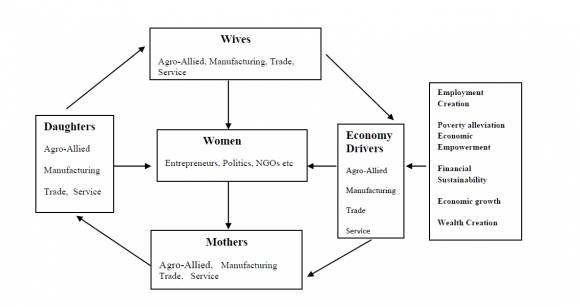
Women are at the heart of development as they control most of the non-monetary economy including subsistence, agriculture, bearing children, domestic labour (Jeminiwa, 1995) and also in the community economy (trading, wage labour, employment, etc). They are pivotal to the developmental programmes of many African countries because they play diversified roles in growth. Women entrepreneurs may play the role of wives, daughters, mothers and economy drivers (Fig. 1). According to the Economic Commission for Africa (ECA 1991), next to the agricultural sector, the informal sector is the largest employer of women in most African countries. There were an estimated 16 million women in sub-Saharan Africa engaged in the sector in 1990 (ILO, 1990). Although the representation of women in the informal sector is higher than that of men (Berger and Byvinie 1989), the participation of women is underestimated. Economic reforms and macroeconomic policy, particularly in today's world of deregulated financial and labour markets impacted differently on women and men due to their unequal position within the 2012
( D D D D ) C Year i) i) i i ) i isociety and the formal economy. Increasingly people including women earn their living from informal wage labour or self-employment (ILO 1990a; 1990b). For most women, labour-based, income-generating activities are the most important source of income, particularly for poorer ones. IV.
6. Material and Methodology a) Study Area
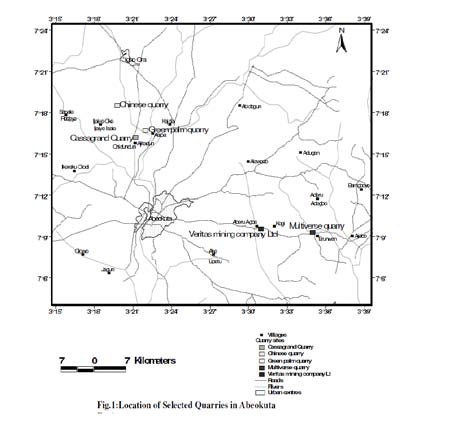
The study area is located between (latitude 7 o 9' and 7 o 14' north) and (longitude 3 o 26' and 3 o 40' east) in the humid tropical region of Nigeria. The study quarry sites include selected sites like the abandon Quarry at Adigbe and AGI Quarry in Abeokuta North and Abeokuta South Local Government Areas (LGAs) and the Oba Quarry in Odeda LGA of Ogun State, Nigeria (Fig. 2). At the time of the last national census in 2006, the study area had a population of about 561,056 inhabitants comprising 261,481males and 291,575 females. The breakdown by local government area of the male and female population is shown below in Table 3. The study sites fall within the basement complex geological setting of south western Nigeria characterized by the rocks of the Pre-Cambrian age which are made essentially up of the older rocks which are differentiated into Biotite Granite Gneiss, Migmatites Biotite Gneiss, Biotite -Muscovite Granite, Hornblende Granite, and Schist (Kehinde-Phillips, 1992). They are composed primarily of banded gneiss in which hornblende-biotite rich bands alternate with quartzoligoclase rich feldspar bands (Jones and Hockey, 1964). All these rocks constitute good aggregates and
( D D D D )C have been found to be very suitable for quarrying and construction purposes (NEST, 1991). Quarries serve as sources of employment to various people within and outside the area (Oguntoke and Yussuf, 2008). Major environmental impacts of the quarries include ground vibration, air shock, flying rock and dust from blasting operations (Chen and Huang 2001; Spathis 2006). The gender biases observed in other aspects of life (be it social, economic, education etc.) can also be observed in the quarries. The activities at the quarries is very patriarchal in nature and is hostile to women and children, however, the pervading poverty among the rural dwellers mostly made up of women, positioned them for easy exploitation and discrimination. Women are engaged in the most demeaning and least paying jobs in the quarries. Major quarrying companies in the area as identified by the Federal Geological Survey Department (FGSD) includes: AGI, Guffanti Nigeria Plc, Associated Granite Industries, Fijabi Adebo Holdings, Obasanjo Holdings (Oba), P.W Nigeria Ltd, Veritas Mining Ltd, Bormadek Quarries, Equations Nigeria Ltd, Chinese Quarry, Green palm Quarry, Kassagrand Quarry, and Multiverse Quarry (Oguntoke et al., 2009).
7. b) Sampling Methods
Three methodological tools were employed in this study, which include:
? A focus-group discussions with women quarry workers in the selected quarry sites where openended questions were used to elicit information on issues relating to their roles in quarry activities and the impacts on their lives . The answers to these questions were used to improve the usefulness of the quantitative data. The group discussions were also recorded on tape for future analysis. ? Personal interviews using structured and semistructured questions were conducted with women who engaged in the quarry activities. All questionnaires were pretested. ? Finally, we reviewed the literature on the role of women quarry workers in quarry activities in the study area. This is to provide us with the conceptual context for the analysis of the data collected through the survey and also to generate a testable hypothesis for the study.
8. c) Sampling procedure and sample size
The surveys dealt with working conditions and activities as well as gender distinctions in quarrying activities and incomes, with particular focus on role of the women. The instrument used for data collection is structured questionnaire. Information were collected on the socio-economic characteristics of respondents, quarry activities engaged in, as well as level of access to economic resources. A purposive sampling method was then used in the selection of the 3 quarries (i.e. the Colonial Quarry, AGI Quarry and Oba Quarry) where the structured questionnaires were administered. 120 questionnaires (i.e. 40 questionnaires in each of the selected quarries were administered. The questionnaire consists of both open-ended and close-ended questions. The questionnaire was divided into two parts: a quantitative section and a qualitative section. The quantitative section includes questions related to family size, family setting (monogamy or polygamy), no of working hour per day, remuneration/wage per day, age, level of education, transportation costs etc. The qualitative section includes questions aimed at identifying subjective perceptions of: i) reasons for engaging in the quarry work, ii) assessment of the quarry job by the women and iii) emotional condition of the women quarry workers, iv) husbands knowledge of the job.
9. d) Analysis of Data
V.
10. Results and Discussion
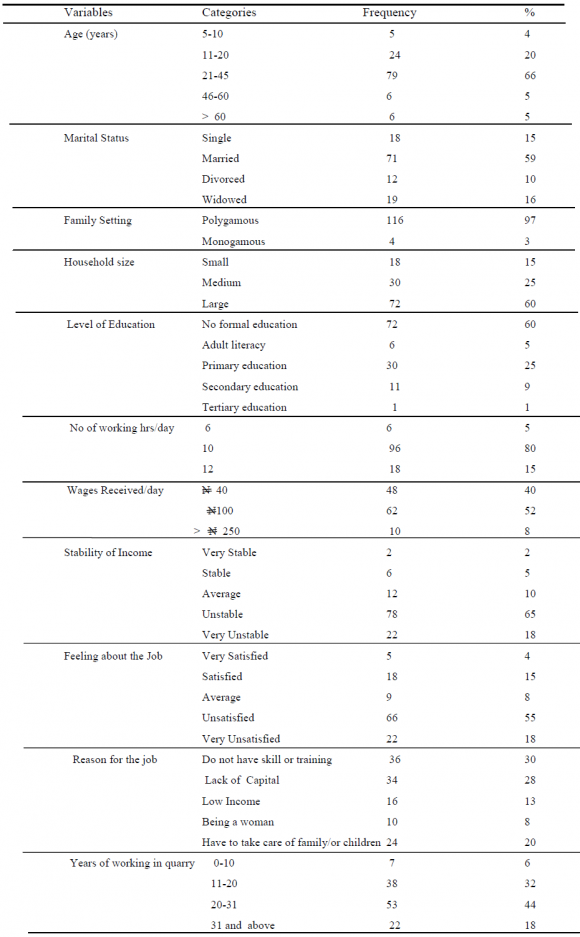
The results of the field assessment of the quarry activities in the studied quarry sites indicated that 40 % of the quarry workers were female (adult, adolescent, and girls). The ages of the female quarry workers range from 5 to 60 years and above with the highest percentage falling within the age range of 21 -45 years (Table 1). In abandoned quarry sites, there is increased number of external workers than in actives quarries as evident in the study area. These women experience a form of deprived or marginalized status in terms of wages and working conditions. Majority (60 %) of the women quarry workers had no formal education while about 29 % had either primary or secondary education. 4). Low literacy levels also speak for the abject poverty of the women in the quarry sector, which in turn shows their vulnerability to remain in exploitative forms of labour like quarrying. The lack of formal education among the women quarry workers also reflects their inaccessibility to skilled employment often dominated by men. The World Bank (1995) has observed that a great disparity exist between men and women entrepreneurs in Africa especially in terms of literacy rate, earned income and other economic activities. Women adult illiteracy rate is higher than that of men in most African countries e.g. Angola, Benin, Nigeria, and others (UNDP, 2005).
The estimated earned incomes for women are however, far lower than that of men. This is also reflected in this study of women quarry workers in The result of this study was subjected to frequency, percentage distribution, regression analysis was used to determine the relationship between the variable identified in this study.
Abeokuta Metropolis. High percentage (90%) of the women engaged in the quarry works are not the owner of the quarry but just employees (mostly casual workers), while the ownership of the quarry sites belongs to few minority of the women (10%) who determined the wages or remuneration of the workers. It was also gathered from the study that majority of the women (80%) on average, work for about 10 hours daily, while the exceptionally energetic ones (15%) work for about 12 hours daily. The remaining 5 %, which are mostly those of the age of 60 and above often work for maximum of 6 hours daily due to the stress involved in the work which their age and health cannot cope with. The UNDP Gender-Related Development Index and Gender Inequality in Economic Activity in selected African countries shows that except for countries like Kenya, Madagascar, and Tunisia, It was also observed from the study that the quarry work seem to be seasonal to some of the rural women as they also shift between occupations according to seasons. They are engaged in some other informal wages labour like hawking goods, land clearing and farm works to make ends meet. This gives the quarry owners the ample opportunity not to provide minimum wages or permanent labour in the quarries, thus 'casualising' the women quarry workers with no formal form of agitation for improve working conditions. The characteristics of most casuals indicate that this form of employment has more to do with limited choices available to the women and their low skills. Employers use casualisation of labour force as an effective way of reducing cost and maximizing profits and de-unionizing the work force. Gender inequalities are present in many ways in the labour market. Costa and Silva (2008) stressed that two relevant indicators of these inequalities are the ratio between female and male participation in the paid workforce and the ratio between female and male hourly wages. These indicators according to them reflect the fact that women face barriers to enter the labour market and, when they find a job; their earnings are lower than those of men. Women's wages on the other hand are viewed as complementary rather than primary, which explains women's willingness to work for a lower wage. This according to ILO (1970ILO ( , 1976)), helps to explain why women's wages often remain barely above 50 percent of male wages in cases where women's productivity is as high, if not higher, than men's.
The wages received by the women in the quarry for crushing the rocks is very ridiculous. The number of head pan of granite crushed daily determines the wages received by the women quarry workers. A head pan which, normally takes about one to two hours to crush attract a wage of ten naira (#10). Majority of the women (21-45years old) crushes about 10 head pan each day giving them about One Hundred Naira (N100) wage. The energetic children, sick, the pregnant, and those of 60 year old and above can only make between forty naira (N40) and sixty naira (N60) daily. Quite a few end up crushing 14 head pans daily (thus making about N140). The 8 % of the women that makes N250 daily are those engaged in the sorting and clearing of the quarry project sites of rubbles. There are many cases in which employers prefer women over men: examples include tea plantations, textile manufacturing firms, and laborintensive industries operating in many areas of the Third World (Elson and Pearson, 1981;ILO, 1970).The preference for women as the primary labour force in these industries reflected the existence of a gender wage gap, even for more educated workers. This phenomenon has been dubbed 'the comparative advantage of women's disadvantage (Kabeer, 2003(Kabeer, , 2007)). It is however not clear that increased access to paid work by women will translate into improvements in family well-being if women's increased workloads in the market are not accompanied by a commensurate increase in men's share of unpaid domestic labour.
It has been argued in the analysis of gender in the labour markets that it is more difficult for women than men to escape poverty through paid work and higher incomes (Kabeer, 2008). Women and girls worldwide especially in developing countries like Nigeria face various constraints related to social norms and values that govern the gender division of labour in production and reproduction. Some regions have stricter constraints than others, curtailing women's mobility in the public domain and confining them to the domestic domain and reproductive responsibilities. These constraints mean that women face greater difficulties than men in translating their labour into paid work. Gender differentials in pay and working conditions partly reflect these gender differentials in capital and capabilities. Further investigations revealed that majority (98%) of the women quarry workers are trapped in the polygamy system of marriage, with over 60% of them This is an interesting discovery in this study and the phenomenon can be attributed to the patriarchal value system which gives the men supremacy over the worker and allow them to marry many wives without making adequate provisions to take care of them. Polygamy also tends to perpetuate women's low social and economic status by forcing women to share valuable resources with their husbands, other wives and children. Financial dependence created from a lack of resources can pressurize women into entering polygamous marriages (CEDAW, 1994). Polygamy exacerbates the impoverishment of women by limiting their access to financial resources during the marriage and upon divorce or death of the husband.
In the discussion of the economics of polygamy in traditional Africa, Benería and Sen (1981); Boserup (1970); Elson and Pearson (1981) argued that polygamy made it possible for a man to control more land and labor, because each wife was assigned a plot of land to cultivate, consequently pointing to an economic basis for polygamy and the bride price. These women mostly uneducated and unskilled are left on their own in abject poverty and have to fend for themselves and children by any available means they can find. About 30 % of the women agreed that they often find succour in the quarry jobs purposely to sustain themselves, while the remaining about 70% said that they need the money saved or generated from the quarry jobs to get enough capital to set up a better and less strenuous job. Ironically, however, many of these women never leave the quarry jobs or able to gather enough money to start another profitable business because the wages received for the strenuous job done is quite little and not even enough to sustain the women for the daily. It is even below the one dollar per day prescribed by the UN as earning per daily to rise above the poverty level.
The women are 'caged' somehow in this job since their expectations are not met and getting out seemly look like a tall dream. They do not have retirement age and no benefit on leaving the job which they often leave with terminal illness which make them unfit for any other kind of labour compared to their male counterparts who are more job mobile. When these women leave the quarries, they have no pension or providence fund given by their employers as they as casual workers. Most of them are often heavily indebted by the time they stop working in the quarry due to repeated illness, medical expenses, unpaid holiday allowances, and other domestic expenses which overshoot their incomes which is too insufficient compared to their expenditure. In order to pay up debts or meet up with their expenses, they most often introduce their children to the quarry to also work as a casual labourer, thus promoting child labour that is frowned at by world organizations. The vicious cycle of poverty thus continue in the family and by extension in the community as many families are involved in the quarry activities.
11. C
The poor quality of labour being experienced by the female quarry workers is due to a number of factors, such as lack of opportunity to receive adequate basic education, limited access to appropriate training, physical constraints, barriers within the family, and communes and workplaces that deprive women of chances to improve their skills and incentives to work. These unskilled women enter the labour market such as working in the quarries and they earn less than men and are often subjected to greater risk of losing such jobs more than the men.
Low skills and discrimination have placed female workers in the most exploitative or lowest valueadded sectors of the economy. The quality of female labour force is quite low like many other developing nations. For instance in a South East Asia country like Viet Nam, statistics on employment distribution data show that around 70%-80% of women work in the informal sector of the economy; 60% are in the agriculture sector; and 20% are in non-agriculture sectors, which are mostly affiliated with micro production and service units (Linh, 2008).
It must be noted in addition that most of the women quarry workers (60%) are involved in their present job without the knowledge of their husbands. Some of these women claimed that they work in the quarry within the hours of outing of their husband from home. The 35% that claimed the knowledge of their husbands in their involvement in the quarry work confirmed non-approval of the job due to lack of care for the children when they are doing their jobs at the quarry. The small children are often left at home without proper care and when taken to the quarry sites are exposed to a lot of danger like dust, noise, accidents from blasted rocks etc. The quarries do not provide facilities for nursing mothers to keep their children like crèches or any attendants to look after them. However, since the husband cannot provide fund for their upkeep, these women are forced to go against their husbands and find work where they can get some money to take care of their children. The quarry work is indeed a hard job. It involves simple tools like curved iron blade with handle and a portable hammer (Fig. 1e and f). Crushing is done manually using these tools. All the women (100%) that engaged in the crushing activities in the quarries use these tools. Assessment of the quarry activities by the women directly involved indicated that almost all the workers (98%) affirmed that the work is tedious. A very high percentage (93%) of the women worker refused to recommend the work for their gender colleagues that are currently not involved in the activities. The 5% that recommended it do so because of misery and lack of hope in the job.
For effective performance at the quarry and as a measure of relief to the daily fatigue, the quarry women workers go on medication. About 40% embraces the use of modern medicine, 35% orthodox medicine and the remaining 25% favours both in order to keep the work going for the sustainability of life. Life in the quarry can be filled with emotion especially at the sighting of workers most of who are young, energetic but haggard sometimes with sores, tough and battered skins or even very old, frail and fragile. 80% of the women workers confirmed their unhappiness about what has gradually turned to be a life job to some of them. 15% (mostly the aged ones among) expressed their displeasure for the job with sorrow and tears draining down from their faces. The only 5% that claimed that they are happy with the job perhaps did so signify their retirement to fate. The unpleasant emotion of the women quarry workers was highly demonstrated by a large number of respondents (80%) who are reluctant to answer the question and refusal to pose for no face appearance picture. However, those that complied did so on persuasion and with financial inducement.
12. VI.
13. Policy Implications and Conclusions
Looking at the context of the result of this study one may argue theoretically and conclude that t the quality of female labor in the quarry sites low. This is caused by a number of factors pertinent to working is such in poor and remote areas. Among such factors are the limited affordability of education and training of these women because of extreme poverty; poor infrastructure, including poor educational and health care facilities; and the prevailing social and cultural customs of the indigenous communities that are often biased against women. Because these women are poor with little or no formal education, mostly unskilled and having unsettled life, labour quality is less of a concern for the employers and local authorities. The low level of literacy, inaccessibility of skilled employment, negligence and insensitivity of the family heads to the yearnings (and aspirations of family members etc.) are some of the driving forces why most women picked up the job. Involvement of a girl child in the quarry activities is a ground for serious concern. Low-wage service sectors such as in the quarry sites are primarily composed of women and this has very different impacts upon income inequality as compared with skilled labour mostly dominate by men. In the quarries, the women are primarily engaged in menial and tedious works which do not require any skill. These women have limited access to critical resources like education, land, technology, and credit; hence, they are often excluded from employment in the formal sector. Although women's measured labour force participation has been increasing in many regions around the world, a process sometimes described as 'the feminization of labour', women are still concentrated in lower quality, more precarious forms of paid work; household vulnerability is increasing ( It was observed that women were negatively impacted upon for example in illiteracy rate, in labour force participation rate, and in income (Amali 2007;Graham-Brown, 1991). Educating the women gives a better chance to control their lives, to earn money, to be better mothers and to have improved relationship with their spouses. Feminists have therefore advanced the issue of empowerment of women through education as a means of challenging patriarchal ideology of male domination and women subordination, transforming the structures and institutions(laws, social practices, political processes etc.) that perpetuate gender discrimination and social inequity as well as equal opportunity for women at all levels in all spheres of human endeavour. There is the need for a better understanding of gender differences because it has a bearing on family harmony and on wellbeing in many dimensions. The elimination of the various barriers women face would result in an increase in their earnings and consequently an increase in the income of the households. It might also result in the economic empowerment of women, economic growth and the reduction of poverty and inequality. Therefore, reducing gender inequalities implies benefits not only for women but also for men, children and the elderly, and for the poor as well as the rich. Similarly there is the need for strong policy intervention (e.g., through awarenessraising programs by civil society organizations and local authorities) to help women overcome their chronic acceptance low quality and lowly paying job especially in these quarries and become interested in participating in some basic economic activities such as petty trading and craft-making to increase their income. In view of the fact that basic education plays an important role, in the longer run and for a larger scale of development, policies and programs should look at linking basic education and vocational training to high-skill enhancement of rural women. In addition, the quality of working conditions and/or job security needs to be improved. Working illegally or without an employment contract and social insurance in the informal sector makes women vulnerable to exploitation, especially when individual employees do not have bargaining power with their employers. A good working environment is a supportive factor for the development of female labour capital because it creates a sense of security (i.e., free from fear of being exploited and of losing their job); therefore, promoting a desire to invest in human capital development (e.g., education and training) for long-term interests.
14. References Références Referencias
Participatory Roles of Women in Quarrying Activities in Abeokuta Metropolis

| Areas | |||
| LGA | Population Males | Females | |
| Abeokuta North | 201339 | 96872 | 104457 |
| Abeokuta South | 250278 | 118346 | 131932 |
| Odeda | 109449 | 54263 | 55186 |
| Total | 561056 | 261481 291575 | |