1. I. Introduction
tress is defined as a disturbing force that upsets a person's equilibrium (Judith and Ruan Hoe, 2003) and results in physical reactions such as body aches and loss of concentration (C. Shannon, Pattie and Leandris, 2006). Similarly, chronic stress not only influences the memory but also the flexible thinking of a human being, a factor which is paramount for engineers. Engineering students demonstrate higher cholesterol level as compared to other students' and females are reported to be more stressed than boys (Foster et al;, due to their varying responses (Alison,2005) and an urge to prove themselves in the male dominating environment. Although females have better time management behaviors, yet they suffer greater anxiety (McKean et al, 2000; Tracey, Devonport and Andrew, 2006) and are more vulnerable to self imposed stresses (Goodman, 2003). One of the major sources of stress among students is examination (Archer and Lamnin, 1985) and it is seen that as the deadline approaches, females show greater stress (Shukla et al, 2003) than males. Major life transitions, such as leaving home and then entering in entirely new environment creates depression in female students (Elinor, 2005), which gradually increases with the age (Gadzella et al;. Leaving old friends and making new ones is quite stressful for undergraduate female students (Denise, 2001). Common stresses among female college students consist of financial problems, test pressure, failing a test, being rejected by someone and relationship breakups (Jennifer, 2001). Mistreatment of various forms also trigger disturbance in female students (Arja Rautio et al; 2005) that includes dominance of male teachers in higher education, where female students hesitate to communicate with their teachers (Rosalind, 1999). In many countries gender disparity remains strongly in favor of boys (James and Carolina,1985) and females are expected to participate more in home activities due to which they face stresses related to attendance and uncertain future (Elinor,2005). Dormitory facilities, love affairs and jealousy cause a great deal of stress in female students (Sajjan and Krupa, 2005). Similarly, competition within girls also produces stress (Catherine, Charles and Sally, 2008) that consumes most of their time. Studies suggest that apprehensive nature, perfectionist approach and tendency to rely on others are some key factors that lead to higher level of stress among female students (Sax, 1997). In conservative societies, females' shyness in discussing their problems often leads to higher levels of stress, (Yujin, 2005). As males benefit more from leisure activities, they are likely to be less stressed than females (McKean et al, 2000). Similarly, girls are more sensitive than boys in the acceptance of responsibilities, reaction to success, fear of failure and fear of acceptance or rejection (Sarla, 1999;Rolf, Eldon and Rebecca, 1994). A research study on female students reveals that girls living in dormitories are more stressed than day scholars and sometimes, more affected by the impact of negative life histories (F. Rab, R. Mamdou and Nasir, 2008). Similarly, lower number of females in engineering education not only increases male dominance but also enhances the pressure on females. Depression that generally prevails in developing countries, due to adverse social conditions (Hussain, Creed and Tomenson, 2008)
2. Year
From the above discussion, it is apparent, that numerous studies have been carried out to investigate those factors that affect the stress level of female students. However, stress inducing factors identified for one kind of female students may be less effective for different students due to socio-cultural and political diversity. Under these circumstances, it is felt, that a research should be carried out in the engineering universities of a typical developing country like Pakistan to determine those factors that are mainly responsible for increasing the stress level of their female students.
3. II. Scope
The scope of the present study is limited to institutions located in the Punjab province of Pakistan. Out of the four provinces of Pakistan, Punjab is the biggest in terms of population and development. Pakistan has 11 engineering universities with about 18,125 students out of which 11,000 are from Punjab belonging to five engineering universities. These universities give admissions to the students from all provinces; however, a major share goes to the students of the home province and male students clearly dominate females in the surveyed engineering institutions. The number of female engineering students varies between 5 to 40 percent in the different engineering disciplines.
Preliminary discussions were held with these female students to ask about factors that could affect their academic progress. Final outcome of the students were arranged arbitrarily in a questionnaire. Data were collected randomly and analyzed on MINITAB 14. Pareto analysis was done to identify the vital factors. SIPOC analysis was used to reach the inputs and outputs of these factors. Subsequently, tools of cause and effect matrix, scatter plots and coefficient of correlation were used to further shortlist the most significant factors.
4. III. Stress Producing Factors
A preliminary survey was conducted with the female engineering students to inquire about factors that could hamper their performance in engineering education and subsequently producing stress among them. Responses of these students were listed in broader categories with the help of affinity diagram (Ali, Alvi and Hammouda, 2008) to organize student's expectations from their respective institutions. Following are the results of affinity diagram: 1. Tension due to examination 2. Lack of freedom in male dominated environment 3. Difficulty in handling technical courses 4. Disliking studies 5. Family discouragement for engineering education 6. Un-certain future due to social restrictions
5. IV. Data Collection
Data were collected with the help of a questionnaire based on the final outcome of an affinity diagram. Questions were distributed arbitrarily to minimize the effects of biasness. Two hundred female students were randomly selected from different public and private sector engineering universities. In order to ensure the quality and credibility of data collection, two surveyors interviewed these female students individually and personally explained the concept of every question, thus avoiding any discrepancy in understanding their meanings. Questionnaire was comprised of nineteen questions and respondents were given the five point Likert-type scale (ranging from 1 = not at all part of my life to 5 = very much part of my life) to indicate the persistency of that problem in their present student life. As a result, average stress level among female engineering students was found to be 72.9 percent.
6. V. Data Analyisis
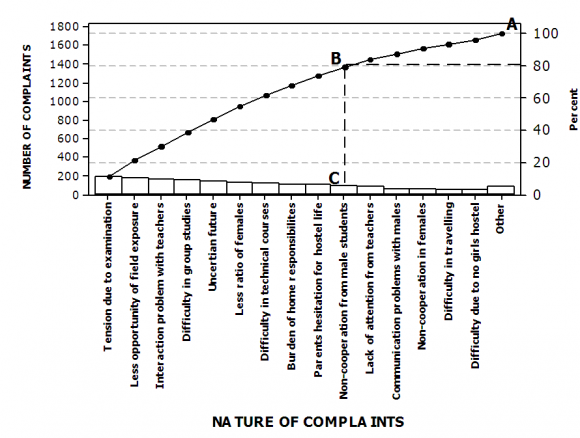
Pareto analysis e.g. was used to separate factors that were responsible for 80% of the complaints from those creating just 20%. In the present analysis, a criterion of complaint was fixed at any of the three points in a five point scale indicating normally, distinctly and very much part of the life. In this manner, total number of complaints against each question was numbered. These complaints were arranged in a descending order and then subsequently plotted in the same order as shown in Figure 1. A cumulative line of these complaints is drawn to cut the right vertical axis at point A. Vertical distance between point A and Xaxis is divided into 100 equal parts. Then, a horizontal line is drawn starting from the point of 80% to cut a cumulative line at point B, which defines a vertical line meeting the X-axis at point C. Figure 1 shows that ten factors that are located on the left of point C are responsible for 80% of the complaints, whilst remaining seven are creating just 20%.
7. Global Journal of Human Social Science
Volume XII Issue W X Version I
( D D D D ) A 2 308. Year
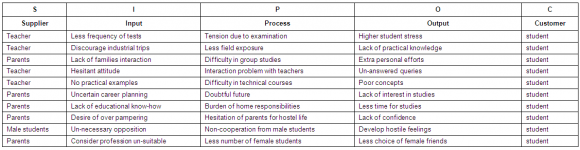
Further probing the six complaints, SIPOC diagram, e.g. , tailored in Table 1is used. Inputs are responsible for creating any change in the corresponding process, whilst outputs are the indicators of that change. Suppliers are responsible for creating the inputs and customers are the recipients of their outputs. In this manner, Table 1 gives the absolute picture of the ten processes along with their inputs and outputs that are mainly responsible of producing and observing any change in them.
Cause and effect (C&E) matrix, as shown in Table 2 uses the inputs and outputs of SIPOC diagram that are outlined in second row and second column respectively. A ranking scale is assumed to correlate inputs and outputs as follows:
No correlation Remote effect Moderate effect Strong effect 0 1 3 9
Appropriate correlation values are shown in Table 2 and are resultantly summed up in the last row and last column. Results indicate that higher stress among female students with 84 points is the best indicator to observe any change in the inputs, because of its strongest link with them. Similarly, the two inputs of teacher's discouraging attitude to take girls on industrial trips and their lower frequency of taking the class tests with the respective totals of 63 and 66 are responsible for producing maximum affects in the output.
Scatter plots are used to see the relationship between two inputs and an output, in which, student stress level of the whole questionnaire is plotted on the vertical axis and the corresponding stress levels of the two individual questions are shown on X-axis. Straight line is drawn to show their mean values in Fig. 2 (a, b). Positive relationships are witnessed between the student stress and the two factors of discouraging industrial trips and lack of class tests, which means that any change in these factors is capable of producing the reciprocal change in the stress level of female students. However, further probe to see the strength of relationship between student stress and the two factors with the help of Pearson correlation coefficient reveals the following: 1. Teachers' discouraging attitude to take girls on industrial trips -0.815 2. Teachers' lower frequency of assigning class tests -0.826 This indicates that teachers' discouraging attitude to take girls on industrial trips and their less frequency of taking class tests have the strongest effect on the stress level of female engineering students.
Although, these findings are context specific and look more applicable in the same environment from which they are extracted, however, countries who share common cultural and social traditions can also benefit from them.
In Pakistan, it is customary that girls who have completed their education spend most of their time at home. This practice reduces their encounters with real world problems and as a result they do not feel confident in their decision making capabilities. Under these circumstances, any further loss of opportunity to see work in industry not only brings distress to them, but, also minimizes their chances of becoming a knowledgeable engineer. Due to this constant marginalization and fear of entering an unfamiliar environment, depression deepens and anxiety heightens among them. Besides this, thinking of failure in examinations also makes them nervous. The situation becomes more complex due to lower frequency of class tests, which does not give them ample opportunity to test their level of preparedness for final examination. It is thus imperative that teachers should improve the confidence level of these students by regularly conducting tests and quizzes. Similarly, frequent industrial trips not only provide an opportunity to groom their personalities but also make them ready for any upcoming challenges.
9. VI. Conclusion
The present study highlights that teachers' lower frequency of class tests and their discouraging attitude to take girls on industrial trips are the factors that are responsible for producing maximum stress among the female engineering students. Although socio-cultural traditions of Pakistan discourage women to openly interact with men, however, any disparity at the time of basic engineering education tends to create permanent vulnerability among these female students. Similarly, irregular class tests along with the non-interactive behavior of teachers also keep these girls unaware of their capabilities to perform at the time of examination. Nowadays, when many girls are being admitted in the engineering universities of Pakistan, it is mandatory that the educational leadership of these universities should do some thing concrete to reduce these stresses, which, subsequently enhances the credibility of engineering education in Pakistan. Table 1 : Ten critical complaints are indicated as processes. Stake holders of these processes are suppliers and customers, who are responsible for creating inputs and receiving outputs respectively. This page is intentionally left blank