1. Introduction
uman resources management or personnel management as a part of the organization is very crucial to run an organization. This department or part of the organization is responsible to recruit prudent personnel for the organizations. It is also responsible to arrange training facilities for employee development, promotion of the personnel, and transferring so that they can operate the organization efficiently. The HR department is also responsible to make a good relation between employee and employer and this congenial relation helps to achieve the organizational goal and individual goal (Legge 1995;Armstrong 2006). Human resource management helps to improve individual performance through a systematic process within the organization (Tahiri et al. 2020). Even, it also helps to improve organizational performance in the long run. The shift from management to Human resource management was momentum in a sense that emphasizes creating a better understanding between the organization and employees. Thus, managerial actions can easily be accomplished resulting in achieving organizational progress (Nielsen et al. 2011).
In the 1980s Bangladesh for the first time has entered the circular mobile phone era. To meet the need of the huge population of Bangladesh, the government has opened the door for the telecom market for national and multinational companies. In 1989, Citycell started its operation for the first time in Bangladesh being 3rd mobile operator in South Asia. That time only Citycell mobile phone operator was monopolized their business in the mobile telecom business and operated their business with a limited number of the subscriber. As a result, they could not face any big problem to operate their business. But, with time, the number of subscribers was started to skyrocket and the new multinational mobile phone operator like Grameenphone has started to operate their business in Bangladesh. At the same time, the mobile phone company had to increase their personnel as the number of users has increased rapidly. So, they had to think differently.
The study has evaluated the existing status of Human Resource Management in the telecommunication companies of Bangladesh. Further, it emphasizes identifying the career opportunity of the employees in the telecommunication companies of Bangladesh. The paper finally identifies some challenges to applying human resource management policy in the companies' accomplishment.
2. II.
3. Literature Review
In recent times, mobile companies have been a key factor to enhance the scale of economies all over the world. Gradually, the demand for this sector has raised intensely resulting in keeping the impact on the overall economy (Asogwa et Rashid & Elder (2009) highlight the significant contribution of mobile telecom industries in the competitive environment. The mobile industry had a significant contribution that is helping a country to get a competitive advantage. Employees of this sector require high skills, technical knowledge, and capacities. Employees' satisfaction is highly required in the telecom sector that helps to expedite organizational performance. Telecom companies should emphasize formulating a competitive marketing policy for getting a competitive advantage. Shah, Biswas, and Qayum (2006) emphasized initiatives of public and private telecom industries in Bangladesh. Both these sectors took lots of initiatives and measures to improve the overall condition in the market economy. But this sector is multifaceted with series of complexities including inadequate connectivity, limited network transmission, and so on. Thus, these telecom industries are getting lag behind. To over this problem, the study recommends allocating more funds to the annual development program. In this way, this sector can get more technical facilities.
Akhter & Jahan (2020) in their study identified that the telecom sector has contributing to accelerate the economy in Bangladesh and helping to ensure digital Bangladesh. Science the beginning of the telecom business has been helping to digitalized the government and private services (such as mobile financial services and government utilities services) and make the services easier, user friendly, and door stops. It has also been working to find the knowledge gap and making a bridge to make a bridge between the service provider and service recipient. As Bangladesh has a huge population and day by day the per capita income has started to increase, the new multinational mobile phone like Grameenphone limited company, a Norwegian based multinational giant, has started to operate their business in Bangladesh with the assistance of Grameen Bank. At the same time, the Bangladesh government is taking a huge amount of money from the mobile phone operator based on their revenue as the number of mobile subscribers is skyrocketing. The mobile services have ensured inclusiveness in the service delivery process by providing various information, news, facts, and happenings. Thus, users are easily getting access to various services very fast in Bangladesh.
As we have discussed that the HR department is the crucial part of any organization to run the business, the mobile phone company is not different from the other. Hossain (2019) has studied and analyzed Grameenphone and Teletalk so that the study can understand the practice of human management of these two companies. The study found that the Grameenphone mobile operator becomes the number one top mobile operator in terms of their number of subscribers and their financial profit over the period. At the same time, this multinational company becomes one of the topmost companies for the employment generation and it's become one of the lucrative companies among the Bangladeshi young fresh graduate. On the other hand, Teletalk, only one government-funded mobile operator is the least company in terms of the number of subscribers, financial profit, and the number of employees is operating their business without making any profit. At the same time, the male-female ratio of the employee is very high between the male and female employee in the Teletalk. But both of the companies have a very good image in terms of corporate social responsibility. However, Grameenphone has done very well with the assistance of very qualified personnel and the HR department is playing a crucial role to operate their business and hold the first position in the mobile phone company in Bangladesh. However, GP has an outstanding performance in profit-making which is increasing day by day. In contrast, the opposite picture of profit-making is seen in the case of Teletalk limited. One important thing is that both the companies have failed to comply with the codes of ILO and Labor Law of Bangladesh (Rahman 2010; Islam 2012).
4. III.
5. Conceptual Framework
Communication is a two-way relationship between two parties to give a particular message (Caldwell & Gulbrandsen 2019). In every organization, it is required to keep better relations between superiors and subordinates (Karma 2008
6. Research Question
The primary question of the study is as follows: a. What is the existing status of Human Resource Management of Telecommunication Companies in Bangladesh? Besides, there are some secondary questions as follows: b. What is the existing promotion and remuneration system? c. To what extent, the telecommunication companies provide incentives to the employee?
V.
7. Research Objective
Besides, primary objectives, there are some specific objectives:
8. To analyze the existing status of Human Resource
Management in the telecommunication sector of Bangladesh 2. To identify the career opportunity of the employees in the telecommunication sector of Bangladesh.
VI.
9. Methodology of the Study
The study has obtained data from both primary and secondary sources. Primary data for the study has been collected using Survey Method including interviews and questionnaires. The questionnaire is composed of both close and mixed ended. The study has included close-ended questions so that relevant data can easily be arranged. Besides, some openended questions would have helped to get detailed answers to the question. The questionnaire has been administered to a total of 115 employees in the telecommunication sector. The study has adopted Cluster sampling, Random sampling, and multi-stage sampling. After clustering, GrameenPhone, Banglalink, Robi & Airtel have been taken into account to collect data. Random sampling has been followed here in selecting employees from telecommunication organizations.
10. Evaluating
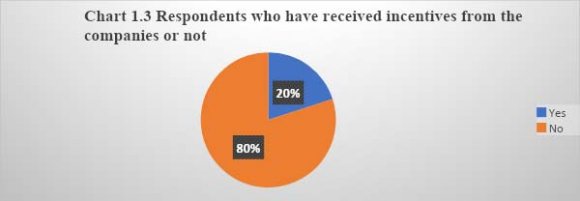
Human Resource Management of Telecommunication Companies 20% of respondents replied that they did not get incentives. One of the respondents said his views-"Companies recruit employees through outsourcing. I am enrolled here as an outsourced employee. Company does not give me incentive."
11. ? Career Opportunity
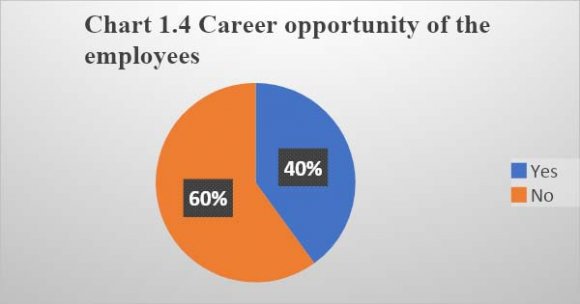
Career development is an integral part of Human Resource Management. Without the flourishing career of the employees, the performance of the organization cannot be promoted easily. Employees have been asked whether there exists any career opportunity in your respective organization.
12. Chart 1.4: Career opportunity of the employees
Chart 1.5: Support of the organizations to employees 60 % employees opined that career opportunity does not exist in the respective organization. They said that they received preliminary training while joining the organization. After that, the training session was hardly conducted. The rest of 40% viewed that they have the opportunity to promote their career.
To promote the career of the employees, the support of the organizations is highly important. Employees responded to what extent they receive support from the organizations. Chart 1.5 shows that 44% of employees got a moderate level of support from organizations. 38% opined that they had high-level support from organizations. 16% opined that they had received low and very low-level support from organizations.
13. ? Promotion
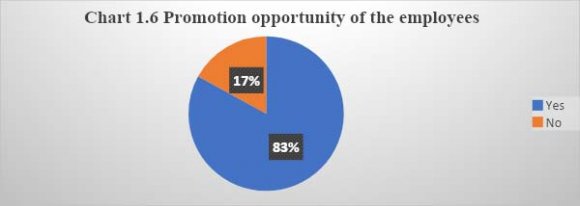
Promotion is an important issue to promote Human Resource Management. Employees were asked whether they got their promotion timely. 83% of employees replied that they did not get a promotion timely. According to them, various issues impede the smooth promotion process in the organizations like proper promotion guidelines, limited job vacancy, limited recruitment, etc. Only 17% opined that they got a promotion on time.
Public sector organization is getting puzzled with bureaucratic complexities that are found in case of teletalk. There are not any promotion policy guidelines in the telecommunication organization. Teletalk being a state-owned organization has promotion rules to follow but these rules are not being practiced effectively in the organization. If the promotion policy is not structured, the organization will not get proper talent who have the qualifications to contribute to the organization.
One employee got a promotion and shared his experience:
"I got a promotion very fast from my organization. I did better perform in the organization and received the best employee award. As a result, it was an easy issue for me to get a timely promotion. Otherwise, it could have been difficult to proceed in the future. I admit it is not very easy to get timely promotion for all the employees. The organization is very strict and follows hard rules regarding the promotion of the employees.
In that context, a smooth promotion process is quite impossible to continue in the organization".
Opposite experience of an employee has las following as:
14. Conclusion
To improve the HRM status of the telecom companies, there is a need to bring change in the existing system. At first, the organization needs to formulate promotion guidelines so that employees are attracted to stay in the job. Besides, a better communication system is highly required with maintaining flexibility. Rules and regulations are needed to be flexible to run the activities of the organization. The remuneration system needs to be systematic so that employees are fascinated to stay in the job. In the context of Bangladesh, the rules and regulations of the telecom companies are moderately flexible. In the case of promotion, employees do not get timely promotions whereas top management gets their promotion easily. As a result, employees find very difficult to get career development opportunity in the telecom companies in
| 32 | ||||||
| Volume XXI Issue II Version I ( ) | ? Rules, Remuneration Regulations, Rules and regulations are highly imperative in a safety issues and business organization. Flexible rules and regulations are important to promote human resources in the organization. Employees were asked to what extent rules and regulations are flexible to promote the organization. 18% Chart 1.8: Access to basic facilities of employees from the companies. 32% 44% expect to get expected remuneration. Chart 1.9: VII. 15% 20% 25% 30% 35% 40% 45% 50% Employees | |||||
| 0% 5% 10% | Chart 1.7: 6% very high | High | Moderate | Low | 0% Very Low | |
| Chart 1.8 Access to basic facilities of employees from the | |||||
| companies | |||||
| 45% | 40% | ||||
| 40% | |||||
| 35% | |||||
| 30% | 28% | ||||
| 25% | |||||
| 20% | 18% | ||||
| 15% | |||||
| 0% 5% 10% | 8% very high Chart 1.Volume XXI Issue II Version I 6% High Moderate Low Very Low | ||||
| 45% | 40% | ||||
| 40% | |||||
| 35% | |||||
| 25% 30% | 24% | 24% | |||
| 20% | |||||
| 5% 10% 15% | 8% | 4% | |||
| 0% | |||||
| very high | High | Moderate | Low | Very Low | |