1. INTRODUCTION
n the case of preservation or conservation, the heritage mainly refers to the cultural heritage of any country. That cultural heritage includes both natural and human-made elements. Cultural heritage implies artifacts (paintings, drawings, prints, mosaics, and sculptures), historical buildings and monuments, as well as archaeological sites that remind of our roots, our past, our previous generations, and our cultures. Artifacts are mainly different types of drawings, mosaics, paintings, and sculptures. Rajshahi is a city with a large number of heritage sites. But the urban heritages of the central cities are difficult to protect due to rapid urban development and redevelopment program. Besides increasing land values due to infrastructural and property development causes constrain and conflict with existing heritage existence [1] Puthia Rajbari complex is a palace in Puthia Upazila that has been built in 1895 for Rani (Queen) Hemanta Kumari that is the best example of Indo-Saracenic Revival architecture [14]. This establishment is spread over a large area in Puthia Upazila and has so many distinct structures with a particular identity. The site is consisting of a cluster of notable Hindu temples as well as a large number of historical temples in Bangladesh [4]. Among them, Hawakhana is one of the most attractive structures that has been used as a recreational place and places to spend leisure time by the king. The actual location of the structure is 3 km west of the main palace complex at Tarapur village in Puthia Upazila. This structure has an immensely pleasant and artistic view of both natural and architectural perspectives. Due to privatism and encroachment of the local people in this area the structure is under threat of demolition. So, the main aim of the study is to conduct an inventory survey showing the potentiality and the underlying intimidations that may cause the demolition of the structure. It also provides some policy guidelines that keep harmony with the present policy guidelines.
2. II.
3. LITERATURE REVIEW
Urban heritage sites in central cities are one of the most vital parts of the city. But it is most difficult to protect because of large scale rapid and urban (re)development [1]. It is much more difficult in rapidly growing countries like Bangladesh. With growing land value, increasing heritage value often remains unrecognized.
Faster population growth and infrastructural development often create constraints on the way of heritage preservation.
But the thing is, heritage sites create a connection between built and live heritages that influences on the national identity of any country to the tourists [7]. That's not also all, even though developing and preserving urban heritage with new development is only the way to achieve a sense of place in any area [8]. Although the idea of conserving and reusing historical buildings comes during the last decades, structural problems are one of the major problems that cause a great disturbance to the safety of the buildings and peoples [10]. To achieve the desired goal, funding and relevant policies are equally important to continue any conservation project [9].
Demolition of any historical buildings or heritage sites is a threat to the present and future generations because it removes the place significant and historical values of the area [4]. Location of the heritage site as heritage buildings at the central areas are more vulnerable to demolition [1] Awareness related to heritage values was mainly related to the monumental values of any site in 19th century [11]. Diversification and expansion of cultural tourism is experiencing in I Volume XX Issue IV Version I recent years [12]. And the satisfaction of tourists depends on four dimensions. These are information, attraction, environment, staff, and access [7]. Besides, increased facilities and services are also more effective to improve the tourist's satisfaction level [7].
Historical and archeological tourism is one of the major attractive and lucrative businesses across the world [13]. And the participation of different kinds of organizations always seems useful to the value-based management of the historical places in an international context [6]. So, having multiple agencies as like nongovernmental and self-financing over the government agencies shows a potential ability to increase the heritage value through the development of any heritage area [9].
4. III. METHODOLOGY OF THE STUDY
This study is a descriptive study that includes both primary and secondary data as well. The collection of primary data follows a Triangular process that includes structured observation, key informant surveys, and expert opinion surveys as well. The structured observation was used to collect existing physical information's about the heritage site as a less amount of data regarding these is available. Besides field observation is also helpful to collect the latest pieces of information also. Secondary data was collected from different journals, articles, and online publications as well. The key informant survey helped a lot to know the actual history of the place. And Expert opinion surveys helped to create a bridge among all of the colled primary and secondary data as well. In fact, it also helped to make the research more reliable and valid.
5. IV. STUDY AREA LOCATION AND ACCESSIBILITY
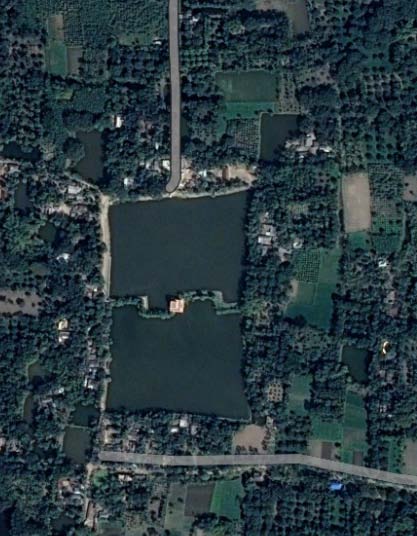
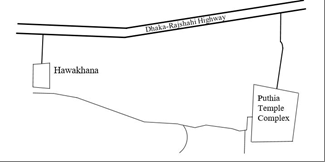
The geographical location of the Hawakhana is within 24 0 -37' and 24 0 -22'-15.99" N Latitude and within 88 0 -81' and 88 0 -48'-51.09" E longitude. The structure is located at the Tarapur village of Puthia upzila. It is about 3 km west of Puthia Raj Bari complex and accessible with van. On the other hand it is about 1 km north of Tarapur Mor from Dhaka -Rajshahi highway which is accessible by van or by walking.
6. HISTORICAL BACKGROUND
The exact establishment period of the structure is unknown but it can be assumed that it has established in the same period after the establishment of the Puthia rajbari and the temple complex. The history of the use of the structure is more or less known to all of the Tarapur village. It has been heard that the kings of the palace used to come to the Hawakhana via horse riding and loved to feed the fishes and spent their leisure time. The kings also enjoyed boat riding on the ponds that were much more attractive to them. Hawakhana was not only used for the local king's recreational purposes but also used as a place for the recreational activities for the kings coming from the other kingdoms.
As far as known from the inventory survey, the last user of this building was King Noresh Narayan Roy. At the time of the partition of the Bengal kingdom, Noresh Narayan left Bangladesh and went to Kolkata. At that time, he divided the ownership of the Dighi between two of his servants named Goni Mondol and Deljer Mondol. As a result of this, the Dighi had divided into two portions by inhibition. At present, an aesthetic road has been constructed on the west part of this inhibition.
7. EXISTING PHYSICAL CONDITION OF HAWAKHANA
Hawakhana is a 3 storied building structure surrounded by a Dighi. The ground floor is underwater. The second and third floor is above the water level of the Dighi. The approximate area of the Dighi is about 80 acres. There is a connected road on each of the east and west side.
The main structural elements of the building are "Chun-shurki" and a layer of brick. The length of this building is 45 feet and the width is 42 feet. The door and windowless ground floor are underwater. On the first floor, there is one door on the west wall and three doors on each of the other three walls. That is a total of 10 doors on the first floor. There is also a 6 feet wide veranda in this building. A three feet staircase is there for the entrance of the first floor. There is no door on the west wall of the first floor, but on the other three sides, there are three open doors. A 6 feet wide veranda is surrounded by four sides of the first floor. The third floor is not open to general people. An about 100sq feet Bath place is there on the ground floor. For the entrance in bath place, there are seven doors on each of the four sides of the ground floor. At present, it is filled up with soil. WHAT WILL BE APPROPRIATE FOR THE HERITAGE SITE-HISTORICAL PRESERVATION OR CONSERVATION?
Heritages are somethings that help to keep up the own identity of any nation or any county. Both preservation and conservation are necessary for any cultural heritage in different cases. Preservation is to maintain and preserve the heritage at the present stage, where heritage conservation is the contrast of preservation which allows the sustainable use and management of the present condition for the future over the period. So, we don't need historical preservation but we need building conservation, more appropriately heritage conservation. And heritage conservation can be used as the best planning scheme based on the inherited culture and cultural value of the place. Again, cultural heritage plays a crucial role in SDG 11 as it is the main goal dedicated to the sustainable development of the cities. This goal aims to protect and safeguard the world's cultural heritage.
In the case of Hawakhana, as it is an old establishment and because of the privatization of the property, the structure is at the risk of demolition. The uniqueness of the structure has faded away because of the open-access of the local people into the structure. One of the main attractions of the structure that is the wide and attractive waterbody (Dighi) has lost its attractiveness because of the division of the waterbody. As the water body is now used for fishing purposes the main intention of excavation of the waterbody has faded away. And the natural elegance of the heritage site is on the way to lose. So, conservation is a must needed for this heritage site. In this respect Md. Fakhrul Alam, Planner, Urban Development Directorate (UDD) shared his experience of historical building conservation planning in the Rajshahi city area and also supports conservation techniques to maintain the historical value of these buildings with growing urban development.
8. VIII. PRESENT ATTEMPT TO THE PRESERVATION OF HAWAKHANA
Over the years, the deterioration of any structure is a natural process. As the structure is almost 3 km far away from the main Puthia Temple Complex and the structure has less connectivity with the main complex, so the popularity of the structure remains unknown to most of the visitors. For many of the years, the building remains unused with no cares. In recent times, the government has taken the venture of reconstruction and improvement of the Puthia Rajbari and Puthia Temple complex. In this process, the Hawakhana complex has also started to be improved and reconstructed. Research assistant of the Archeological department Shawl Talukder informed that 22 lakh taka cost for the improvement and redevelopment work of this building and a cost of 15 lakh taka used for the construction of the new road that connects the entrance of the Hawakhana complex with the existing road network of the area. The construction work has finished at the end of 2015.
9. IX. OVERVIEW ON CONSERVATION AND REHABILITATION OF HISTORICAL AND CULTURAL HERITAGE ACT
This act is mainly a part of the Bangladesh national Building Construction Act, 2012 that is clearly stated as Chapter 3 of this act document. According to the Act, Building, place, or landscape representing any cultural, historical, religious, or spiritual values is a part of social life as well as community pride. So, a strike balance between the present development and heritage conservation is must needed. But being eligible for conservation or rehabilitation any space or structure must fulfill the criterion defined in the Antiquities Act of 1968.
Conservation or rehabilitation projects must go through some major processes like Identification, Categorization, Chronology, Documentation, and Community Participation. The act also clearly states that in case of adaptive reuse of any structure, original elements of the buildings must not be destroyed. Again, in case of the development of any heritage site the development must not be contradictory with the present heritage. A logical consequence with the requirement of the region must be maintained. Great consideration should put in case of selecting building construction elements. In case of partial development or decoration of any buildings, the rules are almost the same as well.
10. X. POLICY RECOMMENDATION AND CONCLUSION
There are currently no official cultural policies in Bangladesh. The different departments under the ministry of cultural affairs perform various activities and practices to preserve and maintain the cultural heritage of Bangladesh. These practices are coined as "cultural heritage preservation policies" [2].
The practices of these cultural policies are not commonly used for any official purpose. Most of these departments have been created or recreated with a changed character after the liberation war of Bangladesh. Naturally, there had been continuous changes and some major modifications and development works took place in the infrastructural facilities and also in its activities until today, and funding patterns also changed accordingly [2].
Among all the departments of cultural policies in Bangladesh, the department of Archeology is working intending to preserve all archeological sites in Bangladesh. This department is responsible for the excavation and re-excavation of the site, to declare the site as a place of historical interest with all the responsibilities of the maintenance and preservation of the site.
Beyond the running activities of the archeological department, a large number of steps should be taken to ensure the perfect conservation and long-term sustainability of the heritage site. Some sorts of steps can be -1. Active participation and involvement of the local community in all aspects of the development and implementation should be ensured. Open access to the building site should also be restricted for the long-term durability of the structure with the perfect elegance. 2. A special committee should be formed with the city development authority, Paurashava authority, and persons from other related fields which will work in collaboration with the archeological department and the local community for the redevelopment and conservation of the heritage site. 3. Having higher potentiality as a tourist spot this site has a lower tourist attraction. So, special attention should be given to developing the site as an attractive tourist spot. 4. Although the site has good connectivity with the Dhaka-Rajshahi highway, another strong connectivity should be created with the main Puthia Raj Bari and Puthia Temple complex. Supportive facilities like information centers, food court, and other support facilities should be provided for the visitors.
All of the information's about the current situation of the heritage site and different types of heritage laws represent the potentiality of this site regarding a vibrant heritage site development. The present physical condition of the heritage site is overall good. But connectivity with the main temple complex and facilities for tourists like safety, security is very much poor. Besides, because of the privatization of the ponds is also responsible for decreasing tourist's attraction to this place. so, the responsible authority must take proper steps regarding making this place as a great tourist place with all types of facilities as well.
First of all, we are highly thankful to the Almighty for the successful completion of this research. We are highly thankful to all of the participants who helped us by providing different types of historical information regarding the heritage site. We specially want to thank Most. Asma Khatun for her cordial help at the time of field survey and the data collection. We are also thankful to the present owner of the heritage site waterbody who permitted us to survey the whole area in detail and also provided a lot of information. And finally, our kind thanks go to the experts who helped us to make our research more valid through their valuable opinions and shared experiences.