1. Introduction
Today, after more than a century of electric technology, we have extended our central nervous system itself in a global embrace, abolishing both space and time as far as our planet is concerned.
-Marshall McLuhan, Understanding Media, 1964. oday we live in such a world which is defined as a 'Global Village. ' Modern technology and the internet are the key drivers, and the major force of global village. Hence the world is now in our grip like smartphone. The internet connects the world and makes the world like a village. Technology and the internet introduce us to a new world as well, which can be referred to as 'Virtual Realm.' Social media like Facebook, twitter, WhatsApp, youtube, and other new media, blogs, online news portals are the platform of the virtual realm. This new media creates an artificial world where we are living now. Specially Facebook and youtube contribute greatly to create this artificial but virtual realm. Among 7.7 billion (worldometers.info: 2019) world's population, over 4.39 billion people are active internet users, encompassing 57% of the global population. The internet users are increasing gradually. In Bangladesh, Internet users are retroactively increased at present. The total number of Internet subscribers has reached 98.136 million at the end of August 2019, where 91.348 million Internet users were in December 2018 (BTRC: 2019). But most of the internet users use the internet for using Facebook. As of June 2019, there are an estimated 2.4 billion monthly active Facebook users, among whom 1.6 billion daily active Facebook users worldwide (dustinstout.com: 19 October 2019). In Bangladesh, the number of social media users is 34 million. Among them, 33.713 million (96.04%) is Facebook users, whereas 0.67 million (1.98%) visit youtube. The majority of them are men 73.8%. The young generation aged 18 to 24 is the largest group (15.6 million) of Facebook users (statista.com: 19 October 2019). Most of them are young adolescent college or university going students. Facebook is the highest and frequently visited new media in Bangladesh. On average, 10 minutes, 57 seconds are spent by the viewers of this site (alexa.com: 20 October 2019). As Facebook is a widely used social media in Bangladesh, it is used as a great platform for spreading fake news in Bangladesh. Facebook has a great impact on overpopulated countries like Bangladesh. Facebook is the most popular social network in Bangladesh. In Bangladesh, almost all internet users use Facebook regardless of age, gender, locality, or ethnic identity. Nowadays, Facebook becomes an integral part of daily activities. Alongside, Facebook is being used for social Communication, knowledge and experience sharing, and business purposes; for spreading fake news and rumors at supersonic speed towards mass people. Fake News: Conceptual Clarity Fake information can be defined as the 'deliberate creation and sharing of information known to be false' (Wardle: 2017). Fake news is more dangerous to society. 'Fake news,' which, according to former US president Barack Obama, creates a 'dust cloud of nonsense,' has become one of the most popular 'sociopolitical topics' in the world right now, thanks to the rapidly growing social media presence across the cultures. Fake news is 'false, often sensational, information disseminated under the guise of news reporting' (Collins English Dictionary). Fake news is to be news articles that are intentionally and verifiably false and could mislead readers (Allcott and Gentzkow: 2017). So fake news can be defined as a news article or message which is published and propagated as false information regardless of meaning, and sometimes which has a motive behind it. The upsurge of technological advancement, especially social media, has paved the way for spreading fake news. The virtual realm spurs fake news as per the speed of air. Nowadays, fake news has been one of the major social problems in the world along with Bangladesh. But the idea of fake news isn't new something. The world faced the crisis of spreading fake news during World War 1. But today, self-seeker groups use fake news as an 'atomic arsenal' to disseminate their popular rhetoric with supersonic speed for fulfilling male purposes. Fake news is usually rampant during any crisis, elections, and even campaigns. The hoaxers and fakers exploit the opportunity of the wavering psychology of the social media users, and fake news becomes 'viral' on social media, Facebook. But society suffers much for spreading single fake news. Recently Bangladesh has faced several acute crisis of spreading fake news during the 'Movement of Nirapod Sarak Chai, 'National election in December 2018' and very recent 'need child's head for Padma Bridge.' Borhanudding, Bhola incident is also the worst example of spreading fake news in Bangladesh.
2. III.
3. Purpose of the Study
Social media has a direct impact on the society around the world including Bangladesh. But the influence of social media, especially Facebook, in Bangladesh, is severe as a densely populated country. New media and online journalism immensely arise worldwide due to the internet. Besides, Facebook, twitter, youtube, others new media like WhatsApp, messenger, and online news portals have also led to the proliferation and spreading of fake news. The main objective of this paper is to explore the social impacts of spreading fake news through the virtual realm and identify the reasons for spreading fake news in Bangladesh as well.
IV.
4. Methodology
This paper is based on secondary literature and data collected from different dailies, online sources, and research papers. Besides, it has been screened social media to observe how fast fake news gets spreading in the virtual realm during the different social crises. Some Facebook posts are also collected as data to see how people become distracted by the fake news and play a role in spreading fake news without knowing its' authenticity.
V.
5. Global Scenario of Fake News
Spreading fake news is a problematic global phenomenon that becomes the cause of worry of global leaders. People are suffering a lot worldwide due to fake news. Even technological developed country like the USA also suffers much for spreading fake news. The people of the USA believe in fake news unknowingly and become disconcerted by fake news where the literacy is very high (100%). This fake news are spreading through the virtual realm as people are habituated to digital media like online news portals, Facebook, Twitter, LinkedIn, Instagram, and Youtube, which are free of cost. According to Pew Research Group (2017), roughly 93% of people in the USA get their news online (either via mobile or desktop) circulated through social media, especially Facebook and youtube. Recent researches on the USA President Election 2016 show that most popular fake news stories were more widely shared on Facebook than on the other popular mainstream news media. In 2016, most discussed fake news stories in USA tended to favor Donald Trump over Hillary Clinton (Silverman: 2016). The alarming thing about spreading fake news is that many people who see or read fake news stories report that they believe them (Silverman & Singer-Vine: 2016). Evidence shows that the consequence of fake news not only helps Trump to win but leads to the death of common people. In October 2017, a slightly distorted news titled headline "FBI Says Las Vegas Shooter Has Connection With Daesh Terror (ISIS) Group" about the Las Vegas massacre became viral on Google and Facebook, which killed at least 59 people and injured more than 500 people. This fake news was spread by Russian propaganda site Sputnik, the internet's largest news platform, which failed to manage spreading misinformation. Later, Sputnik removed this article and replaced it with a story making the opposite claim -"FBI Says Las Vegas Shooter Has No Connection With Daesh Terror (ISIS) Group" without acknowledging its original false story" (Kathleen Chaykowski: 2017). The global community worries about fake news as it is a growing concern. In 2019, lpsos conducted a poll on fake news in Canada. The lpsos poll for Global news reveals 90% of Canadians admit to falling for fake news (Connolly: 2019). Most of the
6. Global Journal of Human Social Science
Canadian (almost 71%) worry about Fake news (Cain: 2019).
Asian countries have not been immune to the fake news phenomenon. As reported by Russel Goldman in New York Times (2016), a hoax story reported in December 2017 spread the threats of nuclear war between Pakistan and Israel. It caused panic in the streets of Pakistan (Nagi: 2019). A horrible scenario caused by fake news can be seen in India. Besides Facebook, WhatsApp contributed a lot to spreading fake news in India and made a massacre result. WhatsApp, which has more than 200 million users, the biggest market of the messaging application in India, has already made a huge mess in the country as at least 30 people fell victim to lynching due to the circulation 'fake news' through the WhatsApp since January last year. BBC's research finds that Indians are 'reluctant to share messages which they think may incite violence, but they feel duty-bound to share nationalistic messages.' 'Fake news stories regarding India's progress, Hindu power, and revival of lost Hindu glory are being shared widely without any attempt at factchecking,' said the BBC researchers (Islam: 2019; Prothom Alo English). There are more than 50 documented cases of mob violence triggered by misinformation spread over social media in India in the last two years. Many platforms, including Facebook, YouTube, and Sharechat, a vernacular language social media start-up and app, play a role (Roy: 2019). In 2018, India was shaken by a spate of mob killings sparked by a hoax about child kidnappers spread on WhatsApp. In just two months, 20 people have been murdered in mob lynching due to the spreading of rumor of child kidnapping but officials and social media platforms have so far been powerless to stop the violence. Many victims in other vigilante killings, such as those over child kidnapping rumors, are targeted because they are outsiders (AFP, New Delhi: 2018). The rumor of child kidnapping can't be stopped but continuing in India. On 22 August 2019, a mental challenge was pinned down on his stomach in Banda, Uttar Pradesh, suspecting him a child kidnapper. The rush of rumors of child-kidnapping and offline instances of violence over a six-week period found the police grappling for solution. Like Banda, Bundelkhand, Chhatarpur, Chitrakoot, and in many other districts of Uttar Pradesh, India, a roughly estimated over 100 incidents of mob violence due to child lifting rumors, in August alone in the state. According to data from IndiaSpend, there have been more than 33 cases of murder and over 99 cases of attacks triggered by rumors of child kidnapping between 2017-18 (Lahariya: 2019).
7. VI. Impact of Fake News in Bangladesh
Bangladesh suffers much for fake news. Facebook is the most used and popular social media in Bangladesh, and becomes a widely used tool for spreading fake news. Among the 163.6 million (2019) population of Bangladesh, almost 33.713 million people use Facebook and some have multiple Facebook IDs. Even some Facebook ID is opened only for the purpose of spreading fake news. The problem of spreading fake news is acute in Bangladesh during the crisis. Sometimes, a crisis moment has been created by spreading fake news through Facebook, which is the fastest medium to reach a maximum audience. Facebook has direct impact on our society. Even some Facebook centered movements have already occurred in Bangladesh indicating the direct impact of Facebook on our society. Such 'Ganojagoron Mancho' in 2013 and recently 'road safe movement' are the result of Facebook. Fake news has a seasonal outbreak too. Fake news is usually rampant during any crisis, elections, and even campaigns. The hoaxers and fakers exploit the opportunity of the wavering psychology of social media users (Islam: 2019; Prothom Alo English). Bangladeshi young generation who use Facebook is suffering from a viral virus. Fake news becomes viral with a supersonic speed and its' impact on society like an 'arsenal atomic bomb.' Some incidents happened for fake news has been illustrated to show the impact of fake news, which creates massacre and causes to death many innocent people.
8. a) Borhanuddin, Bhola, 20 October 2019
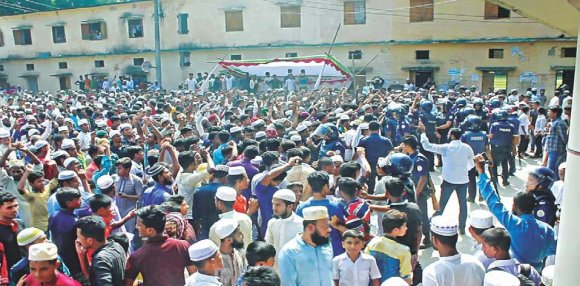
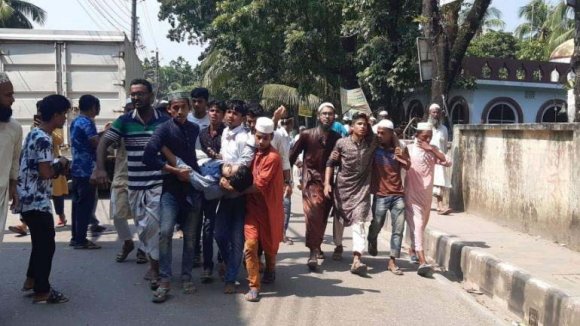
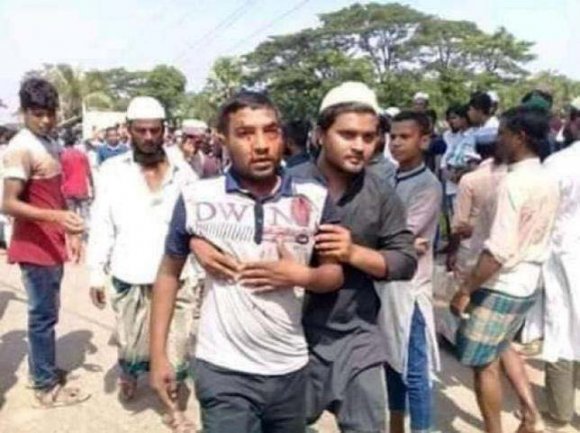
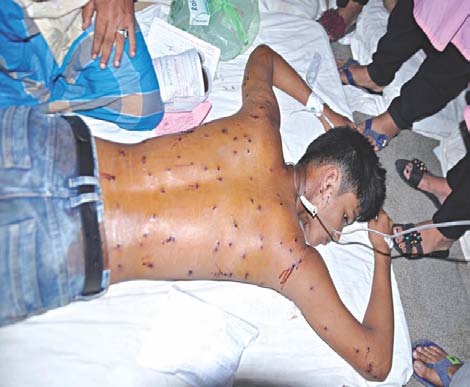
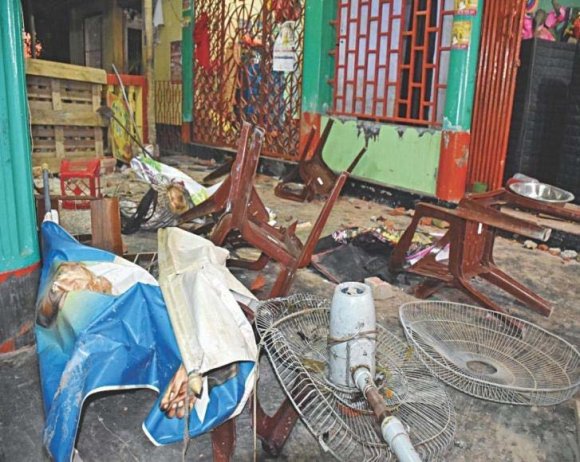
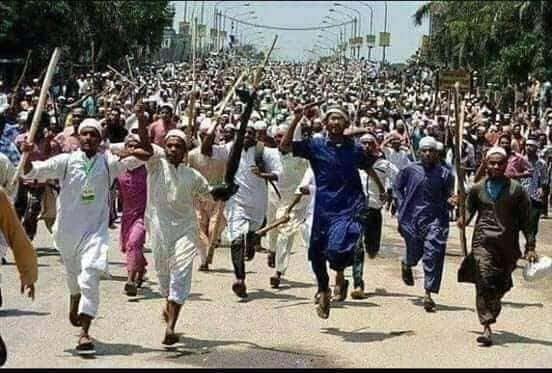
Very recently on 20 October 2019, a clash between villagers and police over an unverified Facebook post in Borhanuddin, Bhola. The clash is triggered by a Facebook post. The unwanted and unfortunate result of this clash is 4 people were killed and more than 200 others injured (20 October 2019; Prothom Alo English) including ten policemen (20 October 2019; bdnews24.com), and one house was torched and 12 more belongings of Hindu community were vandalized (21 October 2019; Daily Star).
A post from Facebook ID of Biplod Chandra Shuvo containing derogatory remarks about Allah and Prophet Muhammad (S) went viral on Facebook, triggering condemnation and protests. Hundreds of villagers gathered for a rally under the banner of 'Muslin Tawhidi Janata' in protest against the social media post and demand punishment of the youth, Biplob Chandra Shuvo, for allegedly hurting religious sentiments on Facebook. The situation went beyond the control of the police, and at one stage of the procession, police fired rubber bullets to disperse the crowd and resulted in 4 death and more than 200 wounded. But the man, Biplob Chandra Shuvo, claimed that his Facebook account was hacked and went to the police station to file a general dairy (GD) the previous night (20 October 2019; bdnews24.com). The hacker has not yet been identified, but the process is on (25 October 2019; Daily Star). In the past, rumors through Facebook posts led to
9. b) Rumors of child kidnapping for Padma Bridge
Bangladesh suddenly faced acute rumors of child kidnapping in the 2 nd half of July 2019. Social media especially Facebook is used as a rumor spreading machine in Bangladesh. Suddenly a rumor of child sacrifices being required for the completion of Padma Bridge, the largest $3bn projects in Bangladesh spread on both social media (Facebook, online news portals) and offline across the country. This rumor sparked after a report circulated of a young man allegedly found carrying the severed head of a child in the northern district of Netrokona on 18 July 2019 (25 July 2019; theguardian.com).
Nine people have been killed in vigilante mob lynching in 9 several districts in Bangladesh sparked by rumors on the virtual realm (Facebook) of child kidnapping till 23 July 2019 (Shirin, 25 July 2019). More than 30 other people have been attacked in connection with rumors (25 July 2019; theguardian.com). Most of the victims were women, deaf, and even mentally challenged person who were outsider. Among the latest victims was a mother of two, Taslima Begum Renu, who was beaten to death in front of a Dhaka school on 20 th July 2019 by a mob that suspected her of being a child kidnapper. Even a deaf man was also beaten to death outside the capital that day while visiting his daughter suspected in the same rumor. At least 25 youtube channels, 60 Facebook pages, and ten websites accused of spreading the rumors have been shut down (25 July 2019; theguardian.com).
10. c) Quota Reform Protests in April 2018
Bangladesh has observed a massive protest of both public and private university students on existing quota reformation. Though this quota reform protest initiates from students of Dhaka University, a prominent public university of Bangladesh, it sparked across the countries all tertiary level of education institutes. This protest one of the longest but successful protests of university students has seen in recent past.
The protests continued sporadically in March and gained momentum in early April 2018 though protesters came under the banner of "Bangladesh Sadharon Chhatra Odhikar Sangrakkhon Parishad" mid-February to organize peaceful demonstrations in favor of reforming the quota system. Both public and private university students, including college students, gathered in streets and blocked key intersections of Dhaka along with other parts of the country, bringing traffic to a grinding halt. The demands raised by protesters in Dhaka struck a chord with students and job seekers across Bangladesh. All students, who protest, across the country boycotted classes and expressed solidarity with the quota reform movement. Protesters declared a massive gathering in April and blocked the key Shahbag intersection in Dhaka for five hours. The protesters asked to government to reform the existing 56% reserved quota to only 10% for expanding opportunities for candidates who don't have quota facilities (Raju & Shovon: 2018).
But this anti-quota protest turned violent only after several rumors were spread in social media platform Facebook, it has emerged after massive gathering in 8 April, which had largely been peaceful until then (Raju & Shovon: 2018).
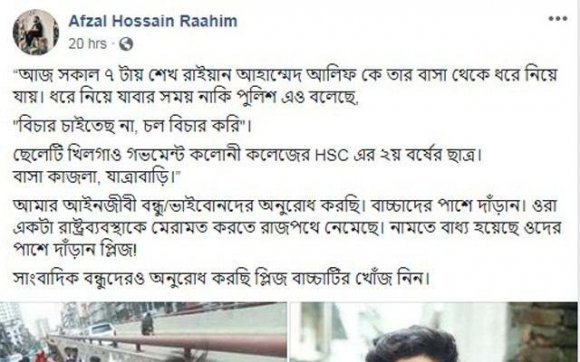
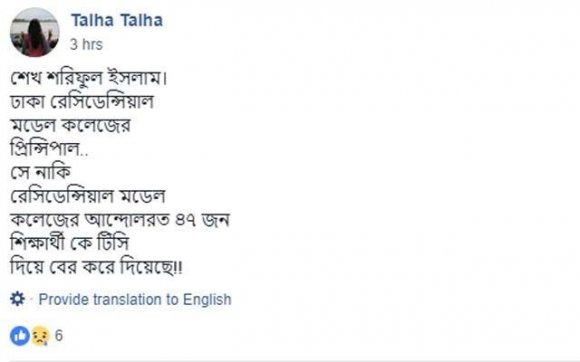
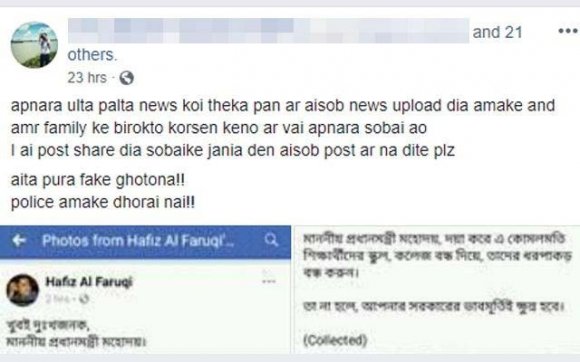
The Dhaka Tribune, one of the leading online English newspapers in Bangladesh, found that much of the chaos and violence during the protests were fuelled by rumors on the social media. Several rumors, given Alauddin told the Dhaka Tribune that on Sunday night, no one was admitted with a scrotum injury. ii. Another rumor was spread by leaders of the Bangladesh Chhatra League, the ruling party's student front, that the protesters had vandalized the faculty of Fine Arts and torched the artwork that was supposed to be used in the Mongol Shobhajatra. But the Chhatra League later issued a statement condemning the alleged vandalism. Besides, Mir Arshadul Haque, the campus correspondent of a English daily, confirmed to Dhaka Tribune that vandalism is fake, and he was inside the Fine Arts Faculty at that time. iii. Another report of the violence surfaced at mid-night around 2 am on 9 April when protesters surrounded the residence of the Dhaka University vicechancellor. A few people, who have yet not identified, attacked, vandalized, and looted the residence. Two cars of the vice-chancellor were also set fire while two other cars were vandalized. The news was served as that the protesters were behind this heinous vandalism, but demonstrators alleged that the attack on the residence was carried out by outsiders and still now they are not identified. iv. There was another rumor early April 11 that Chhatra League's Kabi Sufia Kamal Hall unit President Iffat Jahan Isha had tortured a demonstrator and cut her tendon. It is claimed in the rumor that the leader didn't permit to take the demonstrator to the hospital even though she was bleeding. This rumor spread on Facebook at supersonic speed and incite the protesters along with commoners further. This rumor became trustworthy as the picture and video of wounded girl was posted on Facebook. Tension arises to the apex, and guardians of the students worried about their girls, and this rumor led both protesters and common people agitated. Later, the injured student, Morsheda, clarified in a Facebook video that she had herself injured her foot on broken glass when she kicked the window of Isha's room to rescue a screaming girl who was presumably being tortured there. v. At around 3 am on 11 April's night, another post by Basher Kella claimed that a ruling party student front leader of Dhaka University's hall unit was assaulting general students. The page claimed that armed Chhatra League activists riding around 100 bikes were on the way TSC to attack the protesters. vi. Another rumor that arise based on the Isha's cut off the tendon of a protester because Chhatra League activists had fired shots at students who tried to go towards the Kabi Sufiya Kamal Hall. But a protester dismissed this rumor. vii. There were also few rumors about Chhatra League activists assaulting protesters at Mohsin Hall, a residence of students for Dhaka University. Still, the Dhaka Tribune correspondent couldn't find evidence to substantiate the allegation.
The government tried hard to tackle rumors. About 200 Facebook accounts have been listed in connection to a case filed over "spreading rumors" in the social media during the quota reform agitation in Dhaka (13 April 2018; Daily Star).
The important thing is that this massive student movement, led by students, was organized solely through social media i.e. Facebook alike movement had been seen 'Ganojagoron Mancho' in 2013 in Bangladesh. World has seen the massive power of social media, i.e., Facebook in these two different movements happened in Bangladesh and the Arab Spring in the Middle East in 2012. Later, another massive but peaceful and dynamic 'Road Safety Movement' led by school-going students been seen in Bangladesh organized through Facebook. Thus social media especially Facebook has a massive and direct influence on society in Bangladesh.
11. d) Rumors spread during the 'Road Safety Movement' through Facebook in July 2018
The world faces rumors during crisis moments. Hoaxers and fakers take the opportunity of the emergency period and exploit human psychology and create chaos in society. Especially political rivals grab the advantage of juncture when a country faces movement or war. Hence rumor spread at the highest speed to reach people during world war 1 and world war 2 and other war or crisis time. Bangladesh also suffered much in rumor during the freedom war in 1971. But in rumors get new life and way of spreading in such a way like the atomic bomb in this digital age. Facebook and online portals add a new dimension in spreading rumors and fake news. Power and Ports. As a proof, the DMP portal also provided a snapshot of a news report containing the same photo published in a national daily on October 1. In the later part of the safe road movement, false news of torturing students and raping female students at a ruling party's party office was spread through video posts (Alam; Daily Sun).
On 4 August 2018, Quazi Nawshaba Ahmad, actress and model, went live on Facebook and urged people to 'save the students from attacks' and claimed falsely that two students were killed. But she acknowledged that she hadn't seen anything with her "own eyes".
Her 1.37 minutes long live video went viral on Facebook, which made many aware citizens confused authors whether it was true or not. Later she was arrested by RAB (Rapid Action Battalion) accused of spreading rumor (4 August 2018; bdnews24.com).
Nowshaba was on Facebook live. Another live video went viral on Facebook. A girl, covering her face, claimed that many school-going girls were being raped by rolling government affiliated Chhatra League activities at their party office situated at Jigatala, Dhaka. This rumor can still be found now in the following link. https://www.facebook.com/joydev.n/videos/2220475084 863424/?t=0
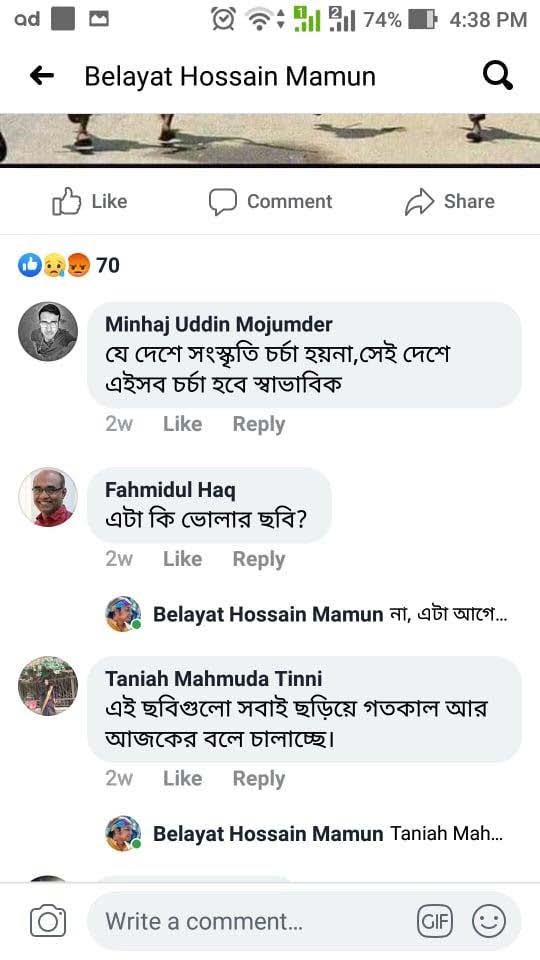
The following pictures also became viral on Facebook on 4 and 5 August 2018 which turned the road safety movement into violent. Though the person, M Mahbub Alam, who posted 'Is it rumor or Photoshop? We want a safe country?' including the picture on Facebook, is a teacher of a private university but confused by this violent picture. Many others become puzzled at this rumor, and took part to spread rumors unconsciously.
These pictures are collected as a snapshot from Facebook by the author 'Sharifa Umma Shirina'.
Not only Facebook users, but some baseless online portals contribute to spreading rumors by publishing fake news. Yousuf Chowdhury, chief executive officer (CEO) of online news portal 'Zoom Bangla' and two students from Dhaka and Bogra were arrested for allegedly trying to create anarchy by publishing fake news and spreading rumors on social media over the ongoing students' road safety movement (9 August 2018; Daily Star).
12. e) Religious hate speech and rumors spreading over
Facebook led to mass death and vandalized.
Several mobs occurred in Bangladesh several times triggered by spreading religious hate speech, defamation, and rumors through the virtual realm, i.e., Facebook which resulted in death and vandalized.
The very fast rumor spread through Facebook draws the attention to Bangladesh in 2012 when using Faccbook was started in here. Since then Facebook has become a widely used tool for spreading rumors in Bangladesh. Hence, Bangladesh faces several crises of rumors frequently.
On 29 September 2012, a mob torched and vandalized several houses of Buddhists in Ramu, Cox's Bazar, one of the worst religious attacks in Bangladesh apparently triggered by a Facebook post allegedly defaming the Holly Quran of Muslims. A Buddhist temple in Ramu was burnt to the ground. The cause of this fanatic zealot was a local Buddist, Uttam Kumar Barua, being tagged in a Facebook image of burning Quran (29 September 2012; bdnews 24.com).
After Ramu violence, another fanatic mob vandalized at least 20 Global Journal of Human Social Science agitated and provoked to do heinous activities like they set fire at least 30 Hindu houses. Over 100 suspects were arrested in connection with the communal (Badal & Hasan: 12 November 2017). A similar incident took place in very recent in Borhanuddin, Bhola, which is illustrated above. This is not enough; Bangladesh has faced similar several crises due to rumor in the past from when Facebook got popularity among mass people.
13. VII.
14. Analysis and Discussion
Bangladesh is continuously facing the acute problems of rumors spreading in the virtual realm like Facebook. The above-given documents show that almost every year, at least one serious social crisis has been created due to rumors spreading on Facebook in Bangladesh. Few dimensions can be traced regarding rumors based on the above evidence. Many reasons can be triggered the quickest spread of rumor in Bangladesh. There are uncountable numbers of online portals in Bangladesh. This rapid growth of online journalism is one of the major reasons for spreading rumors and fake news. Because most of the online portals are run by unskilled and less educated persons who have lack of news sense. Most of them have no ethical knowledge of journalism. A lack of a digital security act for controlling the web portal is another reason for spreading rumors and fake news. Because when a rumor is served covering as a news, whatever medium it doesn't matter,' people don't raise questions about its' authenticity. Though recently Digital Security Act has been adopted, its' implementation can't be seen yet. The lack of a digital security act paves the way for spreading fake news through the virtual realm. There are lots of laws and acts to punish criminals, but implementation is a rare case in the context of Bangladesh, which led people to uplift the law in their hand. Besides, people's mistrust of existing justice, mistrust of police, who are detached from mass people, are another reasons of violence in society. Political perpetrators deliberately spread rumors for taking revenge on political rivals and try to create a chaotic environment and derange social discipline to keep the ruling party in an awkward situation. The suspicious mind of mass people, lack of knowledge, and mass awareness are also considered as one of the major reasons for spreading fake news in Bangladesh. Lack of media literacy is one of the main reasons for spreading fake news and rumor in Bangladesh. Most of the people, who use social media platforms, don't know how to use and in what purpose. It may be the only one fake news but its' impacts on society is severe, which is figured out from above evidences.
15. IX.
16. Feasible Prevention
Scientists and technologists have developed few websites and apps to check fake news, misinformation, and propaganda. Such as Glennkessler, PolitiFact, the Pulitzer Prize-winning fact-checker site, FackCheck.org (subjectguides.nscc.ca) are the popular fact checker by which fake news can be identified. BDFactCheck.com is now popular fact checker in Bangladesh. Alongside, suitable steps should be taken based on the above reasons to mitigate rumors and fake news as well. There is no other alternative way of education to prevent spreading rumors and to believe in rumors. Media literacy can minimize the gap between news and fake news and rumors. The fair implementation of the digital security act can reduce the rapid growth of web news portals, which are the main tools for spreading fake news sometimes and they practice copy-paste journalism and have no sense of ethics. As Facebook is the main tool for spreading rumors and fake news and is the reason of creating violence in the society, it should be monitored in such a creative way so that freedom of speech wouldn't be derogated. Besides, Facebook recently launched an artificial intelligence based program to predict and prevent suicides (wired.com). Similar programs can be implemented to predict and prevent violence and extremism by detecting suspicious users and activities from social networking platform Facebook. But the legal action is must and unavoidable step to throw cold water on rumors and fake news. The much-awaited 'Digital Security Act 2018' has been adopted to perish digital chaos in digital platforms and to make a more secure way of using social media. Though there is some debate about a few sections of the digital security act, it has made a legal way of protecting defaming, spreading fake news, fake information, and rumors on new media platform especially on Facebook. The Digital Security Act (2018) takes prevention measures and punishments under sections 8, 28, 29 and 31 on hurting religious sentiment, and values, disrupting public order, dishing out defaming information and causing deterioration in law, and order by publishing anything on a website or in electronic form or digital format. On the contrary, this act under section 43 allows police in Bangladesh to search and arrest anyone if police official believes that an offense under the law has been or is being committed at a certain place, or there is a possibility of committing crimes or destroying evidence which is the most debatable section that shrinks the freedom of press and freedom of expression. A mass awareness can also be an effective step in preventing spreading rumor and fake news through the virtual realm. Besides, citizen must have to be aware of using Facebook and have use their own concise to differentiate between news and fake news and rumor before sharing.
17. X.
18. Conclusion
Facebook has become a panic of spreading rumors and fake news in Bangladesh along with the world. The impact of spreading fake news in the virtual realm is severe, proved by the above evidence. Sometimes single fake news or rumor may cause to destruction of our secular entity in Bangladesh. It's high time to prevent spreading fake news and rumor on Facebook for our existence.
| following, shaped the quota reform movement turning |
| into violence. |
| Year 2020 |
| Volume XX Issue XVII Version I |
| ( A ) |
| Global Journal of Human Social Science - |
| © 2020 Global Journals |