1. I. Introduction
apacity building is the development of knowledge, skills, and attitudes in individuals and groups of people relevant in the design, development, and maintenance of institutional and operational infrastructures using processes locally meaningful. Entrepreneurial development is anchor on robust capacity-building strategies that involves harnessing creative skills essential to create economic opportunities. The increasing population in Nigeria is an enabler for creative minds to deploy their skills in stimulating viable employment opportunities which provides means of livelihood for the growing labour force. Creative entrepreneurial initiative contribute immensely to the economic growth of developing countries in creating sustainable jobs. Apparently, Nigeria confronts challenges of an ineffective waste collection systems, inadequate coverage of the collection system, and poor management of collected wastes. The creation of regulatory frameworks to encourage private individuals to invest in waste collection, recycling, and to reuse are necessary to build capacity in waste to wealth. Used or expired items in the environments such as empty cans, containers, used/expired tires can be transformed into objects of high premium value when recreated or reworked by creative minds. Recreating disposed items could be a source of livelihood and income-earning in a developing economy like Nigeria. Entrepreneurial prospects in the waste to the wealth value chain are focuse on transforming expired used objects into valuable functional items to generate sustainable livelihoods. The business model of a waste management venture involved in the reuse of waste materials should entail feasibility/cost-benefit analyses; returns on investment/pay-back analyses; branding, marketing and distribution networks; analysis of competitiveness. The easy access to unused or expired tires spurs entrepreneurial drive into these areas and enable skillful creative individuals to explore the transformation of these into objects functional objects of value. Apparently, this creative method of managing disposed tires preserves it for future reuse and more appropriate than the destructive way of recycling through burning.
2. a) Solid Waste Management in Nigeria
The rapid increase in the global population has driven an upsurge in socioeconomic activities such as industrialization, technological developments, changing lifestyles, and consumption patterns. Daily human activities produce different kinds of waste constituting harmful environmental threat to residents of cities in developing nations across the world. Nigeria, with a population exceeding 170 million, is one of the largest producers of solid waste in Africa (Bioenergy Consult, 2019). Nigeria generates more than 32 million tons of solid waste annually, out of which only 20-30% is collected (Bioenergy Consult, 2019). However, the Nigerian federal government promulgated environmental 1988 to safeguard the public space from environmental nuisances that endangers society. Adewole (2009) noted that one of the few statues in Nigeria, which attempts to define waste is the Lagos State Environmental Edicts 1985, therein Section 32, waste is defined as follows:
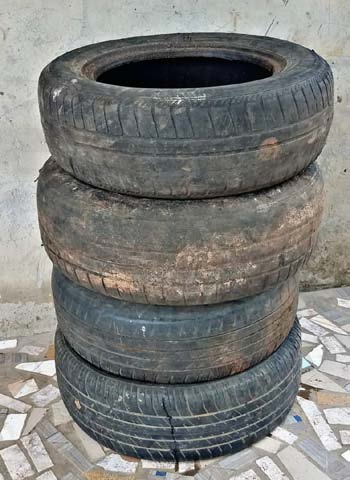
Waste includes: i. Waste of all descriptions. ii. Any substance, which constitutes scrap materials or effluent or other unwanted surplus substances arising Sridhar (1996) defined waste any unavoidable material resulting from domestic activity or industrial operation for which there is no economic demand and which must be disposed of Adewole (2009) Disposed tires constitute a large chunk of the municipal solid wastes in Nigeria due to the countrys heavy reliance on road transportation. The discarded tires are not fit to be used by vehicles because their continuous usage can cause an accident leading to the loss of human lives. Often, waste tires are retreaded for reuse, or processed into crumbs for making surfaces and into chips for use as a solid fuel (foramfera, 2018). However, the unconducive business environment in Nigeria caused by poor infrastructure and multi-tax system hinders industries such as tire production factories that can either retread or recycled for use. The previously available ones have relocated to neighboring countries. Used tires are typically discarded, reused or burnt. Open-air burning of tires pollute the air, contaminate the soils, alters their physical and mechanical properties and makes the soil prone to ecological disasters. Hence, this research reused discarded tires to produce furniture suitable for home use. This research design is product development. The research population is eight unused and expired tires packed from dumpsites around Ifo Ogun State. The materials utilized for this research include unused tires, fabrics, dye, hydro Sulphate, Soda, Foam, wooden plank, Binding wire a) Procedure of Production
3. Production of Center Table
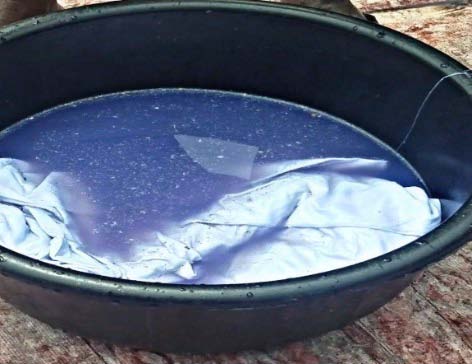
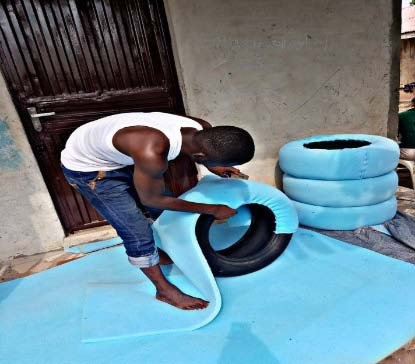
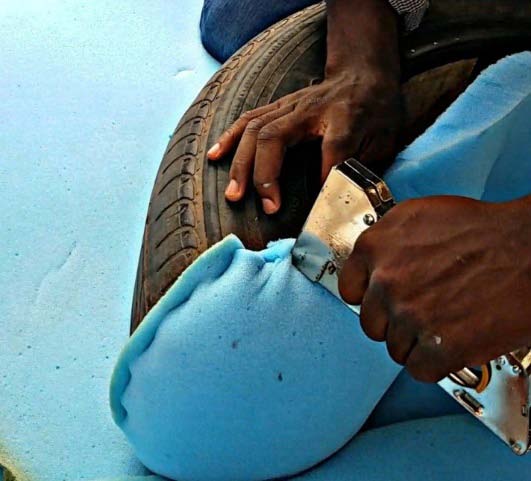
Tires were washed and dried to remove dirts. The fabric was also washed and spread in the sun to dry, then dyed into red and blue using Adire technique (see Plate 2). Dyed fabric was ironed for smoothening. Foam materials with minimal thickness were wrapped and fixed firmly on the tires using stapled gun to prevent removal of the foam from the tyre. Likewise, the dyed fabric with Adire patterns were laid and wrapped on the foam covering the exterior of the tires (see Plate 3, and Plate 4). To create a seat, two wrapped tires were fixed together using a screwed steel plate (see Plate 5); short pieces of 2×3 planks were inserted into the joined tires and nailed on wooden round shape base fixed underneath the lower tires. A round glass piece was placed and affixed on the upper part of the joined tires to produce the center table. Adhesives was applied to the edges of the wrapped foam and fabric to achieve good finishing. Some of the tires were cut into two, using saw blade and small pieces square-shaped plywood were inserted into the openings to brace and strengthen that section of the seat to provide the needed comfort when rested upon. These parts of the furniture were wrapped and covered with foam and Adire fabric. The back rest was placed on a complete tyre that has an underneath base affixed with 4pieces of2×3 in the interior and covered on to the top with roundish based wrapped with foam and Adire fabric, which enables users to seat. Four sets of these seats were produced and each has aluminum steel attached underneath to create balance for the seats and center table
4. III. Discussions and Results
The result shows that expired, and used tires can be skillfully reused to create objects of premium and functional value. The produced furniture resonate comforts and style. Balancing and movability are the trademarks of these creative items. The steel stands attached underneath the furniture's enhance balancing and movability. Adire fabric covers add richness and colourful socio-cultural embodiments to the furniture. Also, incorporated foam material enables easiness and usability. These furniture fit for both indoors and outdoors due to the aesthetics and adaptability features. Therefore, they are suitable for offices, banks, hotels, public buildings, homes and others. Tires are sturdy and non-degradable, hence the furniture will be durable and long-lasting.
5. IV. Conclusion
The transformation of expired and used tires into the home and office use furniture showcases the entrepreneurial opportunities therein in the application creative skills to items of perceived little or no value. Capacity building in waste wealth leverages a sustainable means of livelihood across the value of production of in the reuse of discarded items. Also, this type of entrepreneurial venture can easily be setup because the primary materials are cheaply available. Creative reuse of discarded items such as tires hitherto changes the perception of these items as being objects of no value that constitute an environmental nuisance that could endanger human lives. Reuse is environmentally friendly, safe and cost-effective approach to disposing waste materials than other recycling methods.