1. I. Introduction
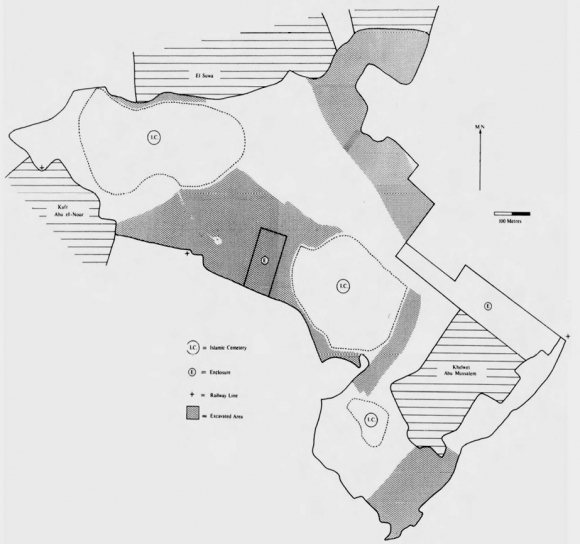
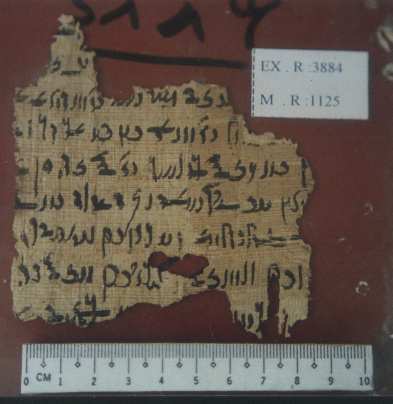
The ancient Egyptians have been compelled to invent a script in order to be exceptional, more swift and cursive according to the requirements of overgrowing life and to suit the different issues of social interactions and the affairs of advanced societies. The demotic was a very swift form of the hieratic script, the demotic script was generally written on papyrus, potsherds and ostraca. In addition, it is believed that the oldest demotic text-preserved till now-is the papyrus of Rylands 1, almost dating back to 643/642 B.C, whereas the latest demotic text-preserved till now-is the Graffiti of Philae Nos.365 and 377, almost dating back to 452 A.D 1 . The objective of this study is to discuss a fragment of papyrus composed of nine lines of demotic script written in ink; the dimensions are about 10 × 9 cm. The provenance is the archaeological area of El-Suwa or the so-called Geziret el-Suwa 2 (Fig. 1); the Necropolis of 20 th Nome of Lower Egypt, known as Pr-Sopedu, which means the House of Crouching Falcon God Sopedu; it is currently within the range of the modern village of Saft el-Henna, City of Abu Hammad, Al Sharqiyah Governorate, Egypt (Fig. 2). Currently, the residue of this papyrus is preserved in the museum store of Tell-Basta under the registration number 1125.
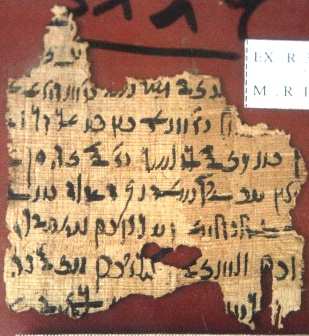
The relevant characteristics of the fragment of papyrus concerning a pledge can be described as follows; 2.1. Type: A fragment of Papyrus (Figs. 3-5) 2.2. Writing material: Ink 2.3. Writing: A demotic text of nine lines written in a horizontal way 3.2. Translation and Linguistic context 3.2.1. //////// [As for] this tomb 1 ///////////// 3.2.2. //////// [It's] mine 2 (which I own)///////////// 3.2.3. //////[Regnal year] 3 28 4 , month 4 of winter (Pharmouthi) 5 [Hor-em-heb]? 6 /////// 3.2.4. ////// I have to give 7 property (income, rent) and food ration (property ration of food) 8 ///////// 3.2.5. /////// He who is [in charge of] you will do the speech 9 (contract or pledge), [therefore] you will do to me what is written 10 (you will execute the document)//////// 3.2.6. ////// He who is entrusted with 11 [that matter of] the year 12 that [you will do what is mentioned before] ///////// 1 "b[tA b (.t)]", which is used as a feminine noun means "tomb", the variant of "b.t", or it may be used as a masculine noun to mean "place", which is a variant of "b(w)"cf: Johnson, Dictionary,pp.2-3/CDD. B. 02; Erichsen, Glossar, p.109. 2 "pAy" is used as a demonstrative pronoun, also as a pronominal copula. But here, it can be read as "pAy=(i) that uses as a possessive particle or a possessive pronoun. cf: Erichsen,Glossar, pp. 128-129; Wb.I.493, 1-5; Johnson, Dictionary, pp.35-36/CDD.P.10 3 ["H.t =HA.t-sp/zp"] is used to mean "the beginning of year, the regnal year and the year of a King's reign, or the meaning of the last year under the rule of a Pharaoh.cf: Erichsen, Glossar, p.287, 321; Johnson, Dictionary,pp.4-5/CDD.H.09.1; Wb.III.19,2-21;20,1-21; Smith, Enchoria 7, p.128. 4 Number 28 comes after the expression "HA.t-sp ", expressing the value of the regnal year that is Twenty-eighth year. As for this number cf: Erichsen, Glossar, p. 700; Johnson, Dictionary, pp.101-102/ CDD. Numbers. 14.1 5 "ib.t/Ab.t ftw/4", means "month 4 of winter", known as "Pharmouthi/rnn-wt.t", it is the name of the eighth month of the year in ancient Egypt. cf: Johnson, Dictionary, pp.37-38/CDD.Months.14.1; For rnn-wt.t/ Pharmouthi cf: Wb.II.437; Parker, R.A., (1950). The Calendars of Ancient Egypt, The University of Chicago Press, Chicago, p.45; Erichsen, Glossar, p.696; As for "fdw/ftw" cf: Wb.I.582. 6 The name of "Hor-em-heb" is related with the priest who will carry out the deal with the owner of the tomb. Cf: Ranke, H., (1935). Die ägyptischen personennamen, Vol.I, Gluckstadt, p. 248; Griffith, Catalogue of the Demotic papyri, Vol. III, p.457. 7 " mtw" means "have, owing (of money or something) yet to be paid", it also means" repay or pay back (a debt, or sum of money), to give someone (a debt, or sum of money) cf: Erichsen, Glossar, pp.37,158,188, 274;Johnson, Dictionary,pp.83,272/ CDD. M.10.1. Regarding "t/ti", which means "to give" cf: Erichsen, Glossar, pp.149, 158, 502, 596,605; Johnson,Dictionary, pp.29, 34, 298/ CDD. M. 10.1; p.95/CDD.I.11.1; p.1/CDD.T.12.1. 8 The masculine noun "aq" means" dedication, ration" cf:Erichsen, Glossar,pp.72,73;Johnson, Dictionary, pp.142,143, 144/ CDD.c.03.1; cf: Wb.I.230-232.Here in our context, "aq" means "food ration that allow a person to have a fixed amount of a particular commodity of food or to have food commodities. As for "nkt" means "property", as in "wnm nkt= to eat the property or food", also "nkt n wnm=food". cf: Erichsen, Glossar, pp.229-230;Johnson,Dictionary, pp.12,89,132/CDD.N.04.1; Wb.II.347,10-16. 9 The noun "sDy" means "speech, report, story", as in "ir sDy = to tell a story" cf: Erichsen, Glossar, p. 482; Johnson, Dictionary, pp.525-527/CDD.S.13.1; As for "sDd" cf: Wb. IV. 394-395. 10 The expression "sX" 10 means "written, speech, matter, thing, document, writing, spell" cf: Erichsen, Glossar, pp.405,458-460; Johnson, Dictionary, pp.412-413, 415-417/CDD.S.13.1. For more about "sX" cf : Zauzich, (1977). Enchoria 7, p.159; Hughes,(1957).JNES 16, pp.58-59;Thissen, Enchoria 2, pp.49-50; Thissen, Enchoria 9, pp. 63-92; cf:Wb.III.476 for "sS". 11 The verb "nHt " means "to believe, to trust, to certificate". The expression "nHt r" is used in the official document to mean" to entrust (someone) with (something)"or "to authorize (someone) concerning (something)" cf: Erichsen, Glossar, pp.224-225; Johnson,Dictionary, pp.112-113/CDD. N. 04.1. For more about "nHt" cf: Vleeming, Ostraca Varia, pp.19-21; Devauchelle, Bior 55, pp.376-377. 12 The feminine noun "rnp.t" means "year" is a variant of "HA. 1 which is beforehand 2 according to the law 3 [by legal means] 3.2.8. //// I will pay 4 for what is before, [this is in exchange for] you will do everything which is above 5 (you will execute every requirement which is written above) ////// 3.2.9. ////// to support 6 (to testify on behalf of) //////// For the sake of content of this study, it should be referred to the semantics related to the meaning of vocabularies. This is beside the syntax-the structure of expressions or the arrangement of phonetic values or ideograms in a logical way. 4.1. The first line, there is b[tA b(.t)], which is used as a feminine noun that means a tomb; it is the variant of b.t, also it may be used as a masculine noun that is a variant of b(w), which means a place, 7 . Moreover, it may be related with the word bAy(w), bAy(.t) mentioned in the texts of New Kingdom, Late Periods and Greco-Roman Periods in the sense of a tomb and a pit 8 . It should be noted that there is a root of b relating with b-A, which means to hack, to cut, to break up the surface of the land in order to build a pit or a tomb. In addition, it may be equal in meaning to stonemason or the person who builds 9 . Here in our context, it is related with the expression tA b(.t), which means grave, tomb and shrine 10 . 4.2. The second line, there is pAy 11 , which is used as a demonstrative pronoun and also as a pronominal copula. But here, it can be read as pAy=(i) that is used as a possessive particle or a possessive pronoun. 1 The masculine noun "sHn/shn" means "command, order, commission" cf: Erichsen, Glossar, pp.463, 447;Johnson, Dictionary, pp.339-340/CDD.S.13.1; Brunsch,Enchoria 9, pp.19-20;Wb.I.217,5; 257,3-4. Also,"sHn" is relevant to the meanings of "official taxation" cf: Johnson, Dictionary, p.340/ CDD.S.13.1; cf: Spiegelberg,W., (1905). Papyrus Erbach; Ein demotisches Brieffragment , ZÄS 42,pp. 56-57(N.14); Vittmann, G., (1998). Der demotische Papyrus Rylands 9, Vol. II, ÄAT 38, Harrassowitz, Wiesbaden, pp.479-480. Also, it is related to "decrees and contracts of payment" cf: Johnson, Dictionary, p.341/ CDD.S.13.1. 2 The expression "Xr H.t" means "previously, beforehand", is used as adverb, this is beside "Xr Hry" cf: Erichsen, Glossar,pp.386-387; Johnson, Dictionary, pp.7-8, 231/CDD.H.09.1. 3 The expression "hp" means "law, legal right" cf: Erichsen, Glossar, pp.274,355,375; Johnson, Dictionary, pp.48-49/ CDD.H.01.1; Wb. II. 488,13; IV.133,22. 4 "iw" is an element of some enclitic or proclitic pronouns, also "iw" is used as a variant of preposition "r". Also, "iw" means "pay or to make payment" cf: Erichsen, Glossar,pp. 19 10 Johnson, Dictionary, pp.3-4/CDD.B.02; cf: Brunsch, W., (1980). Sechs demotische Graffiti vom Gebel El-Têr in der Oase Chargê, WZKM/ Wiener Zeitschrift für die Kunde des Morgenlandes,Vol.72, Wien, pp.7-14, 76-77. But Devauchelle and Wagner rejected this reading, although no further reading was given, cf: Devauchelle, D., & Wagner, G., (1984).Les Graffites du Gebel Teir : Textes Démotiques et Grecs, IFAO, Le Caire, pp.6-7. 11 Erichsen, Glossar, pp. 128-129; cf: Wb.I.493, 1-5; Johnson, Dictionary, pp.35-36/CDD.P.10.1. 1 , being used to mean the beginning of the year, the regnal year and the year of a King's reign, this is to express the meaning of the last year under the rule of a Pharaoh. There is another reading Hsb.t that is used as a feminine noun and means the regnal year; it is the equal variant of HA.t-sp/zp 2 . In addition, there were variant forms of writing that relate to the phonetic value of Hsb.t such as what is mentioned in Pap. Berlin 13554, Pap. Louvre 2430E, and Pap. Turin 6075B 3 . With regard to the study of YOYOTTE, the expression Hsb.t is appeared for the first time in the third intermediate period 4 . So, there was a debate about the reading of the expression HA.t-sp/Hsb.t, where it is read rnp.t-sp by EDEL 5 . As for BECKERATH, it is read as Hsb.t-sp 6 . Whilst in the reading of BARTA, it is rnp.t-hsb.t 7 . Regarding numbers, the ancient Egyptians introduced the earliest welldeveloped counting or numeration system by using Hieroglyphic signs containing unit fractions, cardinal and ordinal numbers, terms, issues, laws and how to solve first order linear equations belonging to arithmetic and geometry, thus there were many terms in ancient Egyptian sources. It is worth mentioning that ancient Egyptian mathematical numbers and fractions could be classified in two elements; cardinals and ordinals. Cardinals are simply 1, 2, 3, etc. It is noteworthy that the higher value is written in front of the lesser value and the numeral follows the noun, which as a general rule, exhibits the singular form in the cardinal manner. Ordinals mean first, second, third, etc. 8 . It is noted that the number 28 9 comes after the expression HA.t-sp, expressing the value of the regnal year that is Twenty-eighth year. In addition, the number 4 10 There is no doubt that one of the ancient Egyptians initiatives is the registration of dates based on the regnal year under the rule of a King. The year in the Egyptian calendar was divided into three seasons; the season had 4 months, each month had 30 days, beside the so-called epagomenal days or the five extra days to be 365 days per year. Regarding the name of Hor-em-heb, it is related with the priest who will carry out the deal with the owner of the tomb. RANKE indicated that Hor-em-heb is a personal name related to the late periods and the early Greek era; whilst KRALL suggested that he was a priest and associated with a priestly family 4 . It is worth mentioning that the lector priest or the embalmer known as Xr-Hb is a priestly rank concerning funerary practices 5 . Therefore, there is a belief that he may be the lector priest who will execute ritual related to the deal, which concerns the tomb. 4.4. The fourth line, there is the expression mtw 6 , which means have, owing (of money or something) and yet to be paid; it also means repay or pay back (a debt, or sum of money) and to give someone (a debt, or sum of money), which is mentioned in the phrases as follows; iw=s mtw=k a.wy=i, meaning I owe you, and in nt mtw=i that means what belongs to me 7 . Also as in mtw=w ti n=f HD X pA hrw nt iw=f r ir =f bnr mtw=w ti n=f Xn tA xAs.t Xn HD (n) HD, notifying the meaning of they will give him x of deben on the day he dies, (and also) they will give (it) to him in the necropolis in silver? 8 . Regarding t/ti 9 that means to give; it is related with the imperative verb my 10 which means cause to give. It should be noted that t is abbreviated form from ti, which is mentioned in the formula of Htp ti nsw.t 11 . 1 Erichsen, Glossar,pp.135,507; Wb.I.530, 7-8; cf: Osing, Nominalbildung, pp.107, 584. 2 3 Bresciani, L'archivio Demotico, p. 58,12. 4 Ranke, ägyptischen personennamen, Vol.I,p.248; cf: Griffith, Catalogue of the Demotic papyri in the John Rylands Library, Vol. III, p.457; Barsanti, A.M., (1900). Rapport sur la découverte, ASAE 1, p.285; Krall, J.,(1881). Studien Zur Geschichte Des Alten Aegypten, Vienna, p,386. 5 Erichsen, Glossar,p.388; Johnson, Dictionary,p.55/ CDD. $. 01.1.; cf: Wb.III.395. 6 Erichsen, Glossar, pp.37,158,188, 274; Johnson, Dictionary,pp.83,272/ CDD. M. 10.1. 7 Erichsen, Glossar, p.188; Johnson, Dictionary,p.272/ CDD. M. 10.1. 8 Erichsen, Glossar, p.336; Johnson, Dictionary,p.79/ CDD. T. 12.1. 9 Erichsen, Glossar, pp.149, 158,502,596,605; Johnson, Dictionary, pp.29, 34, 298/ CDD. M. 10.1; p.95/ CDD.I.11.1; p.1/CDD.T.12.1. 10 Erichsen, Glossar, p.150; Johnson, Dictionary,pp.52/ CDD. M. 10.1. As for"imy"cf: Wb.I.76-77. 11 Erichsen, Glossar, p.596; Johnson, Dictionary, p.1/CDD.T.12.1. It is worth mentioning that the verb ti/ty is used as a variant of the verb rdi and of the verb di, like ti/ty anx which means to give or to cause life and keep alive 1 , also as in ti Hd wbA tAy=i qs.t, conveying the meaning of to give money for my tomb 2 . Furthermore, the verb ti is related with the imperative verb imy 3 , and also ti that is used as a variant of my and may 4 , expressing the meaning of to give. Moreover, there is ti ti, conveying the meaning of to cause to give, which is mentioned in the phrase of r tm ti ti=w, expressing the meaning of in order not to let them give 5 . Also, there is the imperative verb i-my related to the verb ti, which means to give; it is mentioned in the phrase of +Hwty ti anx ntr aA Hr-ib iwn.t, bearing the meaning of Thoth, who gives life, the great god who is in Dendera 6 . There are multiple meanings for the expression aq 7 like dedication, to enter, loaf and ration, the causative meaning is log into, usher in, like aq r pr nfr, expressing the meaning of entry into the good house, literally; log into embalming place or the so-called embalming house. The masculine noun aq, which means dedication, is related with ayq, and also with aqy, conveying the meaning of the official entrance of the King 8 . The expression aq n means ration of, as in aq n H.t-nTr, notifying the meaning of ration of the temple; also as in aq n H.t-ntr n pr Pr-aA, which means rations of the temple and royal possession 9 . Here in our context, aq means food ration that allows a person to have a fixed amount of a particular commodity of food or to have food commodities. As for the masculine noun nkt 10 , it means property, as in wnm nkt , expressing the meaning of to eat the property or food, also the expression nkt n wnm, which means food, is mentioned in the following phrase hp n nA pr.w nA wrH.w nt nb nkt nb, expressing the meaning of legal right of the houses, the empty ration of every property 11 . 4.5. The fifth line, there is the relative converter nty/nt 12 which is mentioned in pA nt iy nb, notifying the meaning of everyone who comes, and in nt nb nt wAH r-r=w, expressing meaning of everything which is added to them, this is beside nt-iw which is not only used as a variant of conjunctive, but also of temporal. As for ir 13 that 1 Erichsen, Glossar, pp.596,604-606; Johnson,Dictionary, pp.1, 62, 77-78, 83/CDD.T.12.1. As for the verb "rdi" cf: Wb.II.464-469; and for the Etymology and Orthography system of L.E.cf: Spiegelberg, W., (1925). Demotica, Vol. I, Verlag der Bayerischen Akademie der Wissenschaften, München, pp.56-57 §108; 117 § 255; Vernus, P.,(1990). Entre Neo-Égyptien et Demotique: La Langue utilisee dans la traduction du rituel de repousser l' Agressif, Rde 41, pp.194-197. 2 Erichsen, Glossar, pp.549, 155, 267; Johnson, Dictionary, p.78,/CDD.T.12.1. 3 For "imy" cf: Wb.I.76-77; Erichsen, Glossar, p.150; Johnson, Dictionary, pp.52/ CDD. M. 10.1;p.112/ CDD.I.11.1. 4 Erichsen, Glossar, p.150; Johnson, Dictionary,pp.52/CDD. M. 10.1; p.112/CDD.I.11.1. 5 Erichsen, Glossar, pp.605, 630; Johnson, Dictionary,pp.80,81/ CDD. T. 12.1. 6 Erichsen, Glossar, pp.150,605;Johnson, Dictionary, pp.3, 68, 95,112/CDD.I.11.1. 7 Erichsen, Glossar, pp.72,73;Johnson, Dictionary, pp.142,143, 144/ CDD.c.03.1;cf:Wb.I.230-232. 8 Erichsen, Glossar, p.73;Johnson, Dictionary, p.144/ CDD.c.03.1; for "aqw" cf: Wb.I.232-233, and for more discussion of meaning cf: Daumas,F., (1952). Les moyens d'expression du Grec et de l'Égyptien, Issue 16 of Supplément aux Annales du Service des antiquités de l'Egypte, IFAO, Le Caire, p. 217; Malinine,M., (1953). Choix de textes juridiques en hiératique 'anormal' et en démotique, Vol. I, Librairie Ancienne Honore Champion, Paris, pp.110-112; as for what is related to Paleography cf: Vleeming, S.P., (1979). Some Notes on the Artabe in Pathyris, Enchoria 9, pp. 96-97. 9 Erichsen, Glossar, pp.56,72-73,500; Johnson, Dictionary,pp.40-41,145-146,148-149/CDD.c.03.1; as for "aq"cf:Wb.I.232,10; Osing, Nominalbildung, pp.89,549, N.418. 10 Erichsen, Glossar, pp.229-230; Johnson,Dictionary, pp.12,89,132/CDD.N.04.1;cf: Wb.II.347,10-16. 11 Erichsen,Glossar,pp.91,213,229-230,560;Johnson,Dictionary,p.136/CDD.N.04.1;cf:Wb.II.347,10-16. 12 Erichsen, Glossar, pp.231,76,186,646; Johnson,Dictionary, pp.1-3, 139/CDD.N.04.1; for "nty" cf: Wb.II.251-253. 13 Erichsen, Glossar, pp. n-Dr.t ir=f sHn, notifying the meaning of when he commanded 1 . This verb may be used in order to mean to lease, expressing the meaning of a contract by which one party conveys land, property, services, etc., to another for a specified time, usually in return for a periodic payment. Moreover, it means allocating a pledge from a person to do a certain task or to assign the responsibility for doing something to someone, which usually happens in the property pledged to someone in contracts and conventions of the ancient Egyptians. The expression Xr H.t 2 means previously and beforehand; it is used as an adverb, this is beside Xr Hry 3 which means previously, also Xr tA H.t/HA.t 4 that means before. The pronominal form H.t 5 is derived from HA.t that means before; also H.t means first, tip and top; it is derived from HA.ty, expressing the meaning of that which is in front and it is used as a nesbe form from HA.t, which comes in the sense of front. As for Xry 6 is also used as a nisbe adjective, notifying the meaning of below or what is below. The expression hp 7 that means law and legal right, is mentioned in the phrases as follows; r X.t pA hp, expressing the meaning of according to the law, hp n pA sHn, bearing the meaning of legal right of the agreement, smn pA hp n mt.t, which comes in the sense of to maintain the law of the matter, and in iw=i n hp n md.t n hb, reporting the meaning of I being in the right and in matter of the Ibis 8 . In our context, the pledge was according to the law and of accord by the law or by legal means, which are based on or concerned with the law. 4.8. The eighth line, there are some expressions already mentioned; this is beside iw 9 which uses as enclitic or proclitic element, also iw is used as a variant of the preposition r. As for the masculine noun iw that means payment, is mentioned in the phrases as follows; iw iw=f aHa r r.t, reporting the meaning of valid payment or legal receipt, iw n mH, notifying the meaning of receipt for payment. With regard to ir iw that means pay or to make payment, is mentioned in the phrases as follows; iw r-ir=w, expressing the meaning of payment which was made 10 . The feminine noun mt.t 11 means matter, thing, case, speech, affair, issue and property 12 ; the plural is mt.wt. As for the expression mt.t nb(.t) 13 which means everything, is mentioned in the phrases as follows; mH mt.t nb.t 14 , bearing the meaning of to execute or fulfill every requirement, r-Xt mt.t nb.t nt Hry 15 , notifying the meaning of according to everything which is above, mt.t H.t-nTr 16 , which comes in the sense of the property of temple, and in mH 1 Erichsen, Glossar,pp.646, 448; Johnson, Dictionary, p.339/ CDD.S.13.1; cf: Wb. IV. 216. 2 Erichsen, Glossar,pp.386-387; Johnson, Dictionary, pp.7-8/CDD.H.09.1. 3 Johnson, Dictionary, p.231/ CDD.H.09.1. 4 Erichsen, Glossar,p.387; Johnson, Dictionary, p.7/CDD.H.09.1. 5 12 Erichsen, Glossar,pp.80, 133,184,213,217,599,642; Johnson, Dictionary, pp.266-268/ CDD.M.10.1. 13 Erichsen, Glossar,pp.37, 285,375,642; Johnson,Dictionary, pp.83, 85,137, 267-269/ CDD.M.10.1. 14 Johnson, Dictionary, p. 267/ CDD.M.10.1. 15 Erichsen, Glossar,p.375; Johnson, Dictionary, p.268/ CDD.M.10.1. 16 Erichsen, Glossar,p.285; Johnson, Dictionary, p.268/ CDD.M.10.1. , expressing the meaning of fulfill everything which is written above. 4.9. The ninth line, there are lacunae; however, there is aHa n 2 , which means to support, to testify on behalf of and to be in need of. Furthermore, the verb aHa 3 is associated with multiple meanings such as get up, arise, stand and to be present.
2. The third line, there is an expression [H.t]-sp (HA.t-sp/zp)
By studying this fragment of papyrus, some difficulties arose such as: There is a dating formula without a royal name or a cartouche, also without official titles and witnesses; as a result there is no dating. Besides, there are lacunae and severe damage to this residue of papyrus; therefore, there is a necessity to address these difficulties. By searching for demotic texts related to El-Suwa 4 , it was observed that there are two demotic scripts 5 (Fig. 6). The lack of demotic texts from El-Suwa is the main difficulty of this study; besides, there is a dating formula without a royal name or a cartouche, in addition to the absence of official titles and witnesses; therefore, there is no specific date mentioned for this papyrus. The lacunae were also a major cause for the lack of clarity of the full context. Therefore, there is a need in order to put or to propose an approximate date of this papyrus; so, the best way is to follow the dating formulas and the calendar methods, which will be used as methodological solutions for this difficulty and the issue. According to calendar methods, it is noted that most of demotic contexts are dated by a regnal year 6 , which indicated the long-established or traditional Egyptian calendar that included 12 months of 30 days in addition to 5 epagomenal days. This was before the 3 rd century B.C. Officially, in 238 B.C the Egyptian priesthood by an authoritative order of King Ptolemy III issued the so-called Canopic Decree, resulting in an alteration of the civil calendar from the fixed year which is composed of 365 days to the so-called intercalary year by adding a sixth intercalary day at the end of every four year. For the reason above mentioned, if there is a dating formula that includes; H.t-sp 28 ib.t 4 pr.t Hrw 5 n Hb, it is clear that this papyrus is written before 238 B.C; this is for the reason of the existence of the 5 th epagomenal day of the regnal year, and this means that the year here is not an intercalary year. The second methodological solution to this issue is to follow Royal activities in El-Suwa; therefore , it is according to NAVILLE who indicated that King Nekht-Hor-heb has a plentiful share of the temple, which is close to Saft el-Henna, located 7 kilometers to the south-east of Zagazig on the basic way to Abou Hammad, where the ancient remains of the city, known as Pr-Sopedu, which is best known for the granite shrine of King Nektenebo II; this is beside the slabs and granite blocks dating back to the reign of King Nektenebo II 1 . Regarding to El-Suwa, there were four mud-brick tombs dating back to the late periods, which were excavated by DUNCAN AND PETRIE 2 . PETRIE pointed out that the necropolis of El-Suwa represents the outline between the XXVI th dynasty and the Ptolemaic era, where there were much of re-used pottery, which dates almost between the XXVI th dynasty and the Ptolemaic period; moreover, it is believed that Saft el-Henna and El-Suwa were regarded as the so-called XXX th dynasty in the affinities and characterization, where the vast majority of the burials were discovered in the cemetery of El-Suwa dating back to the period between the XXVI th dynasty and the Ptolemaic era 3 . On the other hand, ASTON indicated that Bes vases excavated in El-Suwa belong to the phase between the fifth and the fourth century B.C 4 . Due to these methodological solutions above mentioned, which are interested in the dating issue; the probable date is almost between the 4 th and the 3 rd centuries B.C and definitely before 238 B.C, and also before the reign of King Ptolemy III. With regard to Royal activities and archaeological evidences in El-Suwa, it became clear that the probable date is almost between the reign of King Nekht-Hor-heb (Nektenebo II) and the reign of King Ptolemy II. Furthermore, palaeography, orthography, style, and difficulties of the writing way refer to the linguistic characteristics of the Ptolemaic period. It is worth mentioning that through a discussion with Günter Vittmann, there are some important remarks, where He points out that this fragment can be dated to the Ptolemaic period; this is by referring to the third line which we can see[HA.t]-sp 28 ib.t 4. Also, indicates that there is a lacuna in the written word of the season; therefore, He suggested that the earliest King to whom the date could refer is Ptolemy II, = 257 B.C. Furthermore, the most probable of the next two candidates are Ptolemy VI/ Cleopatra II, = 153 B.C, and Ptolemy VIII, 142 B.C. A later date would be impossible. From the above mentioned, it can be concluded that there is a dating period beginning from the 4 th century B.C until the 3 rd century B.C. Therefore, I believe that the earliest King to whom the date could refer is Ptolemy II; this is the probable date, which corresponds with calendar methods, Royal activities and archaeological evidences of El-Suwa.
3. 6.1.
The lack of demotic texts from El-Suwa is the main difficulty of this study, and thus by searching for demotic texts related to El-Suwa, it was observed that there are two demotic scripts. By studying this fragment of papyrus, some difficulties arose such as: There is a dating formula without a royal name or a cartouche, in addition to the absence of official titles and witnesses; therefore there is no specific date mentioned for this papyrus.
4. 6.2.
There are lacunae and severe damage to this residue of papyrus; the lacunae in some written words along with severe damage in some lines of the fragment were also a major cause for the lack of clarity of the full context. 6.3. According to calendar methodologies, it is noted that most of demotic contexts are dated by a regnal year included 12 months of 30 days in addition to 5 epagomenal days; this was before the 3 rd century B.C, and definitely before 238 B.C, where the socalled Canopic Decree was issued by King Ptolemy III; therefore, this methodology of the calendar is not verified and is not the case in our study. 6.4. Regarding Royal activities and archaeological evidences in El-Suwa, it became clear that the probable date is almost between the reign of King Nekht-Hor-heb (Nektenebo II) and the reign of King Ptolemy II. 6.5. Palaeographical study, orthography, and difficulties of the writing way refer to the linguistic characteristics of the Ptolemaic period. According to a discussion with Günter Vittmann, who suggested that the earliest King to whom the date could refer is Ptolemy II, = 257 B.C. Furthermore, the most probable of the next two candidates are Ptolemy VI/ Cleopatra II, = 153 B.C, and Ptolemy VIII, 142 B.C. A later date would be impossible. Therefore, it can be inferred that the earliest King to whom the date could refer is Ptolemy II; this is the probable date, which corresponds with calendar methods, Royal activities and archaeological evidences of El-Suwa. This fragment of papyrus concerning a documented pledge, published for the first time; the shape of the fragment of papyrus is of unequal sides, the dimensions are about 10×9 cm and the material of writing is ink. It is written in one of four scripts of ancient Egyptian language, which is a demotic script, consisting of nine thick lines, which are written in a horizontal way. The provenance is the archaeological area of El-Suwa or the so-called Geziret el-Suwa; the Necropolis of 20 th Nome of Lower Egypt, known as Pr-Sopedu, which means the House of Crouching Falcon God Sopedu; it is currently within the range of the modern village of Saft el-Henna, City of Abu Hammad, Al Sharqiyah Governorate, which is located in the north-eastern Nile Delta, Egypt. It was excavated by archaeological excavations mission of the University of Liverpool of 1986; the registration number of the excavation is 3884, and the discovery place is the tomb No. 5, next to the remains of a mummy. Currently, the residue of this papyrus is preserved in the museum store of Tell-Basta under the registration number 1125; the current status is the need for restoration and preservation. It is noted through the study that the features of cursive signs have considerable accords with the abnormal hieratic, both of which were the initial approach of the archaic or early demotic script. The lack of demotic scripts from El-Suwa is the main difficulty of this study; beside, there is a dating formula without a royal name or a cartouche, in addition to the absence of official titles and witnesses; therefore, there is no specific date mentioned for this papyrus. The lacunae were also a major cause for the lack of clarity of the full context. It is worth mentioning that the essence of context included a documented pledge that was performed between Horem-heb and the owner of tomb. Regarding the name of Hor-em-heb, it may be related with the name of a priest who is associated with a priestly family and who carried out the role of the lector priest or the embalmer, known as Xr-Hb, which is a priestly rank concerning funerary practices of the deal with the owner of the tomb who undertakes to give rations of food in exchange for the execution of the pledge, which is the main of the eighth month of the year in ancient Egypt. Probably, Hor-em-heb is one of the priests who agreed with the owner of the tomb for performing the daily service and funerary rituals. The owner of the tomb acquits himself from the duties and requirements of the rations which he paid as written in the contract. The above mentioned included that the parties are agreed to make payment for the service that will be performed by Hor-em-heb to the owner of the tomb. beforehand will be fulfilled in accordance with the law or by legal means. This will be executed in year 28, month 4 of winter or the so-called Pharmouthi, which is the name
![would especially like to thank Prof. Dr. Günter Vittmann for his help concerning the difficulties related to this papyrus like the issue of dating which He referred to as follows; "Determining the date of this fragment is difficult, it might be dated to the Ptolemaic period, this is by referring to the third line which we can see [HA.t]-sp 28 ibd 4. Also, indicates that there is a lacuna in the written word of the season. Therefore, He suggested that the earliest King to whom the date could refer is Ptolemy II, = 257 B.C. Furthermore, the most probable of the next two candidates are Ptolemy VI/ Cleopatra II,= 153 B.C, and Ptolemy VIII, 142 B.C. A later date would be impossible.](https://socialscienceresearch.org/index.php/GJHSS/article/download/2983/version/103208/5-An-Unpublished-Fragment_html/46985/image-5.png)

| An Unpublished Fragment of Papyrus Concerning a Pledge |
| 3.2.7. ////// the deal (decree) |
| Year 2019 |
| 32 |
| Volume XIX Issue II Version I |
| D ) |
| ( |
| Global Journal of Human Social Science - |
| © 2019 Global Journals |
| -20,44; Johnson, |
| Dictionary,pp.42-43,46,49-50/ CDD.I.11.1;Hughes, JNES 16, pp.57-58; Zauzich, Enchoria 1,pp.35-36. |
| 5 The feminine noun "mt.t" means "matter, thing, case, speech, affair, issue and property", as for "mt.t |
| nb(.t) nt Hry", which means "everything which is above or every requirement is mentioned before " cf: |
| Erichsen, Glossar,pp.37,80,133,184,213,217, 285,375,599,642; Johnson, Dictionary, pp. 83,85, |
| 137,264 -266, 267-268/ CDD.M.10.1; for "md.t" cf: Wb.II.181,7;182,4. |
| 6 "aHa n" means "to support, to testify on behalf of, to be in need of" cf: Erichsen, Glossar,pp.68,389; |
| Johnson, Dictionary, p.117/ CDD.c.03.1; Wb.I.218-220. |
| mt.t nb.t nt sX Hry |
| Year 2019 |
| 38 |
| Volume XIX Issue II Version I |
| D ) |
| ( |
| Global Journal of Human Social Science - |
| © 2019 Global Journals |