1. Introduction
Author ?: Department of Languages, BAU, My mensingh. e-mail: [email protected] Author ?: Department of Languages, BAU. Agricultural University (BAU), My mensingh. It surveys students' perceptions towards the use of Nicenet in facilitating their English writing. While carrying out the research, qualitative research methods were employed. Data were mainly gathered through a questionnaire, students' writings posted on Nicenet forum as well as pre and post test of writing tasks. Participants used Nicenet conference as an online portfolio, where they shared personal experiences and posted writing assignments based on lessons and discussions. The findings of this study revealed that the Nicenet is supportive to reduce language barriers and increase students' motivation in writing English. As an online tool, Nicenet is also found useful for enhancing language learners' writing abilities. It provides opportunities to post messages and allows conferencing among students and teacher(s). The instructor felt that the Nicenet is a constructive tool for monitoring students' writing and providing necessary measures for helping pupils to be good language learners. The findings and discussion of this paper may assist practitioners in implementing Web 2 tools in designing suitable EFL writing activities for students. he emergence and development of Web 2.0 technology (e.g. Nicenet, Facebook, Flicker, Blog, Youtube, WebCT, and Moodle) enable knowledge exchanging in ways such as online meeting and discussion that were not possible before. Through these applications, users can exchange, interact, collaborate and socialize with others in virtual communities. As Warschauer & Grimes (2007, cited in Wang, S. & Va`squez, 2012, p. 412) point out, millions of people now use Web 2.0 technology to interact, collaborate, network, and entertain through blogs, wikis, social networking tools, and multiplayer games; many of these individuals enjoy the thrill of instant self-publishing and feel stimulated by their dynamic interactions online. Allowing people express themselves and interact socially with others these types of tools may be attractive among students which can create positive motivation for FL practice (McBride, 2009). According to Thomas, 2009;AbuSa'aleek, 2015), where some of the studies have also investigated the barriers or difficulties concerning the issue (Luo, 2013;Wang and Va`squez, 2012).
Most learners of English do not require even more passive input in form of texts, lectures or videos, etc. -they need a chance to actively produce language and the chance to use English as tool of communication. This calls for instructional methods and tools promoting 'active' learning that present opportunities for students to express themselves and interact in the target language. Such an opportunity is offered by social networks with English as the dominating language (Borau et al, 2009, p. 78). Tilfarlio?lu (2011) reveals that, since 2004 the emergence of web 2.0 technologies has been changing the way people use the web in the field of education and in foreign language learning. Web 2.0 tools are treated as an unavoidable concept in teaching practices with net generation of today's world. Perhaps the most radical consequence of this is that learners are provided with tools enabling them to create their own Personal Learning Environments (PLEs) by assembling a range of free or open-source Web-based applications. As opposed to the centralising tendencies of VLEs, Personal Learning Environments represent a centrifugal or decentralising process. SNSs, which belong to the latter process, offer environments in which learners can take control of their own learning and through the process of mediation are able to find 'significant others' that can help them in their personal development, which includes but goes far beyond learning a foreign language. Users of these systems are now able to learn languages through rich social and cultural interaction with other learners, including their peers and native speakers, in both asynchronous and synchronous modes of learning (Harrison & Thomas, 2009, p. 120-121).
Many researchers have studied and investigated web 2.0 as a supportive language learning or teaching tool in ESL/EFL classrooms where they have found most learners and educators considering its usefulness without hesitation. Studies on the issue not only report the positive effects of Web 2.0 but also discuss its problematic areas with possible solutions especially fit for the ESL/EFL contexts. Avoiding the conventional thought of teaching-learning and giving importance on educational technologies, the new ways of integrating Web 2.0 tools in non-native English classrooms are being explored with an interest to make it purposeful for both teachers and learners. Chang et al. (2012) come to the conclusion in this way, "foreign language teachers and every educator must now consider how their current teaching paradigms will be improved or could possibly be supplanted because of a pervasive web" (p.61).
2. b) Why to Use Nicenet?
The interest on Nicenet had been grown up because it has a plain design and does not require advanced IT skills as well as it is a valuable resource for its sophisticated communication tool that brings powerful web-based conferencing, personal messaging, document and resource sharing and class scheduling which are essential to effective distance learning. Whereas, tools like Moodle and WebCT require adequate IT knowledge due to the complexity of design, have many course tools as well as technical terminologies. To log into them, students need to go through several websites then through several pages. And thus, most of the time these tools are confusing and complicated to the students especially in an EFL context like Bangladesh where these applications are not massively practiced in language classrooms.
3. II.
Research Methodology a) Design and procedure While carrying out the present research, qualitative methods were employed to collect data. Data were mainly gathered through peer feedback and students' writings posted on Nicenet forum maintained as an online portfolio, where they shared their experiences and posted writing assignments based on videos, lessons and discussions. The data were analyzed using T-test. Students also participated in the learning satisfaction survey questionnaire after finishing the post-test. The researchers played the roles of an instructor and an observer respectively.
4. b) Participants
The participants in this study were 50 undergraduate students of intermediate level of BAU, Mymensingh who were found humble (whimsical) about EFL writing activities in the classroom most of the time. This research was carried out over a period of one semester (the academic year 2017-2018).
5. c) Research instruments
The research instruments were the conferencing in group forums, written posts of the students, the pre-
6. c) The Study Objective
The differential effects of Online Course Management Systems on ESL/EFL teaching and learning in general and developing writing, in particular, were not notably investigated specifically, in English Language classrooms of Bangladesh. The purpose of this paper is to discuss students' experiences of receiving and providing feedback using Nicenet as an integrated tool of English writing classroom. In addition, The discussion of this paper intends to suggest different the types of activities that can be carried out using Nicenet forum in English Language classrooms, indicating how these can be helpful in developing students' writing as well as editing skills.
Like native contexts, now-a-days teachers and instructors of EFL contexts are also using different e-tools like WebCT, Online Learning Forum, eCollege, Moodle, Classroom and Internet Classroom Assistant (ICA) known as Nicenet for their research and teaching practices.
7. d) Research Question
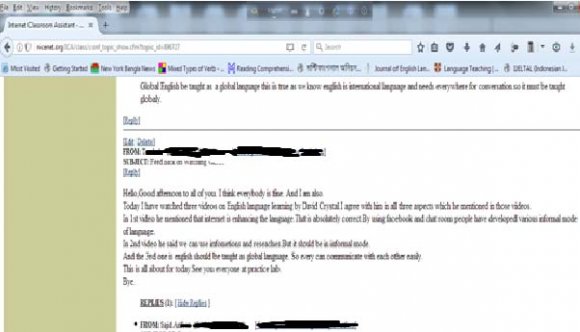
The results gained from the pre-test and the post-test using the research question-Does Nicenet enhance students' ESL writing ability? e) Discussion Forum A discussion forum was created and students were advised to join Nicenet using the class key given by the course instructor after the first week of the course. The instructor worked as administrator of the discussion forum, made group private and managed members to allow or limit messaging between members while they posted messages to all members. Students used the Nicenet conferencing as a place for publishing their writings, and most importantly as a space for providing and receiving peer feedback. In addition, the conferencing was also used for sending guidelines, announcements, assessment criteria and resources such as reading materials, video clips and links to web pages.
Nicenet, a supplement to in-class instruction, was described and instructed to use as a course tool. Students were advised to check the specific tasks posted and to answer the quizzes and were encouraged to check the daily posts and comment on them. In addition, the students were encouraged to post short paragraphs on any topic of their choice.
8. g) The Learning Satisfaction Survey Questionnaire
The learning satisfaction survey questionnaire was used to gather students' opinions regarding the use of Nicenet forum. The survey consisted of 5 questions using a Likert scale (5=strongly agree, 4=agree, 3=not sure, 2=disagree, 1=strongly disagree Evolving EFL Writing Through Interactive WEB 2.0 Tool Nicenet: Students' Perceptions in a Bangladeshi Context questionnaire was about the use of the Nicenet forum in general and their attitudes towards effects of using Nicenet for EFL writing in particular.
III.
9. Results
The statistics of writing task scores suggest a significant increase in the average performance of the students as they posted on (Nicenet) online forum (table 1). There is a clear increase in the mean scores (20.41) and in the standard deviation of performance (3.337) from the pre and to the post tests of writing tasks. A chi-square test had been formulated to find whether students' performance between before and after usage of Nicenet are different (table 3). From the above table, it is obvious that Pearson-chi square value 14.775 is quite higher than the value of 95% confidence interval. Hence, it is proved that the null hypothesis is rejected. Overall, the study shows positive evidence for the use of WEB 2.0 tools in developing students' English writing skills.
10. IV. Results of Learning Satisfactory Survey
At the end of the 12 th week, participants were asked to complete the learning satisfactory survey questionnaire to gather students' confidence, motivation and attitudes towards the Nicenet for English writing course. Students responded to questions about their uses of Nicenet forum in general and their perceptions about advantages and disadvantages of the Forum.
11. a) Confidence
In term of enhancing confidence, 89.7 % of the students are of the opinion that Nicenet enhanced their confidence to write English because they were able to express their ideas in English and to their friends. Posting in the Nicenet forum made them feel socializing with their friends enjoying a relaxed atmosphere of learning English. Further, data supported that students felt confident to write in English because they had less anxiety.
12. Motivation
The integration of Nicenet and peer assessment can enhance students' learning, motivation, interest, and interaction through information exchanging and knowledge sharing. Students admitted that it created an environment for enhancing their motivation to write English. In this study, 87% of the students agreed that Nicenet is a wonderful ground for increasing their motivation. With the help of peers' comments and suggestions, students were able to revise and edit their posts or tasks and republish their prior tasks. In the end, the task was rechecked by the instructor and that time a feedback was given to ensure the quality of the task.
V.
13. Discussion
Daily observations of students' tasks, attitudes, reactions and discussions as well as responses to the questionnaire showed that students enrolled in the Nicenet Forum were active and responsive as they posted more than 280 responses during this research.
The students reported (on the basis of their comments) that the Nicenet was easy to use as it had been featured with few course tools like discussion forums, resources, and personal messaging etc. as well as it required very general IT skills which encouraged them to participate more promptly.
Comparisons of the pre and post test scores showed significant differences in writing achievement.
14. b)
enthusiasm and motivation provided by the course as well.
The students found the online instructions and tasks were important with the combination of fun and considered it as a new way of leaning and developing English writing. It created a warm flexible learning environment between the students and instructor and among the students themselves. However, some students did not take the initiative to post any responses if not prompted by the instructor because using the internet as a learning tool was not common in their education system. They were so used to traditional instruction that depended on books.
That is why; online courses must be selected carefully and must be introduced gradually especially when used in a less available e-resources environment and with freshman students of low proficiency in English, limited computer knowledge as well as of with no prior experience in online instruction.
15. VI.
16. Conclusion
Nicenet as an online portfolio enables students to reflect on their learning process and provides feedback from more capable peers. The interactions and sharing of their experiences increase the practical use of the target language, which is highly essential in the learning process. Using this tool, keep in mind that learning is a developmental process, most importantly students can reflect, change or edit what they write and thus, improve their self-editing skills. This also helps students monitoring their own progress to become more reflective and independent learners. In addition, it facilitates writing to a real reader, hence increases students' self-confidence and motivation to write more and share their experiences with peers. Thus, the study concludes that Nicenet accelerates student-centered learning and allows the students to explore and share their learning experiences outside the classrooms which may also be proved right for any ESL/EFL contexts like Bangladesh.
| N | Mean | Std. Deviation | Std. Error Mean | ||
| Pre-test | 50 | 14.33 | 2.700 | .398 | |
| Post | 50 | 20.41 | 3.337 | .492 | |
| test | |||||
| To test our research objective whether the use | |||||
| of online threaded writing has any impact in improving | |||||
| students' performance, | one sample | test of | |||
| independence in two tailed normal distribution was set | |||||
| and the use of Nicenet in developing ESL writing has | |||||
| indeed a clear impact on students' performance | |||||
| (20.413) shown in table 2. | |||||
| Test Value=0 | |||||
| 95% Confidence Interval of the | |||||
| Nicenet Use | t | df | Sig.(2 tailed) | Mean | Difference |
| difference | Lower | ||||
| Before | 35.984 | 45 | .000 | 14.326 | 13.52 |
| After | 41.487 | 45 | .000 | 20.413 | 19.42 |
| Value | Df Asymp. Sig. (2-sided) | ||
| Pearson Chi-square | 145.77a | 120 | .055 |
| Likelihood Ratio | 89.139 | 120 | .984 |
| Linear-by-Linear | 10.385 | 1 | .001 |
| Association | |||
| N of Valid cases | 50 | ||