1.
severe shortage of essential energy infrastructure is undermining Nigeria's efforts to achieve significant social and economic development. It is deduced that a sustainable economy is built on modern energy system, but the Nigerian energy sector has not yet gotten to the developed status. This research attempts to investigate energy use in Nigeria, and thereby its significant effect on Nigerian economy. Nigeria is possessed with the features of LDC such as; shortages of foreign exchange and resources for development, higher levels of market distortion, relative paucity of energy. Nigeria experience with industrialization has not been sustainable over the years. Consequently, a call for sound industrialization in Nigeria may be the broad requirement for a sustainable economy. Industrialization implies vast social and economic changes. For instance, replacement of laborintensive technique with capital-intensive technique, hand tools by machine tools, a general tendency towards urbanization. Energy supply is therefore suggested as the core factor that is required to enhance industrialization policy.
The energy sector plays a vital role in overall economic activities, as it serves as a prerequisite for sustainable development of an economy. Therefore, energy planning requires link between energy sector and the rest of the economy, and also interaction between different subsectors within the energy sector. According to Bhattacharyya (2011), energy is classified into primary and secondary energy. The primary energy are those energy that have not undergone transformation such as, coal, crude oil, natural gas, solar power and nuclear power. The secondary energy is referred to as transformed energy purposely to make it useful for consumers; such as oil products and electricity. Also primary energy is classified into renewable and non-renewable energy. There has been expanse transition in the primary energy supply system in Nigeria. Formerly, coal was the main source of energy until later when crude oil and natural gas were introduced. To measure the primary energy utilization in Nigeria, it is accurate to focus on at least any of the followings; oil, gas and nuclear power; this is because they generate a significant amount of primary energy use in Nigeria. However, the research background of this study is restricted to oil and gas sector.
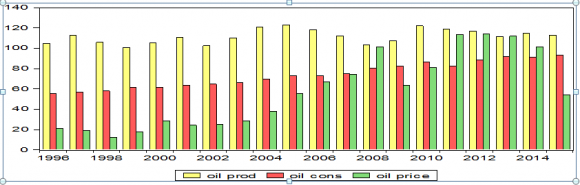
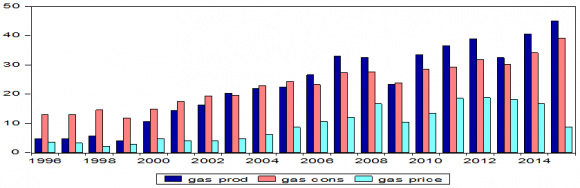
Figure 1 and 2 show the production, consumption and price of oil and gas over the years. The evidences show that there has been under utilization of energy over the years. Increasing prices of oil and gas theoretically supports the excess oil production over its consumption over the years. The reason for the disequilibrium in the oil production and consumption identified in Figure 1 is that, Nigeria has one of the richest energy resource centres, but regulatory uncertainty, militant activity and oil theft in the Niger Delta are deterring investment and production. Figure 2 shows a slight disequilibrium in the production and consumption of gas over the specified years.
2. II. Objectives
This work attempts to look at oil and gas consumption in Nigeria. The purpose of this exercise is to investigate the effect of energy use in the oil and gas sector in stimulating the activities in the economy to be sustainable. The following objectives are designed to aid the execution of the aforementioned research topic; 1. To investigate if the energy consumption in the oil and gas sector generate any significant effect on the activities of the Nigerian economy. 2. To examine the energy use in the oil and gas sector as a factor required towards transitioning Nigeria from their developing status to a developed nation.
3. III. Relevance
A sustainable energy provides services such as lighting, heating, transport, communication and mechanical power that support education, better health, higher incomes and general improvements in the quality of life. Economic roles of the energy industry maybe vital to reviving an economy at a time when issues when issues of unemployment, inflation and low investment are so critical, in other words, a period of economic recession. Energy is regarded as the lifeblood of the global economy; a crucial input to nearly all of the goods and services of the modern world, (Voser, 2012). The energy industry is undoubtedly an engine of growth as its products serve as inputs for production, (NTWGS, 2009).
This research work attempts to explore the inevitable contributions of energy sector on other sectors of the economy. Bhattacharyya (2011) categorized the economic areas linked with energy sector as a supplier of factor input; these are industry, agriculture, residential, commercial and transport.
Evidence from NIRP(2014) shows that the Nigerian manufacturing sector's share of GDP has remained less than 4 percent, contributions to foreign exchange earnings have been minimal and the share of government revenue and employment generated have been very low. This is due to the sector's failure to undergo the critical structural transformation necessary for it to play a leading role in economic growth and development. Also, they identified that there are systematic issues affecting competitiveness in the sector such as energy supply, local freight costs. The implication of this is that low energy supply is a core problem in manufacturing sector.
The broad objective of the agricultural sector has been to be a modern technologically enabled sector that fully exploits the vast agricultural resources of the
4. ( E )
country in order to ensure national food security and contributes to foreign exchange earnings. A sustainable energy supply is relevant to enhance agricultural production; such as the area of transportation of agricultural products, bitumen for manufacturing of pesticide especially for agriculture etc.
Energy use is relevant in residential as it adds to physiological needs of people. Energy use in residential are as follows; maintaining inside temperature, heating water, and cooking, electrical appliances. The form of energy here is final demand, since consumers are interested in transformed energy in order to meet their utility.
ECA (2014), supports prioritizing of power supply for industrial use, because it may generate the following benefits in the country; reduce borrowing costs and mobilize funding for the real sector, facilitate youth training in industrial skills, improve our investment climate, raise our product standard, link innovation to industry and thereby promoting domestic patronage.
5. IV. Methodology
The methodology shows the model specification, data features and estimation procedure purposely to establish the functional relationship between energy use and the Nigerian economy.
6. V. Model Specification
Solow growth model is adopted for this study in order to investigate the degree of energy use in the oil and gas sector that affects the Nigerian economy (see Equation 1). For the purpose of deriving an accurate model specification, it may be necessary to exercise some modifications on the adopted growth model. The model to be estimated is developed on the derivative of Equation 1 (Equation 2), by inserting 'Energy use' derives Equation 3. Re-writing Equation 3 derives Equation 4. Transformation of Equation 4 from its functional form to an estimable form derives Equation 5. Decomposition of the Energy use (?) into "OilCons" and "GasCons" derives Equation 6. It is justifiable to assume that percentage change of GDP is suitable to proxy the degree of economic growth. Furthermore, total investment is used to proxy capital per unit of effective labor. And finally, oil and gas consumption for the amount of energy use in the oil and gas sector. It should be noted that GDP is logged in order to generate its percentage rate and to make it uniform with the rest of the variables, thus, we have a log-linear model. The mathematical model specification is presented as follows:
? t = F (? t , ? t L t )(1)y t = F (k t )(2)y t = F (k t , ? t )(3)GDP t = F (TOTINV t , ? t ) (4)
GDP t = ? 0 + ? 1 TOTINV t + ? 2 ? t + ? t (5)GDP t = ? 0 + ? 1 TOTINV t + ? 2 OILCONS t + ? 3 GASCONS t + ? t(6)Where, GDP t -Measures the level of Economic Growth for the specified years. TOTINV t -Denotes the Total Investment for the specified years. OILCONS t -Denotes Oil Consumption for the specified years.
GASCONS t -Denotes Gas consumption for the specified years. ? 0 , ? 1 , ? 2 , ? 3 are the parameters to be estimated. ? t -Stands for the disturbance term.
LOGGDP t = ? 1 LOGTOTINV t + ? 2 LOGOILCONS t + ? 3 LOGGASCONS t + ? t(7)In time series data estimation, it is routinely to conduct unit root test because of the usual nature of raw data. This is then followed by the appropriate techniques of de-trending raw data such as, differencing and logging. According to Johnston and Dinardo, the presence of non-stationary variables raises the possibility of conintegrating relations. The essence of a structural equation model is an explanation of the movement of the endogenous variables in terms of the exogenous variable. Differencing operation eliminates the long-term movement (trend) in the series. Regression makes sense if a long run relationship exists.
Table 3 shows that all the series estimated in this study were found to be stationary after first difference, which justifies the precondition of applying Johansen method of co-integration. Result of cointegration test indicates two cointegrating equations. Therefore, this was followed by estimating a VEC model in order to determine the significant coefficients that will influence GDP in the long run. About 44 coefficients were estimated in VEC model, but 15 of them were significant to explain the movement of GDP in the long run.
7. VII. Conclusion
Oil consumption plays a vital role in economic development of nigeria. it determines the level of economic growth, overall production of good and services. Empirically, it should be recalled that since the removal of oil subsidy during GEJ regime, the Nigeria economy has been declining significantly. This evidently revealed the relevance of oil use ininfluencing economic activities. Subsidy removal on oil would have been a good policy if revenue generated from it was channeled towards good governance. Due to corruption, political instability, unproductive feature of the economy, oil subsidy removal policy may not be effective in Nigeria. On the contrary, oil subsidy will enhance aggregate production, and hence augment economic development, since oil use is connected with all economic activities. This study has shown that oil use is required for a sustainable economy. Therefore, it is recommended that the Nigerian government should subsidize oil and employ othermeasures to curb the oil exploiting businessmen (known as the cabals).
8. Appendices
| S/N | Variable | Definition | Source | Year | Unit of Measurement |
| 1. | GDP | Gross Domestic Product | Organization Exporting Countries (OPEC) of Petroleum | 1996-2015 | Millions |
| 2. | TOTINV | Total Investment | World Economic Outlook (WEO) | 1996-2015 | Millions |
| 3. | OILCONS | Total Oil Consumption | World Energy Outlook (WEO) | 1996-2015 | Millions |
| 4. | GASCONS Total Gas Consumption World Energy Outlook (WEO) | 1996-2015 | Millions | ||
| VI. Estimation Procedure | |||||
| total investment and oil consumption are significant | |
| shows the results of residual diagnosis on estimated models. The linear model specified in equation 6 was estimated, and the result indicates that | variables to explain the level of economic development. However, the model is not reliable because it is serially correlated. Consequently, the series was logged in order |
| S/N | Residual diagnosis | Linear model | Log model |
| 1. | Autocorrelation | 0.0190 | 0.1177 |
| 2. | Heteroscedasticity | 0.1646 | 0.1453 |
| 3. | Normality | 0.6381 | 0.3678 |
| Source: Author's computation |
| S/N | Series | I(0) | I(1) |
| 1 | GDP | 0.9926 | 0.0005 |
| 2 | TOTINV | 0.0798 | 0.0002 |
| 3 | OILCONS | 0.9817 | 0.0012 |
| 4 | GASCONS | 0.9996 | 0.0018 |
| Source: Author's computation |