1. Introduction
bdullah Thani bin Raja Kecil was better known as Ahmad Boestamam. He was born in Behrang Ulu, Tanjung Malim, Perak in 1920. His struggle took place during the same period as Dr. Burhanuddin Al Helmy and Ishak Hj Muhammad. Their difference was only in terms of educational background. The principles and philosophy of their struggle were somewhat different, but they shared the same goal which was to oppose British colonialism and to strive for the independence of Malaya. Dr. Burhanuddin fought for Malay nationalism and Islamic philosophy but Ahmad Boestamam fought for Malay nationalism and socialism. Ahmad Boestamam's radical take, rose to prominence during his school days, through his involvement in journalism. He has a radical mind. His writing was sharp and pithy. He had an indomitable spirit and was willing to face any obstacles for achieving Malay political goals.
2. II.
3. Struggle in Media
During post-World War II, he and a few of his friends confiscated Perak Shimbun printing office on August 1945. This was accomplished without the need to spend any capital but it needed courage (Ahmad Boestamam. 2004). The incident occurred soon after the end of World War II, during the lapse between Japan, Malayan People Anti-Japanese Army (MPAJA) and British. This opportunity was taken since MPAJA guerrillas and members of the Communist Party of Malaya (PKM) had occupied many buildings emptied by the Japanese authorities. The seizure was carried out with determination to channel his thoughts and ideas, so that the Malays would rise to fight for the independence as well as the welfare of their own people. He was on the British watch since his early involvement in the field of journalism. Thus, his movement had always caught the attention of the British authorities (Malayan Security Service. 1946).
At that time there was a prevailing administrative vacuum in Malaya. This opportunity was used by them to master the printing office and all the facilities. The acquisition of a printing office facilitated their push to publish their own newspaper. With the confiscation of the printing office, the publication of a progressive Malay newspaper in Perak can be realized. Suara Rakyat newspaper was officially published in Ipoh, Perak (A.J. Stockwell.1979) Besides that, Abdul Samad Ahmad had a vast experience as a typesetter in Berita Perak newspaper and was appointed as a member of Suara Rakyat's editorial board. Distribution of works had been done to facilitate the task. Ahmad Boestamam was tasked as an editorial columnist. Mohammad Hanif and Dahari Ali were tasked as news reporters who were responsible for finding local and foreign news which were later translated and published in Suara Rakyat. Mohammad Hanif was also tasked to write articles. In addition, Abdul Samad Ahmad was appointed as head of printing and typesetter. Arshad Ashaari was responsible for managing the sales, advertising and distribution matters. Arshad Ashaari was Moktaruddin Laso's confidant and had successfully conducted distribution assignments neatly and thoroughly.
Ahmad Boestamam stressed that the main purpose of Suara Rakyatwas to create awareness among people about the importance of the state, explaining the rights and responsibilities of the Malays and describing from the rights of the Malays in the British administration of Malaya to the Malays understanding their rights that had been excluded. He emphasized this in the editors' column of Suara Rakyat Suara Rakyat is indeed a Malay newspaper aiming at expressing ideas or atau concerns of the general public. Therefore the public are welcomed to use it to the fullest. So concerns and wishes of general public will be considered.
(Suara Rakyat. 1945)In order to enlighten the people, especially the Malays and also the immigrants, Suara Rakyatalways took the approach to oppose British in its early years to gain the attention and support of the general public who did not dare to fight against the British. The main message was the call for the people to unite and oppose the injustice that occurred and demanded a system of government based on the concept of democracy to form own government.
In fact, in the next issue, Suara Rakyat had voiced a recommendation for British to grant independence to Malaya immediately, together with Indonesia. The newspaper also pointed out that the independence of Malaya shall be given using a democratic system that put the interests and will of the people to determine the independence of Malaya (Suara Rakyat.1945). In an editorial column, Ahmad Boestamam asked the British to give preference to the people of Malaya the right to determine their own government. He stressed:
Thus, in Suara Rakyat view, the aforementioned way of governing the country or enacting laws is what called democracy.
(Suara Rakyat.1945) For this recommendation to be successful, Ahmad Boestamam suggested the following to the British:
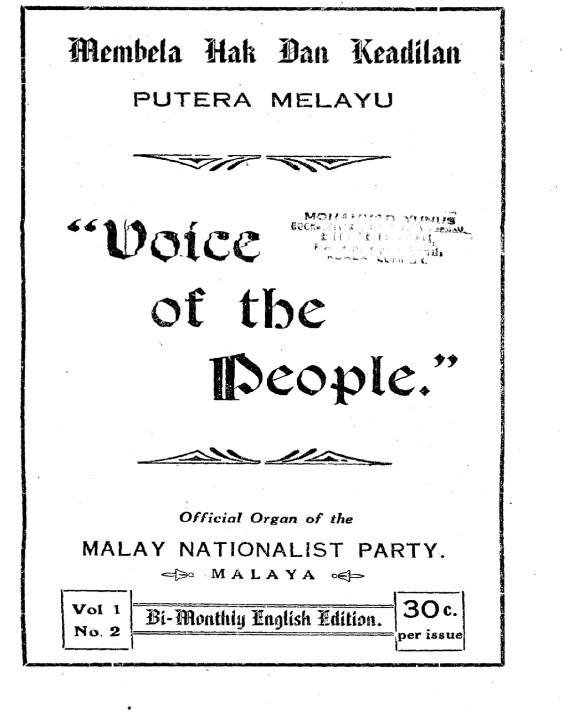
It is sufficient if the power is given to every group of people comprising 500 people to express their desires in the House of Representatives, or the public halls where any laws to be created or formed will be decided later. (Suara Rakyat.1945) He further explained that democracy was the right of the public, including the Malays. In fact, he said democracy was fundamental in the teachings of Islam and had been the practice of the Malays for a long time prior to the arrival of the British. Thus, democracy should be granted back and practiced in Malaya. Therefore, he stressed, and said the following to British: "We urge for democracy to be implemented in Malaya?" (Suara Rakyat.1945). This warm and encouraging response made the editorial board of Suara Rakyat to think that the time had come for the reader base of their newspaper to be widened and also it involved the elite Malay aristocratic to an uprising balanced between the aristocracy and the common people. Therefore, to strengthen the political struggle of the Malays, they also tried to publish Englishlanguage newspaper. The newspaper was named Voice of The People which was also managed by the same publishing company as Suara Rakyat. The first issue of Voice of The People was distributed in October 1945. Contents of this newly published newspaper was identical to Suara Rakyat. It criticized and slammed the British colonial authorities, aristocrats and the common people who are indifferent to the struggle for the independence of Malaya.
The influence of political developments in the outside world played an important role. For Ahmad Boestamam, political conditions in China also had a profound impact among the Chinese community in Malaya. In fact, the political developments in China had become more interesting to be studied and exemplified by the whole people of Malaya. At that period, China were experiencing a civil war between nationalists under the Kuomintang Party and the communists led by Communist Party of China, and this event had also attracted the attention of the Chinese in Malaya. The clash between these two factions had seemed to have no end. But the Chinese people's struggle must be continued and questions raised by Ahmad Boestamam were whether the clash or conflict with bloodshed can be avoided? The answer to this question was very difficult since a struggle requires sacrifice and the sacrifice was inevitable in bloodshed and tears. That was the very meaning of a struggle. Therefore, national struggle should be the core of a country. This was intended to consolidate and strengthen the struggle of the people. In order to deal with the problems of war and conflict, the best way for a country, no matter China or Malaya was election(Suloh Malaya.1946). That was what recommended by Ahmad Boestamam.
Through Suara Rakyat, every dissatisfaction was expressed without fear. Ahmad Boestamam voiced various ideas and opinions regarding setbacks and the need for the Malays to rise to defend themselves. Journalism has matured the political struggle and highlighted the charisma and leadership of Ahmad Boestamam. His ideas and thoughts were very thoughtful and able to touch the hearts of readers, especially the Malays at that time. The firmness and sharpness of Ahmad Boestamam's writing in criticizing the colonialist can be seen in his writing as follows:
We lashed, we lashed without skin. If we criticize we criticize to a great magnitude. Words like 'cruel', 'undemocratic' and such have been part of our game on every single day.
(Ahmad Boestamam.2004) These sharp and scratching criticism were expressed in written form through an article published in the newspaper. The sharpness of these offensive ideas and criticism towards British made him to be constantly monitored by the British authorities, in fact, he was called before the British authorities in 1945. The principle of "freedom of press" saved him from being penalized. However, since his name was listed in the category of those who can endanger British's position in Malaya, he was blacklisted by the British (Malayan Security Servive.1948). Suara Rakyat was used to its best possible use in order to awaken the Malays. The newspaper criticized British's brutal and undemocratic acts. The shooting event in Teluk Anson, Perak was a tragedy that could not be accepted by the Malay (Ahmad Boestamam.2004). For the radicals, this demonstration was just a peaceful demonstrations aimed to express their dissatisfaction against the British administration. But the British had the opinion that the shooting was intended to break up people's demonstrations so that it would not spread and jeopardize national security. Here, two contradicting approaches in interpreting democracy were clashing with each other. Therefore the issue of demonstrations and democracy had always been a hot issue for past and present. It was a key issue in the political struggle and have always spoken of in the press. The Malays were not happy with the unjust way the British government acted and the fate of the Malays after the war had not changed. Suara Rakyat's vocal approach has caused dissatisfactions for British but at that time there were no serious actions taken, apart from their demand that proper apology must be published in the newspaper. Such actions did not affect the exponents for the paper. Suara Rakyat's development was very encouraging and well received in the state of Perak, the total output and sales increased from time to time. Suara Rakyat was quite well received and it managed to convince the general public about the need to unite and to continue fighting, this assertion can be proven by examining responses from readers with their pithy comments. Among positive outlooks among readers regarding articles published in Suara Rakyat were as follow:
We Malays have lived in darkness for centuries. We did not have a chance to raise our heads to speak out our freedom. This is a golden opportunity for us to unite to fight for our demands. Our young people must be united and make a way to demand freedom and equality. Please support MNP for they are able to help us towards that. Now we must unite and force ourselves to support the cause of MNP. MNP will bring us to relinquish the freedom of the Malays ... We think it is better to die than to deny the freedom of our country. I therefore call on all youth and you gentlemen, to give full support to MNP.
(Suara Rakyat.1946) III.
4. Struggle in Political Arena
Boestamam used his pen to influence the readers, especially the Malays, on the need to have a sense of awareness and the rise to fight for their people which had long been colonized. Through the newspaper, he suggested that a political organization must be formed to defend the Malays. In fact, he was willing to use his position in Suara Rakyat, for the success of a proposal such as the establishment of a political party for the Malays. His hard work was paying off with the birth of a Malay political party in Malaya by the name of Malay Nationalist Party (MNP). Ahmad Boestamam was willing to establish political party in order to achieve his political ambitions, in contrast to Dr. Burhanuddin who had never set up a political party but was often invited to lead one. Ahmad Boestamam was a brave politician who will ensure that the struggle was accepted by his friends when he formed a political party. MNP was the first political party to show his direct Volume XVI Issue II Version I 27 ( D ) political involvement, which was in 1945 (Ahmad Boestamam.1972).
Malay Nationalist Party (MNP) was officially established on 17 October 1945 in Ipoh, Perak. The first party flag was red and white in colour. It aimed to inform all members and the people of Malaya that MNP's official which was known as Sang Saka Merah Putih had profound meaning towards the fight against British in Malaya. The decision to make Sang Saka Merah Putihas the official emblem and the flag for MNP was decided in the party's first congress held in Ipoh, Perak on November 30 to December 4, 1945. The meaning of red and white colour, as published in Suloh Malaya press, issued on 15 Mei 1946 was military-like: If we're to suggest a color then we suggest that the color would be red-white. There are at least three reasons why we agreed with red and white colors: 1. Red and white are the colors of the national flag of our neighbors, Indonesia who had 2. According to some histories, red-white was the flag of Hang Tuah's struggle, a renowned 3. Red-white has profound and accurate meanings.
Red means bold (blood), white means (Suloh Malaya.1945) Thus, MNP fighters chose the red and white flag as a symbol of their struggle. In this case it symbolizes courage and strength and their bravery to confront the British who were colonizing Malaya. This was also a source of inspiration to MNP members who were mostly of Indonesian descendents. By taking the spirit of the Indonesian people who defeated the Dutch in Indonesia as example, it was not merely a spiritual struggle but also the struggle of blood and tears. The struggle of using sharp bamboos as weapons.
Then he set up the Angkatan Pemuda Insaf (API) in 1946. API is a youth wing of MNP. Through API, his leadership was increasingly evident. He was able to travel all over Malaya to seek support and developed API influence. ii API had a very radical and was listed by British as a political organization which endangered British's position in Malaya. British also categorized API as equivalent to CPM by allegations that there were close cooperations between the two organizations. This charge was listed in Malayan Security Service report (Malayan Security Servive.1947).
iii API opposed so hard and tried to drive British out of Malaya, and this can be found in British'sColonial Office document."...the API demands the quitting of all Dutch forces in Malaya." (CO537/2140.136697). Ahmad Boestamam's leadership was evident through API movement and he was inspired to form the paramilitary forces through Ants Army which was founded by Sukarno in Indonesia.
The struggle of political parties based on Malay nationalism was readily accepted by the community at that time because of their love of their own people, which is a human nature. It 13,350 people, the total membership from five areas was very active. In fact, in the meeting to establish MNP branch, the Suara Rakyat newspaper were distributed to the audience. In doing so, the role of the press had became wider and well-known. Such a situation was a result of the distribution of Suara Rakyat newspaper that successfully exposed news on MNP's establishment and membership campaigns conducted by the newspaper. MNP including API and AWAS movement were active in five districts in the state of Perak Ipoh (Kinta), Dinding, Krian, Batang Padang and Kuala Kangsara. MNP's active nature was recognized by the British. It was recorded in Colonial Office-Malaya Command, Fortnightly Intelligence Review No. 60. Malay Affairs confidential report (CO537/2140.136697). These statistics showed that the Malay youth of Perak, Selangor and Pahang have a strong will and determination to expel the British out of Malaya.
Since the beginning of the fight, they had been stressing out the importance of independence, API and AWAS move towards achieving that goal. The emergence of API and AWAS made British to be more cautious. Assessment and firmness of API movement was clearly stated by their leader Ahmad Boestamam in API's Political Testament. The objectives of API's establishment were to achieve the following:
1. Uniting enlightened youth in one PACT.
5. Strengthening the struggle for the nation and the homeland air. 3. Provide political, SPIRITUAL and PHYSICAL
training to the youths so that they are always ready to be a leader whenever required. 4. Rebuild Malaya based on the true notions of democracy, according to the sovereignty of the people. 5. Demanding for representatives in the government of Malaya.
(Ahmad Boestamam.1946) In API's Political Testaments, it was clearly and distinctly outlined that they were against the British and categorized Malaya as colonized and semi-colonized countries. API interpreted that Malaya was semicolonized due to the involvement of the Malay race, represented by the Malay elites who joined the British government and and had been suppressing the radical Malay together with the British. Thus, the radical Malay had to deal with various forms of oppression. Therefore, the API outlined five stages of repression carried out by the British colonialists and feudal Malay groups as follows:
1. Oppression from colonialist.
6. Oppression by own race who became the tools for the colonialist. 3. Oppression from feudal groups. 4. Oppression from old-fashioned clergies. 5. Oppression from the capitalists of their own
people as well as foreigns. (Ahmad Boestamam.1946) Recognizing this stage of oppression led the radical Malays to take the stand that they would never Volume XVI Issue II Version I 29 ( D ) and will not be compromised. Their tough stance is enshrined in API Political Testament as follow:
In short, A.P.I. wants to fight for the country to attain independence and with all the existing means, via gentle means if possible, and hard if forced.
(Ahmad Boestamam.1946) Based on this API Political Testament, Ahmad Boestamam was arrested and charged in court on 31 March 1947 by British colonial government for issuing written document alleged seditious. In fact, he was also accused of printing 1000 copies of this documents to be distributed during API Congress held in Melaka (The Malay Mail. 1947) Thus, in 1947, API and AWAS were banned in Malaya, by the British government (Malayan Security Servive.1948).
His prominence in API finally forced him serve prison time on charges of wanting to wage war against the British. Then on 16 Julai1947 API was not only banned by the British but also labeled as an illegal organization. iv Jaafar Hussin, Head I of Temerloh MNP described Ahmad Boestamam as a radical leader and proponent of revolution. He visualized Ahmad Boestamam as burly, bearded, bushy mustache and long hair leader-like Tarzan, such as Bung Tomo character from Surabaya, a prominent Indonesian guerrilla movement.
Via API he became famous and that had provided a reason for the British government to arrest and imprison him with multiple charges of involvement with the communist elements. In leading API, Ahmad Boestamam had been successful in terrifying the British government. His stridency and radicalness finally forced him to be imprisoned in British detention camp for 7 years. His experience was immortalized in his book entitled Tujuh Tahun Malam Memanjang that tells the ups and downs in British detention camp (Ahmad Boestamam.2004). v In recalling the communist accusations that have been made by the British and UMNO against him, an article entitiled "Kenapa Saya Dituduh Komunis" was published in Fikiran Rakyat newspaper dated 5 April 1957 to answer all questions. His writings and criticism always lashed the colonialist and the elite Malay aristocrats which made them unhappy. Thus, he was accused to be a communists or communist sympathizers due to the fact that his criticism was too harsh for the Malays who are under the command of British colonialism. For Ahmad Boestamam, the Malays have lost their identity and goals, and that they just danced to the tune of the West. This is evident in his statement in the following passage; "The Malays are only good at following the tunes from the West? samba, rumba and conga?" (Fikiran Rakyat.1957). Thus, he had to go through many obstacles.
This fitted well with his position as the Supreme Commander of API (Jaafar Hussin.1989).
A seven-year prison sentence did not weaken his fighting spirit. His release in 1955 gave him a new breath in facing political struggle. Thus, on 11 November 1955 he and his colleagues established the People's Party of Malaya (PRM). This reflects that for 7 years in jail, his soul and spirit had never been bounded. According to Ramlah Adam, Ahmad Boestamam was a very brave left-wing activist. Ahmad Boestamam's bravery was described as follows:
But all that was only temporary. His political agility eventually revived. He only lasted five months. His tame nature was finally lost, swallowed by his strong political spirit. Once he was a radical, he would not turn rightist. That was Ahmad Boestamam.
(Ramlah Adam.1994) After his imprisonment, the radical Malays were still working and formed understanding between them. This was evident when Dr. Burhanuddin was invited by PAS to strengthen the party's leadership in the struggle for the independence of Malaya. This action demonstrated the achievement of a form of understanding between Ahmad Boestamam and Dr. Burhanuddin when Dr. Burhanuddin was invited to lead PAS in 1956 (Ahmad Boestamam.1972).
The first step he made was to ask Ahmad Boestamam and his friends in PRM for advice. This step was performed in order to ensure that the tone and actions remain the same as before, to be more pungent and radical. This claim may be asserted through dialogue between them as follows:
With me at the helm of the leadership then it would be easier for me to instill a leftist soul in it. In other words, Dr. has the ambition to make PAS a progressive Muslim movement, is it ? Dr. Burhanuddin thanked us for giving our blessing to him to lead PAS. And we hoped that he managed to carry out his ambition in making PAS as a progressive and left-minded Islamic movement.
(Ahmad Boestamam.1972) PRM's establishment was a continuation of Ahmad Boestamam's struggle. He was a far-sighted politician. Because of that, he also used methods of cooperation with Chinese radical political parties. In 1957 he led the PRM to establish political cooperation with the Labour Party of Malaya (LPM). This collaboration gave birthto Socialist Front (SF) on August 31, 1957. (Ahmad Nizamuddin.1988). SF was a coalition IV.
7. Conclusion
Ahmad Boestamam was a figure that varied his means to voice his opinions and views on British colonialist. Apart from setting up a political party, he was also active in the field of writing and journalism. In politics, the highlight of his career was being elected as an MP of Setapak from 1959 to 1964 in election and subsequently elected as Opposition Leader for the Parliament of Malaya for one term. In journalism, he made a name as a critical and incisive journalist via his writings. He also used the arts in order to awaken the Malays. He had also written short stories and poetry. Due to the intensity and sharpness of his writing, he was eventually entrusted to leadUtusan Sarawak newspaper as Chief Editor cum personal political assistant to the Chief Minister of Sarawak, Datuk Patinggi Abdul Rahman Yaakub from 1970 to 1971 (9 months) (Ramlah Adam. 1994).
The integrity and friendship between him and Dr Burhanuddin was not merely in political struggle before independence, but the tone and rhythm of their struggles remained the same in the post-independence era. They understood each other and never hit back, though they was in different parties. Even so, they are both part of the Malaya's House of Representatives in 1959-1964. That was how closely and mutually they understood each other in dealing with the real enemy namely the British and the leadership after independence. This situation proved the integrity of cooperation and understanding among Malay radical figures. They can work together despite different ideologies. In any case, they were never hostile, in fact they were willing to compromise in order to achieve the ambition of liberating Malaya and to stay loyal in their struggle under the Greater Malay concept. His political experiences were written in his historical works such as Tujuh Tahun Malam Memanjang, Meniti Jalan ke Punchak dan Pengalamanku Perjuanganku serta Dr Burhanuddin, Putera Setia Melayu Raya.
Thus, their struggle was recognized by Tun Dr. Ismail bin Abdul Rahman, Deputy Prime Minister of Malaysia (1970Malaysia ( -1973) ) during his speech when he received an honorary Doctor of Laws at Universiti Sains Malaysia Convocation on September 23,1973as follows:
Even though independence were achieved by the moderate, history proves that radical nationalists had also contributed to the achievement of independence. vi Finally we can say that Ahmad Boestamam was a Malay politician who was ahead of his time. In the situation where the community and the Malay leaders were in conducive state, he had risen and called on the Malay to resist British colonialism and later the independence of Malaya. given below:
References Références Referencias

| STATE | BRANCH MEMBERS | DEVELOPMENT | SOURCE | |||
| BIASA | API | AWAS | REGION | |||
| PERAK | 11,000 | 2000 | 350 | 5 | Good | K.Kampung |
| SELANGOR | 3500 | 1050 | 400 | 4 | Good | CID |
| N.SEMBILAN | 1700 | 800 | 120 | 3 | Weak | CID |
| MELAKA | 4000 | 900 | 70 | 2 | Good | - |
| JOHOR | 1000 | 400 | 130 | 4 | Good | Dato Onn |
| SINGAPURA | 2500 | 600 | 140 | 1 | Good | CID |
| PAHANG | 6000 | 1000 | 100 | 3 | Good | - |
| TERENGGANU | 5200 | 300 | 60 | 2 | Good | - |
| KELANTAN | 2300 | 700 | 80 | 6 | Good | Raja & CID |
| PERLIS | 800 | 120 | 1 | Weak | Raja & CID | |
| KEDAH | 720 | 100 | 2 | Weak | Other parties | |
| P.PINANG | 3000 | 600 | 1 | Good | - | |
| S.PERAI | 1400 | 200 | 40 | 1 | Good | - |
| SUM | 43,120 | 8.770 | 1,490 | 35 | ||
| TOTAL | 53,380 | |||||
| Fig. 3 : | ||||||
| existed among the Malays | ||||||
| from then until now. Not only MNP Center was | ||||||
| established in Ipoh was well received but MNP's | ||||||
| branches established throughout the state of Perak was | ||||||
| equally well received as in Sitiawan, Pasir Panjang, | ||||||
| Lumut, Kampar, followed by Gunung Semanggol, | ||||||
| Taiping, Kuala Kangsar, Kerian and Batu Gajah. The | ||||||
| same can be said in Hulu Langat, Selangor and in | ||||||
| Temerloh, Pahang. It was estimated that MNP's | ||||||
| membership reached 53.380 persons by December | ||||||
| 1947 (A.J. Stockwell.1979). According to AJ Stockwell, | ||||||
| on average, the statistical distribution of MNP | ||||||
| membership in Malaya were as follows: | ||||||