1. Introduction
ounterproductive behaviour has gained importance due to its influences on organizations and employees. Recently, researchers have conducted studies which show its causes on individual and organizational levels (Appelbaum & Matousek 2007). Individual and organizational factors are known to influence the behaviour and attitudes of their employees. One of the major concerns of many organizations that need urgent attention is counterproductive work behaviour which is assumed to be a problem that violates significant organizational norms and threatens the wellbeing of an organization, its members, or both. Counterproductive work behaviour is an urgent concern for the organizations because it is assumed to cost organizations billions of dollars each year (Bennett & Robinson, 2000). Counterproductive work behaviour imposes numerous costs on organizations such as decreased performance (Hussain, 2014), lower levels of productivity, lost work time, higher intention to quit and stress problems for other workers (Appelbaum & Matousek, 2007).
Today organizations operate in a very competitive global environment. Given the major expense for most organizations is the cost of labor, any step that can be taken to reduce these costs will be beneficial. Therefore, increasing productivity and reducing counterproductive work behaviour are better strategies along with Person-organization fit (Silversthorne, 2000). Since well-run corporations of the world have distinctive cultures that somehow are responsible for their ability to create, implement, and maintain their world leadership positions (Schwartz and Davis, 1981), finding employees that have good fit with the organization is critical.
Person-organization fit (P-O Fit) has implications for organizations to establish and maintain a 'good fit' between the people and their jobs. Companies use a substantial amount of resources when recruiting new employees and it is crucial for them to ensure that these new hires will align with the environment they are put into. Finding the right person for the job is an important task to be filled by the achieving a higher quality of work life. Hence, personorganization fit is an important concept both for employees and employers and can be broadly defined as the compatibility between employees and the organizations. A good fit between organization and employee is important, especially when considering the impact of work-related factors such as job satisfaction, organizational commitment, employee turnover and counterproductive work behaviour which are important work outcomes for competitive advantage. Workers who fit well in their organization are more likely to experience positive work-related outcomes, such as greater job involvement (Blau, 1993), better work attitudes (Caldwell & O'Reilly, 1990), and Organizational Citizenship Behaviors.
The relationship between P-O fit and counterproductive work behaviour is not necessarily direct rather, several variables are likely to intervene and moderate the relationship. A meta-analysis suggests that the variables such as task performance, selfesteem, and agreeableness, among others, are tied to person-organization fit (Kristof-Brown, Zimmerman, & Johnson, 2005). These variables address personal characteristics and performance ability that could be related to the occurrence of counterproductive work behaviour. Furthermore, these prospective moderating variables, task performance, self-esteem, and agreeableness, refer to the degree of adequacy with which workers complete their job-related tasks, how positively or negatively they think of themselves, and the extent to which employees are pleasant and accommodating.
There is no exaggeration to say that the destiny of an organization lies in the hands of the individuals working in it (Dawley, Andrews & Bucklew, 2010). Hence person-organization fit is essential for the productivity of the organization and also for the psychological wellbeing of the employees. As Robbins and Judge (2009) described that organizations faces a dynamic and changing environment and requires employees who are able to readily change and move easily between teams. It is more of importance that employee's personality fits with the overall culture than with the characteristics of any specific tasks. Values are considered a primary component of an organization's culture. Values are "an enduring belief that a specific mode of conduct or end state of existence is personally or socially preferable to an opposite or converse mode of conduct or end-state of existence". Values have a major impact on organizations. They are at the core of personal behaviour, influence the choice we make, the people we trust, the appeals we respond to, and how we invest in our time and resources. At the organizational level are viewed as a major component of organizational culture
2. Research Methodology a) Sample
The population of relevance was all employees working in the manufacturing industries in Baddi, Himachal Pradesh. This excluded administrative personnel as well as human resource management department. The unit of analysis was therefore the employees related to production and their supervisor. The present study involves voluntary participation by the employees. Researcher used convenient sampling method to collect the responses of all the participants. The size of the sample is 300 (N=300). The sample consists of 150 male participants and 150 female participants. The age of the respondents ranged between 18-58 years. In the total sample of 300 respondents, 207 respondents were married and 93 respondents were unmarried. 126 of 300 respondents were temporary employees in the companies, 114 respondents were working on contract basis in their respective companies and 60 respondents were regular employees.
3. b) Design
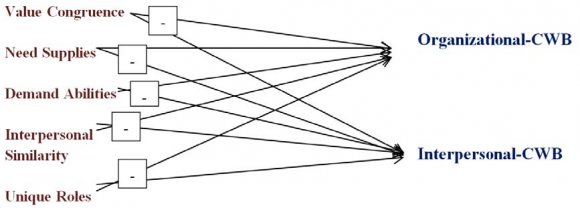
Correlational research design has been employed to see the relationship between the four dimensions of person-organization fit (value congruence, need supplies, demand abilities, interpersonal similarities and unique roles) and two dimensions of counterproductive work behaviour (organizational and interpersonal-CWB). Further, regression analysis was computed for the total sample and separately for both the genders to find out the best set of predictors of counterproductive work behaviour. t-test was also computed to find out the significance of difference on all the independent and dependent variables. (Spector, 2006) Participants responded to a 45-item self-report CWB-Checklist scale developed by Spector (2006). Items asked respondents to rate the extent to which they engaged in counterproductive work behavior. Items were rated on a 5-point likert scale with 1= Never to 5= Every day. Sample items include "Purposely worked slowly when things needed to get done" and "Took supplies or tools home without permission". Cronbach alpha of 0.86 was reported for this scale.
c) Tools i. Counterproductive Work Behaviour-Checklist (CWB-C)ii. General Environment Fit Scale ( 1 indicates that when independent variables were entered in regression model with organizational-counterproductive work behaviour as criterion for the total sample, Interpersonal Similarities itself accounted for 12% of variance. A significant increase of 4% was obtained in R 2 when these variables were entered along with Need Supplies accounting for 16% of the total variance. Table 2 indicates that for the total sample, when independent variables were entered in regression model with interpersonal-counterproductive work behaviour as criterion Unique Roles accounted for 4% of variance. A significant increase of 2% was observed in R 2 when these variables were entered along with Need Supplies accounting for 6% of the total variance. Table 3 indicates that in male employees, when independent variables were entered in regression model with organizationcounterproductive work behaviour as criterion, Unique Roles emerged as the best predictor accounting for 12% of variance. A significant increase of 5% in R 2 was observed when it was entered along with Need Supplies accounting for 17% variance. A significant increase of 3% was observed in R 2 when these variables were entered along with Need Supplies accounting for 20% of the total variance. Table 4 indicates that in male employees, when independent variables were entered in regression model with interpersonal-counterproductive work behaviour as criterion, Unique Roles emerged as the only significant predictor accounting for 5% of the total variance. Table 5 indicates that in female employees, when independent variables were entered in regression model with organizational-counterproductive work behaviour as criterion, Interpersonal Similarities emerged as the best predictor accounting for 16% of variance. A significant increase of 4% in R 2 was observed when it was entered along with Demand Abilities accounting for 20% of the total variance. Table 6 indicates that when independent variables were entered in regression model with interpersonal-counterproductive work behaviour as criterion Demand Abilities emerged as the best predictor accounting for 8% of variance. A significant increase of 4% in R 2 was observed when it was entered along with Need Supplies accounting for 12% of the total variance. Table 7 indicates no significant mean difference Volume XVI Issue I Version I
3 ( A )between male and female employees on the variables of interest of the present study.
4. IV.
5. Discussion
It was hypothesized that the correlation of the dimensions of person-organization fit which are value congruence, need supplies, demand abilities, interpersonal similarities and unique roles with organizational-counterproductive work behaviour and interpersonal-counterproductive work behaviour will be significantly negative. These hypothesized relationships were tested using Karl Pearson Product Moment Correlation Analysis. The findings of the present study have supported the hypothesized relationships between the variables. Consistent with the findings of the present study is conceptualization of person-organization fit by Cable and Judge (1994); employees prefer organizations where their personal characteristics are aligned with organizational attributes. When employees develop a positive perception concerning their degree of fit with the organization, their liking and communication their organization would be high. Hence, the tendency to act negatively at workplace would be low. Specifically, as demonstrated by this study, when employees Person-Organization Fit is high, the tendency to display a counterproductive work behavior would be low. Demir, Demir & Nield (2015) study is also consistent with the findings of this study. Their findings indicated that person-organization fit has positive significant influence on job performance and organizational identification. The study also indicated that person-organization fit has significant negative influence on production deviant behaviours. Therefore when employees have good fit with their organization they are more likely to identify themselves with their organization which will also enhance their job performance. If person-organization misfit occurs then this will result in employee's engagement in production deviant behaviours, which will influence the productivity of the organization. Another study found out to be consistent with the present study was carried out by Deen & Bosley (2015) argued in their study that a high degree of correlation between personal values and organizational values, which means that increase in positive personal values count for positive increase in organizational values and this strengthens the person-organization fit. And this high person-organization fit makes employees feel more committed to their organization and are less likely to engage in counterproductive workplace behaviours and this will contribute to the development of organization.
Furthermore, it was also hypothesized that there will not be any significant mean difference between males and females with respect to dimensions of person-organization fit, organizational-counterproductive work behaviour and interpersonal-counterproductive work behaviour. The findings of the present study have supported this hypothesis also. The possible explanation for no significant difference found between males' and females' sample lays in interpreting this finding from the labor market perspective and management perspectives. The current unemployment rate is very high reflecting a loose labor market. Hence, the most important factor among employee is to get a job and retain and secure their current position. Moreover at current, companies are more focused to increase their profit rather than sending their employees for development purposes and to experience lost man working hours. In addition, knowing that assigning of duties and matters related to development is considered as 'managerial prerogatives', employees care less on issues related to their fit with organization, their growth, development, organizational support and psychological well-being.
To conclude, empirical evidence has shown that a high level of person-organization fit is related to a number of positive outcomes; whereby, the better the person-organization fit, the greater the job satisfaction the employees experienced (Liu, B., Liu, B., & Hu, J.2010). O'Reilly, C.A., Chatman J. & Caldwell, D.F. (1991) has demonstrated that there is empirical association between person-organization fit and organizational commitment. Person-organization fit was also found to predict intention to quit and turnover (Chatman, 1991;Vancouver, 1994). There is also the tendency that employees will demonstrate a counterproductive behaviour at work place when they are not happy. In addition, when employee starts to develop negative emotions, negative affectivity, cynicism and anxiety, incidences of CWB is inevitable (Aquino, K., Galperin, B.L., & Bennett, R.J. (2004).
V.
6. Limitations
First, the sample of this study was taken from the manufacturing industries alone in Baddi, Himachal Pradesh. Vardi and Weitz (2004) indicated that Counterproductive Work Behaviour is a universal problem and occurs in any work organization. The work nature and work environment between the service and production organizations differs. Moreover, Aryee, Budhwar, and Chen (2002) emphasized that the work nature and work environment between the public and private sector is also different. Therefore, future research should also investigate the occurrences of Counterproductive Work Behaviour in service organization for both the public and private sector. Secondly, this study is a cross-sectional in nature. In cross-sectional study, the data was collected at one point in time (Sekaran, 2003). Henle (2005) point out that employees are more likely to be tactful and covert when doing deviant acts. Such tactful and covert acts were found to be pervasive, costly and harmful to the organizations as mentioned by scholars such as Aquino, and Bennett (2004), and Vardi and Weitz, (2004). This suggests that future Counterproductive Work Behaviour research should adopt the longitudinal study. In longitudinal study, the data will be collected over time (Sekaran, 2003). Therefore, it will provide avenues for tracking the employees work behaviour over time and to have better understanding on the impact of organizational variables, work-related variables, employees attitude and personality traits on counterproductive work behaviour. Thirdly, the sample of this study is only 300, which is very less and a study conducted on a sample of 300 respondents cannot be generalized. Data was obtained from a single geographic area Baddi, Himachal Pradesh India, which could limit the generalizability of the findings to other geographic areas.
Volume XVI Issue I Version I

| Christopher Beasley, | |
| Leonard Jason & Steven Miller, 2012) | |
| 18 items scale named General Environment Fit | |
| Scale conceptualized by Christopher Beasley, Leonard | |
| Jason & Steven Miller (2012) has been used to measure | |
| person-organization fit. It is multidimensional instrument | |
| which includes subscales for conceptualization of fit | |
| which are, Value Congruence, Interpersonal Similarities, | |
| Need Supplies, Unique Role and Demand Abilities. The | |
| items ask about how well the organization you currently | |
| work in matches your values, needs, abilities and | |
| characteristics on a four point Likert scale ranging | |
| from 1=Strongly Disagree, 2=Disagree, 3= Agree, | |
| 4= Strongly Agree. III. | Results |
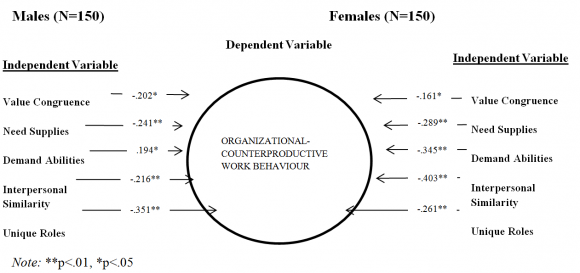
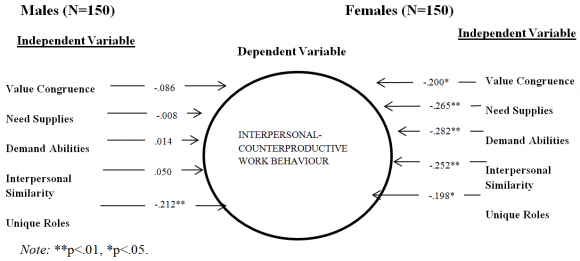
| Figure 2 indicates that male employee's | |
| organizational-counterproductive work behaviour signify- | |
| cantly and negatively correlated with Value Congruence | |
| (r=-.202*), | |
| Sr. No. | Predictor | R | Beta Weight | R 2 | R 2 Change | F Change |
| 1 | Interpersonal | .344 | -.344 | .118 | .118 (12%) | 39.879 |
| Similarities | ||||||
| 2 | Unique Roles | .403 | -.214 | .162 | .044 (4%) | 15.719 |
| Sr. No. | Predictor | R | Beta Weight | R 2 | R 2 Change | F Change |
| 1 | Unique Roles | .193 | -.193 | .037 | .037 (4%) | 11.509 |
| 2 | Value | .233 | -.131 | .054 | .017 (2%) | 5.301 |
| Congruence |
| Sr. No. | Predictor | R | Beta Weight | R 2 | R 2 Change | F Change |
| 1 | Unique Roles | .351 | -.351 | .124 | .124 (13%) | 44.430 |
| 2 | Need Supplies | .413 | -.218 | .171 | .047 (5%) | 8.360 |
| 3 | Interpersonal | .445 | .170 | .198 | .027 (3%) | 4.921 |
| Similarities |
| Sr. No. | Predictor | R | Beta Weight | R 2 | R 2 Change | F Change |
| 1 | Unique Roles | .212 | -.212 | .045 | .045 (5%) | 6.990 |
| Behaviour (N=150) | ||||||
| Sr.No. | Predictor | R | Beta Weight | R 2 | R 2 Change | F Change |
| 1 | Interpersonal | .403 | -.403 | .163 | .163 (16%) | 28.720 |
| Similarities | ||||||
| 2 | Demand | .449 | -.200 | .202 | .039 (4%) | 7.196 |
| Abilities | ||||||