1. Introduction
atient satisfaction is a profoundly attractive result of clinical consideration in the medical clinic and may even be a component of a wellbeing status. Patients' satisfaction is an important outcome measure guiding quality improvement in the healthcare setting while the patient-centred care movement places increasing importance on patient engagement in clinical decision-making. A patient's appearance of fulfilment or disappointment is a judgment on the nature of clinic care in the entirety of its viewpoints. Whatever its qualities and restrictions, quiet fulfilment is an indicator that ought to be crucial to the appraisal of the nature of care in clinics. Recently, the International Living Annual Global Retirement Index nominated Malaysia, with a score of 95 out of 100, as the first rank in the Best Healthcare in the World category of the 2019 (Elankovan, 2019). Being number one means that Malaysian hospitals are great in serving their patients. So, does this fact reflect in the patients' satisfaction? Ganasegeran (2015) pointed out some bad images in Malaysian hospitals such as too long waiting times, emotional burnout, service orientation of doctors, particularly doctor's professionalism, the lack of empathy, poor level of competencies, aggressive pursuit of monetary gains, and their disregard for patient suffering in medical practice had caused substantial dissatisfaction towards public healthcare service providers. Quek (2014) argued that these two (2) categories of healthcare which is the public sector and private sector healthcare are serving Malaysia healthcare at its best. Rapport et.al, (2019) documented that good communication and environments can improve patient experience and follow-up at home is vital. They even suggested that a special care centre needs for patients those who are involved in entry and exit from the hospital. Similarly, the Malaysian public healthcare sector is trying to serve its patients despite the influx of patient admissions, propagating surplus demand of uneven population healthcare provider ratio and perceptions of poor service quality. In the scope of patient satisfaction in Selangor, health services are considered to be of good quality if customers' expectations and perceptions are well balanced. Sharifa (2010) alluded the determinants confirming customers' expectations will lead to satisfaction, while factors disconfirming it will result in customers' dissatisfaction, reduced compliance to physicians' treatment and deterioration in overall disease management. The study is to investigate the factors affecting patients' satisfaction, to 'determine the most affecting factors that affect patients' satisfaction and to determine if there are any differences in patient satisfaction based on types of hospitals.
2. II.
3. Literature Review
The satisfaction of patients with technical expertise and outcomes is positively linked with the delivery enhancement efforts of hospitals. Patients' satisfaction is recognized as one of the most important quality dimensions and key success indicators in the health care industry (Oyatoye, 2016).
4. a) Definition of Patients' Satisfaction
Patients' satisfaction is defined as an individual assessment of health care providers and services and patients' satisfaction prompts compliance with medical advice and treatment, service utilization, and enhancement of the doctor-patient relationship. Patients' satisfaction with hospital treatment positively influences the image of the medical facility (Afthanorhan et al, 2018). They found that many factors are involved which are the assessment of the quality of the medical service associated with the rapid solution of the reported P problem, staff empathy, as well as the understanding and precise knowledge. Experience with a health care service can have a positive influence on the patient's expectations of the services. Besides, these researchers suggested the need to satisfy the health needs of patients by the staff competency but also strive to meet these expectations which lead to enhanced satisfaction considering the quality of medical services. As the health care staff meets the expectation of patients, the patients' will be more satisfied. Thiedke (2007) documented that patients' satisfaction reflects the provider's ability to successfully deliver care or laboratory services that meet patients' expectations and needs.
5. b) Empathy
Empathy refers to how hospital staffs caring and personalized attention to its patients that will gradually lead to patients' satisfaction. In the case of healthcare services, empathy is the ability to treat, care for and cure the patients. Empathic involvement occurs when an individual responds to the emotional state of someone else without experiencing the emotion themselves. The patients hope the doctors can give more attention and listen to them. Other than ease of communication attention and patience of the staffs are indicators of empathy. This element is important especially for the female patient during embarrassing examinations performed by the physician (Chiapponi, 2016). In a similar vein, Kitapcia, (2014) found that empathy is positively related to the patients' satisfaction.
6. c) Competency
For another variable, competency, it is the capability of the hospital staffs when they are communicating with patients. It comprises training of the healthcare staff, their technical and cultural abilities as well as their communication ability with patients. The most important aspect that determines patients' satisfaction is the quality of the health care service provided as patients' perception of the ability of their health care provider will likely to affect their selfconfidence in the skill of their health care provider. Poor competency level of health care staffs could lead to substantial dissatisfaction due to patients suffering. Ganasegeran et.al, (2015) emphasized that professionalism is imperative to improve patients' satisfaction by enhancing the relationship between doctors and patients. Hassali, (2014) also studied patients' satisfaction and discovered that there is a positive relationship between competence and patients' satisfaction.
7. d) Service Quality
Service quality is "a function of the difference between service expected and customers' perceptions of the actual service delivered" (Goel, 2015). Shabbir et al. (2016) emphasized that patient satisfaction is commonly used to determine service quality. They also found that there is an association between service quality and patient satisfaction. Service quality is the most vital key factor regarding service suppliers to get the upper hand, so it should be to be very much enhanced and well-measured (Lee & Yom, 2007). In the case of patients' satisfaction service quality is meeting or exceeding the patient's expectation. Patients' satisfaction and health service quality both should be considered together for the balance and stability of health care organization in a competitive environment. In the case of healthcare services, if the provided care and services fall short of their expectations, the expected outcome is dissatisfaction. On the other hand, service quality may play a more significant role in overall patient satisfaction (Johnson, 2015). In fact, to a patient, service quality is about satisfying the needs and providing the necessary medical services (Sathiyaseelan et al., 2015). In this study of patients' satisfaction, there is a positive relationship between service quality and patients' satisfaction.
8. III.
9. Research Framework
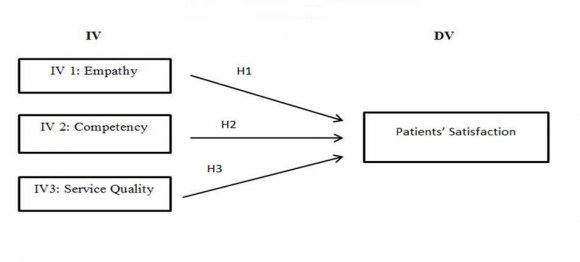
In regards to the above discussion, a research framework has been established between the independent variables and the dependent variable.
10. Methodology
This study is categorized as a quantitative study method that uses a survey method to collect relevant data. Research design selected for this study is a descriptive study. The descriptive study can be used to determine the relationship between variables and usually used to describe the current situation (Husin, 2017). Descriptive research is used in a study that has conclusive data based on quantitative ability. Some factors have been shown to influence patients' satisfaction with health care services including patients' socio-demographic characters, the physical appearance of the hospital, general environment of the premises, patients' understanding and expectations from various health care services (Muhondwa, 2008). The patients' satisfaction questionnaire used in this study were taken from Afthanorhan et al, (2019). These measures have then been adapted to suit the patients' satisfaction in the Selangor hospitals context. The questionnaire was reconstructed to figure out the performance of the hospitals based on the patients' perception of the hospital staff empathy, staff competency, service quality and their satisfaction.
11. a) Data Collection
The researchers have collected the data at the hospitals' pharmacy as the patients were waiting to be called for medication at Hospital Shah Alam, Hospital Ampuan Rahimah Klang, AVISENA and Colombia Hospitals. The questionnaires were given to patients from four hospitals in Selangor which are both public and private. This study managed to collect feedback from 206 patients from four hospitals namely. The data collection lasted for four weekends. There are (6) parts in the distributed questionnaires. The first part consists of 1 section; (A) Demographic Information. Demographic information is self-developed by researchers based on respondent's details, consists of 6 items that include information such as gender, age, marital status, occupation, monthly income and type of disease. All of this information is collected through multiple-choice questions. The second part in the questionnaire consist of 1 section; (B) suggestion for further improvement in patient's satisfaction on Selangor hospital. The third part in the questionnaire consists of 4 sections; (C) Patient's Satisfaction, (D) Empathy, (E) Competency and (F) Service Quality. The respondents of this study were requested to indicate their level of perception which presented by using a seven-point Likert scale of frequency, ranging from '1' (Strongly disagree) to '7' (Strongly agree). The data was then analysed using Statistical Package for the Social Sciences (SPSS).
V.
12. Result a) Demographic Analysis
The respondents consist of male and female patients. Table 1 shows the demographic characteristics of the respondents in which 53.4% of them are male, and 46.6% are female. Next, most of the respondents were in the age group 25 -30 years old is 51.0, total respondent was 31 -35 years old is 17.0%, in a group of 36 -40 years are 15.5%, and the remaining 16.5% of the respondent were 40 years above. From the descriptive analysis in marital status, it shows of the respondent were single constituting 50.0%, 42.2% are married, 2.4% are widowed and 5.3% respondents of them are divorced. For the occupation, the majority of the respondents are private which hold 42.2%, 32.5% are come from the government sector and respondent from self-employed in 25.5%. Other than that, monthly income where the respondents were income RM1001 -RM3000 which hold 38.8%, respondents' income RM3001 -RM5000 was 28.6%, 17.0% from monthly income more than RM5000 and income less than RM1000 is 15.5%. Lastly, it was followed by the type of disease in others show in higher per cent which holds 38.3%, high in fever are 30.1%, for influenza are 3.4% of respondents, for dengue are 12.1%, for asthma 11.7% and diabetes are 4.4%. 2 shows the result of the reliability test. The reliability coefficient of Cronbach's alpha is acceptable if the value is greater than 0.7. Therefore, based on the result of the reliability test that has been analysed, it shows that the Cronbach's alphas of variables in the study are all above 0.7. This means that the reliability test among the variables has high internal consistency. Based on Table 2, the Cronbach's alpha for Patients' Satisfaction (DV) is 0.835, 0.915 for Empathy (IV1), 0.871 for Competency (IV2), and 0.866 for Service Quality (IV3).
13. c) Independent Sample T-test
Next, Table 3 shows the t-test. The primary concerned with the significance value-if it is greater than 0.05(i.e., p > .05), the group variances can be treated as equal. However, if p < 0.05, we have unequal. From the result of Levene's Test for Equality of Variance is statically significant, which indicates that the group variances are equal. These are ratios of the mean of the differences to the standard errors of the difference under the two assumptions: (0.05420/0.10334) = 0.525, (0.05420/0.10255) = 0.529. The format of the test is t(df) = p = significant value, the value t(204) = 0.525, p = .600. It can be concluded there is no difference in patient satisfaction towards different hospitals. The finding of this study showed that there is no difference in patient satisfaction between private and public hospitals since the significant value is p<0.05. This finding means that both types of hospitals in the current study provide equal services to their patients. Majority of patients were equally satisfied with the service provided at both types of hospital in Selangor. Based on the results obtained in Table 4, it can be observed that the sig. value from the Levene Test is 0.008 <0.05), meaning that the variances for two samples are equal and the results from the independent t-test procedure is .0.600>0.05. It can be concluded that there is no difference between private and government hospitals in term of patients' satisfaction.
14. d) Correlation
Next, Table 5 shows the correlation analysis. It is found that the correlation between patients' satisfaction and empathy a positive correlation of 0.786.
The correlation between competency and patients' satisfaction positive correlation of 0.758 and between patients' satisfaction and service quality is a positive correlation of 0.765. Based on Table 6, it shows that adjusted R Square value is 0.663. It means that 66.3% of the dependent variable; patients' satisfaction on Selangor hospitals is explained by the current independent variable; empathy, competency and service quality.
15. f) F Test (Goodness of Fit Model)
Based on Table 7 below, the significant value of the model is 0.000 which is less than 0.005. It depicts significant relationships exist between all three independent variables; empathy, competency, and service quality with patients' satisfaction on Selangor hospital. Thus, the model used is compatible and fit. Therefore, all variables used in this study are considered as valid. 8, shows the model of results. All three independent variables have positive affected patients' satisfaction, with a significant value of less than 0.05. Empathy, competency and service quality make patients satisfied. This result also showed that empathy has the highest beta value, .403. Second is service quality with .284. and competency with beta value .176. .001
Next, Table 9 shows the hypothesis testing. It is found that the significance effect between patients' satisfaction and empathy positive correlation. The relationship between empathy and patients' satisfaction significant due to its p-value of 0.000 is less than the alpha value of 0.01. Thus, the null hypothesis (H0) is rejected while the alternative hypothesis (H1) is failed to reject. The relationship between competency and patients' satisfaction significant due to its p-value of 0.046 is less than the alpha value of 0.01. Thus, the null hypothesis (H0) is rejected while the alternative hypothesis (H1) is failed to reject. The relationship between service quality and patients' satisfaction significant due to its p-value of 0.001 is less than the alpha value of 0.01. Thus, the null hypothesis (H0) is rejected while the alternative hypothesis (H1) is failed to reject. VI.
16. Finding and Discussion
This study has tried to identify the patients' satisfaction on Selangor hospitals that are categorized in following types: (i) the relationship between empathy and patients' satisfaction, (ii) the relationship between competency and patients' satisfaction, and (iii) the relationship between service quality and patients' satisfaction.
17. a) The Relationship between Empathy and Patients' Satisfaction
The result shows that there is a positive relationship between empathy and patients' satisfaction. Besides, the relationship is found to be significant. Empathy plays a very important role in making patients happy. The result is consistent with prior studies which concluded clinicians who use more empathic communication can elicit more relevant information from patients about their illnesses and concerns, thus the outcome of this study was important in terms of management practices (Blatt, 2010). The results of this study showed that the hospital staff's empathic skills significantly and substantially influenced patients' satisfaction (Kitapcia, 2014).
18. b) The Relationship between Competency and Patients' Satisfaction
Based on the correlation results, there is moderate (.758) relationship between competency and patients' satisfaction. The result for multiple regression shows that this variable does influence patients' satisfaction. This study is consistent with prior studies that concluded the quality of the health care service provided affects patients' confidence in the skill of health care provided (Loh, 2019). Probably, this finding document that Selangor people are concerned about the staff competency in treating them as the respondents considered this staff already capable and competent in delivering their job well. So, the factor of competency is one of the keys to patient satisfaction.
19. c) The Relationship between Service Quality and Patients' Satisfaction
The result shows that there is a relationship between service and patients' satisfaction. Besides, the relationship is found to be significant. The result is consistent with prior studies which that concluded personal relationships greatly affect the service quality perception since the services are intangible and inseparable from consumers (Abbasi-Moghaddam, 2019).
20. VII.
21. Conclusion
This study provides an addition of an empirical study that for Malaysia hospitals, be it in private or public hospitals, they serve the same. Thus, there is no difference in patients' satisfaction. Both types of hospitals provide a good quality service. Empathy or good emotional treatment is found the biggest factor that satisfies patients. The second factor is no doubt service quality that links significantly to patient fulfilment. All identified variables contribute a big amount (R 2 =66.8 percent) to the overall hospital performance that makes its client happy and satisfied. There is a relationship found between staff competency and patients' satisfaction, it does affect patients' satisfaction. All these doctors and nurses are considered highly qualified. Their competency does make differences in the respondents' satisfaction. Thus, this new finding would provide an insight to the stakeholders for better serve healthcare provider.
22. VIII.
23. Recommendation
Since empathy is found as the highest influence, the future research is recommended to make the staff more empathetic to the patients. The hospital staff should have more ability to recognize, understand and share the thoughts and feelings of the patients. By doing so, they could develop sensitivity to others that could be therapeutic and life-saving. For the service quality, hospitals should always ensure that the patients are given professional and prompt service. Service quality should be further enhanced as nowadays it becomes one of the most crucial elements for gaining sustainable advantage and it will give the hospital industry a great opportunity to create a competitive differentiation among others. Another element is staff competency that could be further adequate Malaysia hospital to be at the top-notch healthcare provider in the world.
| Frequencies | Percentage | |
| Gender | ||
| Male | 110 | 53.4 |
| Female | 96 | 46.6 |
| Age | ||
| 25 -30 Years | 105 | 51.0 |
| 31 -35 Years | 35 | 17.0 |
| 36 -40 Years | 32 | 15.5 |
| More than 40 Years | 34 | 16.5 |
| Marital Status | ||
| Divorced | 11 | 5.3 |
| Married | 87 | 42.2 |
| Variables | No. of Items | Cronbach Alpha |
| Patients' Satisfaction | 5 | 0.835 |
| Empathy | 5 | 0.915 |
| Competency | 5 | 0.871 |
| Service Quality | 5 | 0.866 |
| T-test | |||||
| HOSPITAL | N | Mean | Std. Deviation | Std. Error Mean | |
| DV1 | Public | 105 | 4.9314 | .87170 | .08507 |
| Private | 101 | 4.8772 | .57548 | .05726 |
| Levene's | T-test for Equality of Means | |||||||||
| Test for | 95% CI of the | |||||||||
| Equality of | Difference | |||||||||
| Variances | ||||||||||
| F | Sig | t | df | Sig (2 | Mean Difference | Std Error Difference Lower Upper | ||||
| tailed) | ||||||||||
| Patients' | Equal | 7.119 .008 .525 | 204 | .600 | .05420 | .10334 | - | .25794 | ||
| Satisfaction | Variances | .14954 | ||||||||
| assumed | ||||||||||
| Equal | .529 180.959 | .598 | .05420 | .10255 | - | .25654 | ||||
| variances | .14814 | |||||||||
| not | ||||||||||
| assumed | ||||||||||
| Patients' Satisfaction | Empathy | Competency | Service Quality | ||
| Patients' | Pearson | 1 | .786 ** | .758 ** | .765 ** |
| Satisfaction | Correlation | ||||
| Sig. (2-tailed) | .000 | .000 | .000 | ||
| N | 206 | 206 | 206 | 206 | |
| *Correlation is significant at the 0.05 level (2-tailed) | |||||
| **Correlation is significant at the 0.01 (2-tailed) | |||||
| e) Determination Coefficient (R 2 ) | |||||
| Model | R | R Square | Adjusted R Square | Std. Error of the Estimate |
| 1 | .817 a | .668 | .663 | .42977 |
| a. Predictors: (Constant), Empathy, Competency, Service Quality | ||||
| Model | Sum of Squares | df | Mean Square | F | Sig | |
| 1 | Regression | 74.985 | 3 | 24.995 | 135.325 | 0.000 b |
| Residual | 37.310 | 202 | .185 | |||
| Total | 112.295 | 205 | ||||
| a. Dependent Variable: Patients' Satisfaction | ||||||
| b. Predictors: (Constant), Empathy, Competency, Service Quality | ||||||
| Unstandardised Coefficient | Standardised | ||||
| Model | Coefficient | T | Sig | ||
| B | Std. Error | Beta | |||
| Constant | .236 | .239 | .986 | .326 | |
| Empathy | .415 | .085 | .403 | 4.904 | .000 |
| Competency | .185 | .092 | .176 | 2.011 | .046 |
| Service Quality | .323 | .094 | .284 | 3.438 | |
| Hypothesis | Result | Significance (p-value) less than 0.01 | |
| H1: | There is a relationship between empathy and | H1 is supported | .000 |
| patient satisfaction | |||
| H2: | There is a relationship between staff | H2 is supported | .046 |
| competency and patient satisfaction | |||
| H3: | There is a relationship between service quality | H3 is supported | .001 |
| and patient satisfaction |