1. Introduction
hat planet Earth emanates a form of energy detectable by its inhabitants with minimal training, is described in many ancient traditions. This form of energy has a variety of regional names: (e.g., prana, chi, mana), and with minimal training is detectable by the hands, or by dowsing. Detecting prana has been practiced for millennia before scientific investigation was begun. It is now necessary for Science to recognize this phenomenon and its associated practice. My first attempt to test the validity of the dowsing system I learned in Sardinia was to see if it provided believable results. It gained credibility after assessing the vital energy of physical objects of sentimental importance, religious icons and items of vocabulary which described positive emotions (high scores), physical objects (usually with moderate scores), and negative sentiments (low scores)- Caddy (2011). The definition I've used for what is referred to as pranic energy, or often nowadays the biofield, comes from https://www.Ayurvedum.com/ what-is-prana/. This site defined Prana as "The Sanskrit word for the cosmic energy that is the essence of our existence". Prana or chi are terms used in Eastern philosophy and practice to describe the energy functions both of the human body and of our planetary environment (e.g. Senner). To refer to prana as 'cosmic energy' implies that this form of energy exists throughout the cosmos. This definition thus implies that the presence of prana precedes the development of life and is not only present where life already exists. Such a clarification is necessary in order to make sense of the results described here. It seems logical to enquire whether other planetary bodies have similar pranic energy levels to the Earth, and I believe that a logical enquiry is possible, whether or not living organisms are present on them. In this study I take advantage of the capacity of dowsing to assess the energy level of distant items.
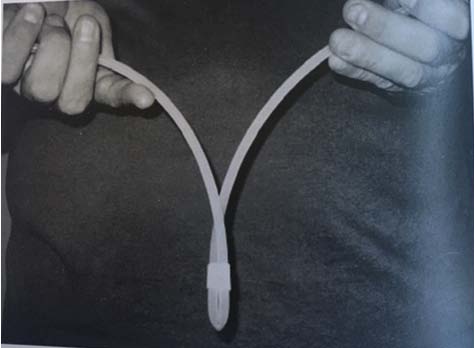
Before dowsing an object or concept, I ask the dowsing procedure to measure the level of prana energy associated with the item being assessed. Dowsing intensity is determined by the number of rotations of the wand (Fig 1). While holding the dowsed name in the conscious mind I ask the subconscious mind what level of pranic energy this name evokes. When the test score is reached, it is impossible to further rotate the wand, and the number of rotations up to this point is the score for the name in question. Dowsing is performed automatically in a light trance state with an empty mind. The minimal conscious attention is confined to recording the number of rotations. The names of planetary and lunar bodies were tested one after the other with a brief pause between them.
2. T Volume XX Issue III Version I
3. ( B )
Fig. 1: Dowsing with a rotating wand of stiff plastic tubing. After asking for the level of pranic energy of an object, the y-fork is forced upwards and completes a revolution automatically, which is counted. This exercise is repeated until it is blocked -no further revolutions are then physically possible. That last counted rotation is the number sought.
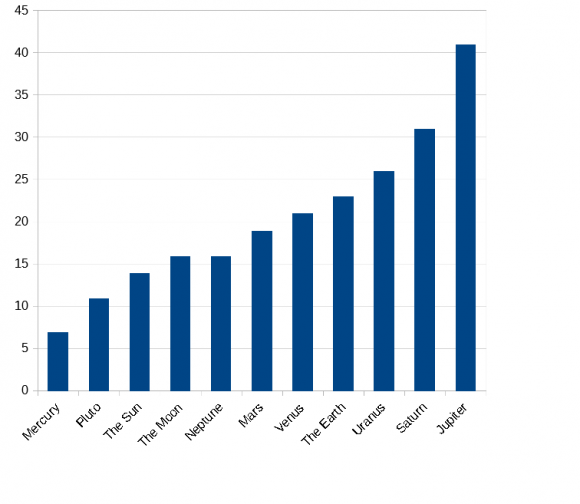
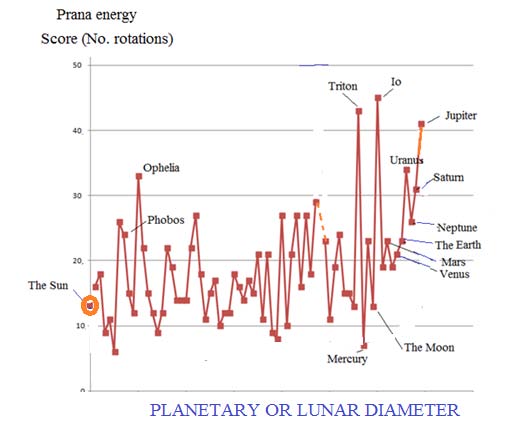
One category of objects having spiritual significance since ancient times for humans, are the planets. My first trial in 1997 was to see what scores were elicited by the names of planets, the sun and the moon, and to compare the results with the published dimensions of these bodies and their distances from the sun (Table 1). When I first dowsed a planet's name, Jupiter, for vital energy and got a high score, this aroused my curiosity, and led me to dowse the other planetary names. Fig 2 shows the results plotted for the planets and our moon. In 2007 I became aware of a relevant data base on Wikepedia for the moons rotating around the other planets of the solar system. The data base on Wikipedia: "List of Solar System objects by size", provides information on their distance from the sun, and the diameters of all planets and moons. Prana energy scores for the moons circulating around them was obtained in a similar way to the planets. (The distance from the sun of the moons was set equal to that for the planet they circulated around).
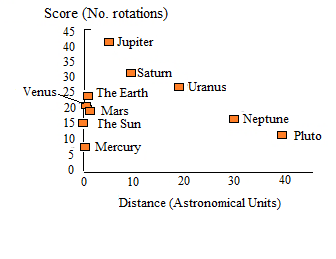
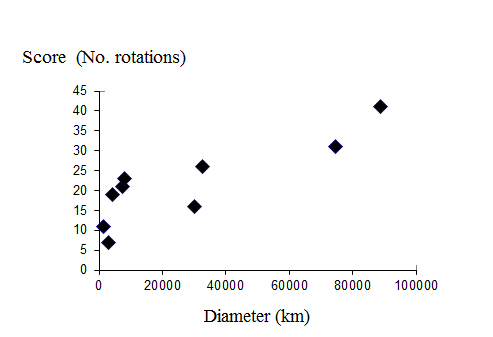
The results of these tests are summarized in Table 2 and Fig The analysis consisted of ordering the planetary bodies and their moons by size (taking the natural logarithm of their diameters), or distance from the sun, and plotting their ranked values against the corresponding values of the dowsing scores.
4. II.
Results III.
5. High Scoring Moons
One of the highest-scoring moons, Io, is the innermost moon of Jupiter. By a subsequent literature search it was found to be the most geologically active moon, and its orbit lies within a high energy belt of radiation. It may not be surprising if for example, gravity is associated with pranic energy, in that the closest moons to the planet are subject to strong gravitational forces and are also the highest in prana energy. The What emerges from inspection of these results is a general increase in energy reading with moon/planet diameter, and also that the trend in scores generally increases with distance from the sun. The sun, its closest planet Mercury, and the most distant planet, Pluto, are low-scoring bodies for prana energy, The Earth, Mars and Venus evoke a moderate to high score, and the distant large gaseous planets (Jupiter, Uranus, Saturn and Neptune) give very high scores.
other high-scoring moons, researched after dowsing was complete, are:
Ophelia, the nearest moon to Uranus; it 'shepherds' the brightest ring around this planet.
Triton, the largest moon of Neptune, is the only moon in the solar system which rotates in a retrograde orbit, as well as being one of the moons that is geologically active with surface geysers. From the above ranked scores, as an indicator of prana, Triton looks the most positive moon for fluid content that would contribute to mass movement within it, followed by Callisto and Europa. Whether the scores are due to the presence of life, or (more probably) a result of tidal flexing (enhanced movement of liquids below the moon's surface) remains to be seen.
6. (COMMENT: Nonetheless, these results I believe, validate the method used!)
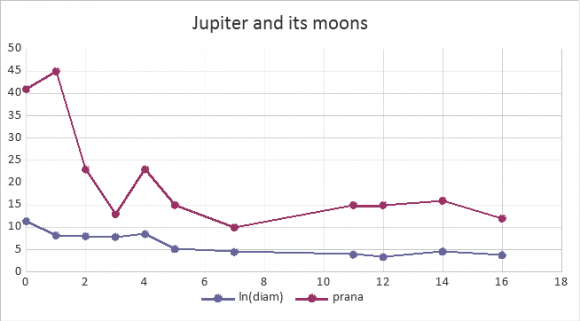
A second consideration is to investigate whether a high prana score is in part due to tidal flexing, and this suggests to consider the scores for moons closest to their home planet where gravitational pull is most extreme. Some examples are given in Table 4: The fact that our moon has a relatively low score (13) could be due to a lack of liquid strata, no rapid rotation, and/or a relatively low mass. That both Charon and Phoebe have relatively high scores for tiny moons rotating close to the mother planet is interesting. Fig. 6: Prana scores and the natural logs of the diameters of Jupiter and its moons, listed in sequence outwards from the planet.
IV.
7. A Tentative Interpretation
I had no preliminary information on the moons before dowsing, but if these results have any meaning, this would have to be suggested by systematic, explainable, and non-random interrelationships between the dowsing scores and the planet's and moon's physical dimensions and distances from the sun. I leave it to the reader to judge if this is the case. It would also imply a fundamental increase in the capacity of the human subconscious to access distant information beyond the range of action of the conventional senses, either directly, or as stored in a cosmic data base, as suggested by several authors.
The suggested significance of these results may be that the outer large planets either receive or generate the high level of pranic energy suggested by dowsing their names. From the results obtained I conclude that the level of prana for cosmic bodies is higher for those (like the gas giants) where much of the mass consists of mobile gases or fluids, or is subject to gravitational shocks from adjacent larger bodies inducing volcanic eruptions. Small planets or moons, especially those close to the sun, are generally characterized by a lower level of pranic energy, and the relatively modest levels of prana shown by the Earth despite its life forms, may be due to a substantial portion of its geology consisting of relatively inert rock strata.
The impact of some form of galactic radiation is another possible cause, and it may be relevant that the outer planets are closer to the termination shock wave (Fig 6) generated by the leading edge of the solar system while spiraling along its galactic arm around the center of the galaxy (ibex.swri.edu).
V.
8. Conclusion
Perhaps as suggested by experts on pranic energy, subtle energy emission declines when increased levels of conventional energy are emitted from the same location as photons? I'm not assuming here that these scores are evidence for the presence of life forms on other planets or moons, which can only be confirmed for planet Earth. At the moment we lack data on living life forms for other planets. At the same time, this exercise appears to confirm that it is the body itself that is being scored by this method, not just a noun in the English language. access to a 'cosmic library' extending throughout the cosmos where such information is stored, are two possible hypotheses. It is clear however that accepting that such information is in some way valid, poses unresolved questions for the conventional methodology of Science, but could provide useful clues for key factors affecting life forms. A conclusion from this and other experiments with dowsing, is that this is a methodology for accessing information available to the subconscious mind. It seems reasonable to conclude that the subconscious can access information on distant objects in time and space in a manner analogous to distant viewing (Mandelbaum 2000, Tiller 2007, Targ 2012). Whether this is achieved by the personal subconscious directly accessing the object being dowsed, or whether there is 9. Tiller, W.A., (2007)
9. Volume XX Issue III Version I
| Solar system bodies | Distance from sun (AU) | Diameter (km) | Dowsed score (No. rotations) |
| The Sun | 0 | 1392000 | 14 |
| Mercury | 0,39 | 3031 | 7 |
| Venus | 0,72 | 7521 | 21 |
| Earth | 1 | 7926 | 23 |
| Mars | 1,52 | 4222 | 19 |
| Jupiter | 5,20 | 88729 | 41 |
| MOON | PRANA SCORE | PLANET & MOON SEQU. |
| TRITON | 43 | Neptune I |
| CALLISTO | 23 | Jupiter IV |
| EUROPA | 23 | Jupiter II |
| TITAN | 19 | Saturn VI |
| ENCELADUS | 16 | Saturn III |
| GANYMEDE | 13 | Jupiter III |