1. Introduction
n recent times, the world has witnessed a convergence of novel technological networks that connect computers on the internet, and the virtual social networks that have linked humans irrespective of differences in the time zones. In institutions of higher learning, the most popular Social Networking Technologies (SNTs) being used are Facebook, Twitter, Whatsup, and YouTube (Manzira&Tsvara, 2015). Consistent with other SNTs studies (Hussain et al., 2012;Boumarafi, 2015;Munguatosha et al., 2011), Social Networking Technologies is regarded as the engagement of participants online and the creation and sharing of user generated content. These internet based tools and technologies have audio and visual capabilities that among others, capture, store, connect and retrieve content (Hussain et al., 2012).
A study conducted in Algerian Universities shows that 100% of its students use Social Networking Technologies for different purposes and some of them have more than one social media account (Boumarafi, 2015). Further, extant literature shows that students use SNTs to discuss group project works, share assignments and course work as well as files and lecture notes (Zanamwe et al., 2013;Munguatosha et al., 2011;Boumarafi, 2015;Manzira & Tsvara, 2015). This is an indication that social networking technologies contributes to a student's life experience, knowledge and skills.
The use of these SNTs in education comes with benefits like personalization, collaboration, information sharing, common interests, active participation, and group work support (Mazman and Usluel, 2010). Furthermore, Manzira & Tsvara (2015) posits that potential learning occurs outside the classroom as students can be able to access educational resources as long as they are connected to internet and indeed, students benefit from the use of SNTs because these technologies have a positive aggregate effect of improved academic performance and growth (Zanamwe et al., 2013). Previous studies have shown that SNTs are being widely used in institutions of higher learning for studying purposes followed by research, and reading both news and notes (Munguatosha et al., 2011;Rumanyika & Galan, 2015;Manzira & Tsvara, 2015). This shows the importance of SNTs within the education sector.
Despite the importance of SNTs adoption, in Uganda's context SNTs adoption is very low. A study by the freedom on the net report (2014) has demonstrated that only 15% of Ugandans use SNTs. The effect of this has been predominantly adverse, specifically low retention levels, low socialization levels, low student engagement levels and no sense of control and ownership of knowledge among students (Munguatosha, 2011). Therefore, knowing how to improve I SNTs adoption remains a crucial and virgin research area.
The technology adoption literature is prevalent with studies that demonstrate the importance of Perceived Ease of Use and Percieved Usefulnes in influencing the adoption of information technologies (Bwiino et al., 2016a Giner et al., 2009). Indeed,when a technology is perceived as simpler and easy to understand it as easily adopted and besides if the technology is perceived to be useful, its adoption rate increases (Bwiino et Thiga et al., 2015;Mccracken, 2011). However, the majority of these studies have dwelt on the credibility of the news medias and journalism (Chu, 2009;Yaakop et al., 2012;Rory, 2008;Canini, 2011) while others focus on the hosipitality industry (Fotis, 2011;Seth, 2012;Endsley et al., 2014). Surprisingly, little research about SNTs adoption has considered the education sector (Hoffman, 2009;Grover & Stewart, 2013; Kingsly et a.l, 2013) in general and more specifically institutions of higher learning. The only study in Uganda is by (Munguatosha et al.,2011) and besides the conceptual link between perceived credibility and adoption of SNTs is not shown by Munguatosha et al(2011). This is ideally a knowledge gap that this study intends to fill.
Therefore, reliance on Perceived credibility by organizational managers has been argued to predict SNTs adoption (Paquette, 2013;Castillo, 2011;Thiga et al., 2015;Minjeong, 2010) if educators are to surrender some control to embrace the informal leaner-centered instructions that empowers the learners, increase student engagement, collaboration and knowledge retention levels with a cummulative effect being better academic performance.
2. II.
3. Theoretical Framework
The conceptual link between peceived ease of use, perceived usefulness and SNTs adoption can best be explained by the Technology Adoption Model (TAM) propounded by Davis (1989). TAM is built on the bedrock that affirms that in a bid to accept a new or her mind, the usefulness and ease of use of that technology, if it is to be adopted and used (Davis, 1989). Tobbin (2012), argues that these two beliefs create a favorable disposition or intention towards use and consequently affect its use. He notes that Perceived Usefulness (PU) is said to be the degree to which a person thinks that using a particular system will enhance his or her performance. For the Perceived Ease of Use (PEOU), is simply the degree to which a person believes that using a particular system will be very appropriate (Davis, 1989). TAM has been applied in studies like the acceptance of internet and mobile related technologies, such as mobile payments, mobile banking, mcommerce. For that reason using TAM as a basis to study the acceptance of social networking technologies by higher institutions of learning is exceedingly a valid approach.
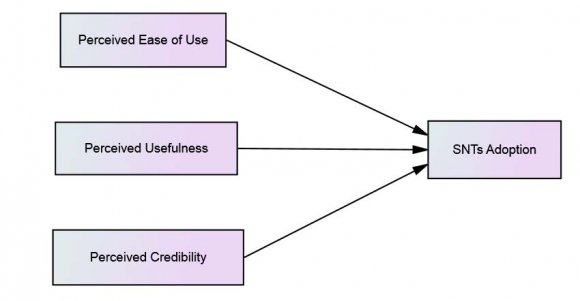
Based on this, it is hypothesized that H 0 : Perceived Ease of Use is positively related to SNT Adoption in institutions of higher learning in Uganda. H 1 : Perceived Usefulness is positively related to SNT Adoption in institutions of higher learning in Uganda.
However, it should be noted that Davis (1989) The framework linking perceived credibility to SNT Adoption can best be explained by the Heuristic Systematic Model of Social Information Processing proposed by (Chaiken , 1980). The bedrock of this model is based on the critical assumption that people can engage in Systematic or Heuristic processing of the message or information (Chaiken & Trope, 1999). Systematic processing involves analyzing the details of the messages and this is regarded as content or message credibility (Chaiken, 1980(Chaiken, , 1987)). The framework further posits that in Heursitic processing, people consider a few informational cues and form a judgement based on these cues for instance the source of the message or the medium of transmission of such messages (Chaiken, 1980(Chaiken, , 1987)).In this context therefore, Perceived Credibility is recognized as the believability of a source, its media and content and it rests largely on perceptions of the trustworthiness and expertise of the information source, media and content as interpreted by the information receiver (Metzger and Flanagin, 2013).
Perceived Credibility can therefore be measured in terms of the Source Credibility, Media Credibility and Content Credibility which is inline with other scholar's findings(Lee & McLoughlin, 2010;Uday and Pallavia, 2013; Newell& Goldsmith, 2001) and besides, studying perceived credibility has been central in determining the persuation of information in psychology (Chaiken, 1980(Chaiken, , 1987;;Chaiken & Trope, 1999; Newell & Goldsmith, perceived credibility will enable institutions of higher learning to consequently be persuaded to use them in teaching and learning hence adoption of SNTs.
It is apparent from this preliminary work and the conceptual model presented that the study of Perceived Usefulness, Perceived Ease of Use and Perceived Credibility will have implications for both academia and practioners. Figure one below illustrates a framework toguide this study;
4. Literature Review a) Perceived Ease of use and SNT Adoption
In the adoption of technologies in institutions of higher learning, students use information technologies that are simpler and easy to understand as well as how useful they deem such technologies to be (Daruish et al., 2015). In fact, this is confirmed by Susanto & Aljoza (2015) who posit that dimensions of perceived ease of use of an online public service relates to an individual's perception on the web navigation and ability to use it anywhere anytime. Bwiino et al (2016a) further argues that institutions of higher learning should develop more user-friendly and user-oriented e-learning content on SNTs for successful adoption and that learning to use a technology is normally considered easy if it requires less mental effort.
Extant literature indicates that much more attention should be paid to perceived ease of use by policy and decision makers to ensure accurate, valid, up-to-date, sufficient, free-of-error, and precisely present information in using online technologies (Bwiino et al., 2016a;Almahamid et al., 2010;Park, 2009;Davis, 1989). This is further established by Delbasic et al (2013) who argue that students easily use technologies that they have a clear understanding; this is an indicator of the potential contribution of perceived ease of use on SNTs adoption.
A study by Agarwal & Prasad (1999) indicates that ease of use becomes a significant predictor of both attitude and usefulness when users are not familiar with the system and therefore a basic requirement for information technology system design. In fact, if system designers want the users to find the system easy to use, clear and understandable, the technology should use understandable terminologies other than jargon that would confuse the users (Hasan & Ali, 2014).
Generally, if a system is easy to use, less effort is needed by the users to adopt it which increases the possibility of system usage and the more complex the system is, the more difficult it becomes to use by the user and only few can adopt it because it will need much effort and attention on the part of the user (Strogatz, 2001). Perceived ease of use is the degree which an individual beleives that using a particular system will be simple and free of effort understandable (Davis, 1989). In line with previous literature, this study postulates that Perceived Ease of Use is positively related to SNT Adoption in institutions of higher learning in Uganda.
5. b) Perceived Usefulness and SNT adoption
Perceived usefulness by Davis (1989) is a belief from someone that using a particular information technology system will enhance job performance. Research conducted by Munguatosha et Davis, 1989;Venkatesh & Davis, 2000). This gives confidence in the hypothesis that Perceived Usefulness is positively related to SNT Adoption in institutions of higher learning in Uganda (H 1 ).
6. c) Perceived Credibility and SNT Adoption
In communication research, the credibility of the communicator has widely been suggested to influence the processing of the communicated content and the change of audience attitudes and beliefs which influence the user's behavioral intention to adopt a technology (Newell & Goldsmith, 2001). Minjeong (2010) further argues that individual audiences are paying closer attention to the media that they perceive to be credible and that when individual audiences rely more on a certain communication medium for information seeking, they are likely to rate the medium more credible than other media.
Previous research has shown that the credibility of the channel/medium of communication influences the selective involvement of the audience with the medium (Lee & Mc Loughlin, 2010;Uday and Pallavia, 2013; Newell & Goldsmith, 2001). This shows that the user's perceived credibility of a social networking technology will affect its adoption directly through users' trust and expertise which determines the user's attitude and intention to use a technology (Kyung &Gretzel, 2008). Minjeong (2010) further argues that credibility will provide strong predictive power of the perceived service quality provided by social networking technologies in Institutions of Higher Learning as ascertained by systems reliability and availability as key success factors for ICT-supported learning.
Metzger and Flanagin (2008) posits that people are motivated to evaluate the credibility of the information they receive in order to determine its trustworthiness. The outcome of this postulation is that people engage in effortful evaluative processes in order to be certain of content or source credibility. Extant literature has focused on examining the credibility of ecommerce, political, news, and health web sites, as well as wikis, blogs, micro blogs ). Based on literature, recommended approaches to evaluation of the credibility of online information typically includes five criteria that users can employ that is checking the accuracy, authority, objectivity, currency, and coverage or scope of the information and/or its source (Metzger, 2007).
Further, Metzger and Flanagin (2013) argue that the reputation, endorsement, and consistency heuristics are all premised on the notion that if a number of people use information, recommend it, and agree with it, then it is credible. This simply means that if managers of institutions of higher learning recommend the usage of SNTs by students and lecturers, and agree to use them, then they are credible teaching platforms and the information circulated on these SNTs would be regarded credible.
Heldman et al., (2013) asserts that due to the multi-way, interactive functionality that is inherent to SNTs, these platforms can allow people to increase direct engagement to maintain and increase trust and credibility.
The consequence of this would be identification of the pedagogical information needs of users, strengthening communication which enhances socialisation among the users, and encouraging users to create, share and collaborate on user generated content (Cameron et A study conducted by Cheong (2002) shows that the adoption of an information media like the SNTs significantly depends on the perceived credibility of the source, media and content. Further, a recent study conducted in Nigerian universities by Edogor et al., (2015) shows that 68% of the students agree that social networking technologies are credible sources of information because senders of the messages get firsthand information, some of the messages come from the mass media, many of the messages are backed with pictures of what is reported, senders of the messages can be reached for clarifications and many of the reports are known to the members of the public. This is the basis upon which hypothesis H 2 which states that "Perceived Credibility is positively related to SNT Adoption in institutions of higher learning in Uganda" is formulated.
IV.
7. Methodology
This study used a cross sectional survey research design to collect data from managers of institutions of higher learning in Uganda. This decision is in line with the view of Ohaja (2003, p.74), who suggests that "whenever the major source of primary data for a study would be the views of any particular group, a survey would be called for."
The population of this study is made up of senior academic staff of Institutions of Higher Learning in Uganda like the heads of departments, deans of Perceived Credibility of Social Networking Technologies in Uganda's Institutions of Higher Learning faculties, principles and directors because they are at the center of implementation of such technologies for learning in education. The total population for this study was 284 institutions of higher learning obtained from the Uganda National Council for Higher Education website. A total sample of 166 institutions of higher learning was generated using the formula suggested by Yamane = the Sampling Error This is because the Yamane formula assumes a normal distribution of the population (Yamane, 1967). The Yamane formula was therefore considered suitable for determining an appropriate sample size.
From the Ugandan Institutions of Higher Learning, a stratified sampling technique was used to select institutions from the institutional categories by the Uganda National Council for Higher Education.The institutions of higher learning are categorized into 12 major types namely Public Universities (6), Private Universities (32), public university colleges(9), private university colleges(4), public tertiary institutions (52), private tertiary institutions(102), commercial and cooperative institutions (26), health institutions (23), National teachers colleges(5), other degree awarding institutions (11), Technical colleges (10) and military training institutions (4). Thereafter, we used simple random sampling to ensure that each participating institution had an equal chance of being chosen. This is because the population of interest was relatively homogeneous and yet simple random sampling technique provides estimates that are unbiased and have high precision in such conditions (Meng, 2013). An aggregated sum of One hundred and forty six questionnaires was retrieved from the field indicating a response rate of 88%. The unit of inquiry was the senior academic managers of institutions of higher learning and the unit of analysis was the individual institution of higher learning.
8. V.
9. Measurement of Variables
To measure Perceived Ease of Use, this study employed a self-generated scale arising from extant literature. Questions generated were used to measure the extent to which an individual perceives that using SNTs will be free of mental effort and easy understand ability using scales developed by (Shahzad et al., 2016;Davis, 1989;Venkatesh & Balla, 2008;Venkatesh& Davis, 2000). An example of the items generated for perceived ease of use is: "It will be easy for teachers and students to become skilful at using SNTs in education."
In order to measure Perceived Credibility, this study used a self-generated scale resulting from extant literature. Questions generated were used to measure the degree to which a person trusts the use of SNTs as credible to perform the expected service. Consequently, this study measured perceived credibility in terms of source credibility, media credibility and content credibility, using scales developed and tested by previous scholars (Lee & McLoughlin, 2010; Uday and Pallavia, 2013;Newell& Goldsmith, 2001). An example of items generated for the Perceived Credibility scale is:"I will trust the source of information on SNTs as a teaching platform in this institution".
For SNT adoption, this study used a selfgenerated scale resulting from extant review of literature. According to Hussain et al (2012), Kingsly et al ( 2013) and Reuben et al (2012), the domains of SNT adoption are create, engage and share user generated content. An example of items generated for the SNT adoption scale is:"I plan to use SNTs when carrying out my academic activities". All items were later anchored on a five-point Likert scale -strongly disagree to strongly agree.
10. VI. Reliability and Content Validity Index of Variables
Following the administration of the survey, content validity index was used to establish the construct validity of the scales; content validity index was found to be greater than 0.70 which is the minimum as suggested by Amin (2007). Internal consistency of the questionnaire was determined by calculating the Cronbach alpha coefficient, reliability estimates were all greater than .70 which is the minimum as suggested by Nunnually (1978). The validity and reliability of the variables is indicated in table 1 Perceived Credibility of Social Networking Technologies in Uganda's Institutions of Higher Learning Perceived Usefulness was also measured using a self-generated scale adopted from existing literature. The scale was used to measure the extent to which an individual believes that using SNTs will improve the job performance of the workers in the organization (Shahzad et al., 2016;Davis, 1989;Munguatosha et al., 2011;Venkatesh and Balla, 2008;Venkatesh& Davis, 2000). An example of the items generated for perceived usefulness is: "In this institution, using SNTs will enable lecturers and teachers to accomplish their academic tasks more quickly".
11. Results
In order to test the formulated hypothesis, we use the Pearson(r) correlation analysis and regression analysis to ascertain the predictive effect of Perceived Credibility on SNT adoption and the results are displayed in table 4 and table 3 respectively; From Table 3 above, at a preliminary level, correlation results indicated that Perceived Ease of Use has a positive and significant relationship on SNT adoption (r =.784;p< 0.01). This implies that a positive change in SNT adoption is related with a positive change in Perceived Ease of Use. Also, correlation results in Table 3 above further show that Perceived Usefulness has a positive and significant relationship on SNTs adoption(r = .734; p < 0.01). This is an indicator that a positive change in Perceived usefulness positively affects SNTs adoption. Additionally, results in Table 3 above show that Perceived Credibility is positively and significantly related to SNTs adoption (r = .611; p <0.01). This is an indication that a positive change in Perceived Credibility is associated with a positive change in SNT adoption. With reference to correlation results obtained from Table 3 above, further evidence is adduced by the results of regression analysis as displayed in Table 4.
Results indicate that 62% of the variance in SNTs adoption is attributed to Perceived Ease of Use (R 2 = .615; p < 0.01). The regression coefficient of Perceived Ease of Use was significant at (? = .784, t = 15.167; p < 0.01). Also, from Table 4 above, it can be deduced that Perceived Usefulness explains approximately 54% of the variance in SNTs adoption in institutions of higher learning (R 2 = .539; p < 0.01). The regression coefficient of Perceived Usefulness was significant at (? = .734, t = 12.978; p < 0.01). Further, Results in Table 4 above show that approximately 37 per cent of the total variance in SNT Adoption is explained by Perceived Credibility (R 2 = .373; p < 0.01). The regression coefficient of Perceived Credibility was significant (? = .611, t = 9.255; p < 0.01). On account of this, it can be adduced that Perceived Ease of Use, Perceived Usefulness and Perceived Credibility are positively related to adoption of SNTs in institutions of higher learning in Uganda and therefore, a positive change in Perceived ease of Use, Perceived Usefulness and Perceived Credibility will positively influence the adoption of Social Networking Technologies in Institutions of higher learning in Uganda.
12. VIII.
13. Discussion
The results of this study have provided some theoretical implications and practical implementations to the field of technology adoption in education in institutions of higher learning in Uganda. For the theoretical contributions, this research provides an insight into the influence of perceived credibility on SNT adoption in the education context which is different from the previous studies on SNTs adoption which have not considered perceived credibility as an important factor (Munguatosha et al, 2011;Meng, 2013;Metzger &Flanagin, 2013) to influence social networking technologies adoption. In addition, this study is one of the first studies to align perceived credibility as a significant predictor of SNT adoption in institutions of higher learning in Uganda.
The findings of this study also provide implications for practitioners. The findings of this study has found that perceived ease of use has a positive and significant effect on SNT adoption in institutions of higher learning in Uganda which implies that H 1 which states that "There is a positive and significant relationship between perceived ease of use and SNTs adoption in institutions of higher learning in Uganda" is supported. These findings are in line with previous studies (Bwiino et al., 2016a;Daruish et al., 2015;Munguatosha et al., 2011;Venkatesh & Balla, 2008;Davis, 1989). Thus this study suggests that for successful adoption of SNTs in institutions of higher learning, designers of such systems should design systems that are easy to learn to use, that are easy to Year 2017 Volume XVII Issue X Version I ( G )
access, that are flexible, clear and easily understandable by the user.
The learning point here is that managers of institutions of higher learning should encourage faculty in their institutions to design teaching content on SNTs that are easy to learn, easy to access any time anywhere to ensure flexibility and above all content and ways of using such technologies should clear and understandable. These will accelerate the adoption levels of SNTs in institutions of higher learning in Uganda.
Arising from the findings of this study, it has emerged that Perceived Usefulness has a positive and significant relationship with SNTs adoption in institutions of higher learning in Uganda. These findings have therefore supported H 2 of this study which states that "There is a positive and significant relationship between Perceived Usefulness and SNTs adoption in institutions of Higher learning in Uganda." In fact, this study suggests that SNTs should be designed in such a way that they will help users enhance their academic job performance, accomplish academic tasks more quickly, increase academic productivity and above all enable users to accomplish their academic work effectively and efficiently. These findings are consistent with previous studies (Bwiino et The learning point here is that for successful adoption of SNTs in institutions of higher learning, managers should implement technologies that will improve the academic job performance of the faculty and the students in an effective and efficient manner.
The results of this study have indicated that perceived credibility has a positive and significant effect on the adoption of social networking technologies. Thus the author suggests that managers believe that a positive change in understanding and evaluating the source credibility, media credibility and content credibility of the teaching information exchanged on SNTs would build more trust for social networking technologies. This might be due to the fact that most resourceful information is got on the internet so they have no problem with trusting the source and content on the social networking technologies. This is in line with previous studies (Lee & McLoughlin, 2010;Udayet al., 2007;Newell& Goldsmith, 2001) which indicate that in case the user has trust in the use of a particular technology, its adoption will be very easy.
Based on these findings, the learning point is that enhancement of SNT adoption in institutions of higher learning in Uganda will demand a managerial culture that focuses on understanding and evaluating the credibility of the source of information, the media through which the information is sent and above all evaluating systematically the content credibility.
14. IX.
15. Limitations of the Study
This study employs a cross sectional survey which lacks time richness explanation considering the fact that information technology adoption is a dynamic field which changes as time goes on. Hence, a longitudinal survey would be used to supplement the findings of this study. Secondly, this study considered only the senior managers since they are the ones at the centre of implementation of such technologies in institutions of higher learning. Further research can consider other stakeholders at the centre of implementation of these technologies like the students and lecturers.
The study was limited by the research methodology employed by using a survey to collect data which relies on self-report measures which can result in a social desirability bias. Though the managers completed their questionnaires anonymously, it is possible that they may have wanted to respond in ways that made them look helpful in terms of using SNTs. While the prospective for this effect is possible, the probability that it would impact the study's findings is low, given that managers did not know the hypotheses put forward by this study or the desired responses.
16. X. Recommendations and Conclusion
Findings of this study indicate that Perceived Ease of Use is essential for SNT adoption in institutions of higher learning in Uganda. This study therefore recommends that once SNTs are designed in a way that they are flexible, easy to access and above all easy to use, their adoption rate will accelerate. Therefore, institutions of higher learning should develop and adopt technologies that can be used by employing little or no mental effort in learning to use and the same time they should be clear and understandable.
Further, this study shows that Perceived Usefulness is strategic for SNTs adoption in institutions of higher learning in Uganda. Therefore, this study recommends that once managers of institutions of higher learning in Uganda implement technologies that improve on the academic job performance of the faculty and students, SNTs adoption will be easy. In fact, institutions of higher learning should adopt technologies that help users to accomplish their academic tasks more quickly, that improve on the academic job performance, improve productivity and enhance job effectiveness and efficiency.
From this study, it emerged that the source, content and media credibility are crucial for SNT adoption in institutions of higher learning in Uganda. The findings of this study suggests that once the source, media and content of the SNTs are reasonable and believable, they build trust and credibility of the use of the SNTs in institutions of higher learning in Uganda. Perceived Credibility of Social Networking Technologies in Uganda's Institutions of Higher Learning Institutions of higher learning should therefore develop and adopt technological innovations that consider the source, media and content of the information on SNTs as credible by the students and lecturers so as to foster significant actual system usages.
Generally, this study suggests that managers of institutions of higher learning should put into consideration the perceived ease of use of SNTs, Perceived Usefulness and Perceived Credibility in order to enforce successful adoption of SNTs in institutions of higher learning as a dependable and credible teaching plat form.
17. Year 2017
Volume XVII Issue X Version I ( G )
| Other studies postulates that the adoption of |
| information technologies largely depends on the |
| perceived usefulness of a technology in terms of how |
| such technologies can improve on the individual job |
| performance (Surachman, 2013; Bwiino et al., 2016b; |
| Venkatesh &Balla, 2008; Munguatosha et al., |
| 2011; |
| S/N | Variable | CVI | No. of Items |
| 01 | Perceived Ease of Use | .78 | 6 |
| 02 | Perceived Usefulness | .79 | 6 |
| 03 | Perceived Credibility | .80 | 6 |
| 04 | SNT Adoption | .83 | 8 |
| Source: Primary Data | |||
| S/N | Variable | Cronbach Alpha(?) | No. of Items |
| 01 | Perceived Ease of Use | .833 | 6 |
| 02 | Perceived Usefulness | .912 | 6 |
| 03 | Perceived Credibility | .834 | 6 |
| 04 | SNT Adoption | .827 | 8 |
| Source: Primary Data | |||
| VII. | |||
| S/N Variable | 1 | 2 | 3 | 4 | |
| 1 | SNTA | 1 | |||
| 2 | PEOU | .784** | 1 | ||
| 3 | PUSF | .734** .809** | 1 | 1 | |
| 4 | PCRD | .611** .614** .694** .892** | |||
| Source: Primary Data | |||||
| Key: SNTA=Social Network Technology Adoption, PCRD= | |||||
| Perceived Credibility, PEOU = Perceived Ease of Use, PUSF = | |||||
| Perceived Usefulness | |||||
| Variable | R 2 | ? | t | P |
| PEOU | .615 | .784 | 15.167 | 0.01** |
| PUSF | .539 | .734 | 12.978 | 0.01** |
| PCRD | .373 | .611 | 9.255 | 0.01** |
| N = 146; **P < .01 | ||||
| Source: Primary Data | ||||
| Key: PEOU = Perceived Ease of Use, PUSF = Perceived | ||||
| Usefulness, PCRD = Perceived Credibility | ||||