1. I. Introduction
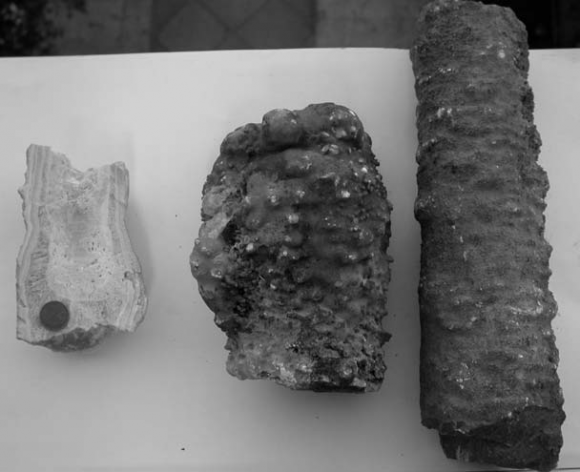
peleothem studies (trace elements (Sr, Mg and P), O and C isotopes, and U/Th disequilibria series) are a good proxy to understand the climate variability during their growth. The relationship between the time growth (U-Th dating), laminae extention rate of the stalagmite and/or stalactite, petrographic and textural studies (S.E.M.), and isotopes (? 18 O, ? 13 C) variations are the useful tools to determine the climate variation during the last 10.000 yr. BP (e.g., McDermott et al., 1999;Huang et al., 2001). McDermott et al. (1999) illustrates the climate variability in Europe from three spleotherms from (Ireland, Southern France and North Italy) during the Holocene (10,000 up to now). They conclude that during the Holocene there has been significant decoupling between the Atlantic (Ireland site) and Mediterranean seaboard (France site). They also affirm that there has been little climate variation between the southern Alpine (North Italy) and the Mediterranean seaboard (France site). However, for a better understanding of the climate variability during the past 10,000 yr. BP, much more studies has to be accomplished, increasing the number of speleotherms studies around Europe. In this direction some studies have focused their energy to samples younger than 10.000 yr. Bard et al. (2002) demostrated that ? 18 O in a stalagmite from 19 metres below present-day sea-level at Argentola Cave on the Tyrrhenian coast of Italy exhibits a 2-3 ? shift to lower values between 180 and 170 ka (MIS sub-stage 6.5). Approximately 0.8 -1.5 ? of the observed 2-3 %0 shift in ? 18 O can be accounted for by changes in the isotopic composition of the vapour source, but the remaining 1-2 ? was interpred as conditions in the region during MIS 6.5. The inferred change to wetter conditions during sapropel 6 is consistent with the pluvial events during this and later sapropel events (S1-S6) inferred independently on the basis of decreases in ? 18 O in speleothems from Israel (Bar- Matthews et al., 2000;Ayalan et al., 2002).
A remarkably coherent picture of continental climate Late Pleistocene variability with close links to the oceanic realm has emerged from studies of speleothems from the eastern margin of the Meditteranean. Partucularly inpressive is the well-dated composite ? 18 O record for the past 185 Kyr based on 21 speletherms from Soreq cave in Israel (Bar Matthews et al., 1996;1997;1999;Kaufman et al., 1998;Ayalan et al., 1998;. One of the reasons that robust matches can be made between different coeval speleotherms in this composite record is that the shifts in ? 18 O are relatively large (several per mil), indicating a relatively strong climatic signal in the ? 18 O record. The Soreq record appears to reflect predominatly two effects (i) changes in the ? 18 O of the oceanic vapour source, and (ii) the "amount effect" (Bar Matthews et al., 1996;1997;1999;Kaufman et al., 1998;Ayalan et al., 1998;. These studies are important because they establish a critical link between the oceanic realm and continental climate in the Meditteranean region. Thus, ? 18 O minima in speleotherms from Soreq coincide exactly with the occurence of sapropel events in the Meditteranean sea, and recently it has been shown that this is true for glacial as well as for interglacial condition (Ayalan et al., 2002). The dominance of the "amount effect" on ? 18 O in stalagmites in this region allows reliable recostraction of arid and pluvial phases. However, It appears that, from this point of view and following this approach, there is not such a studies covering the southern Italy area during the Holocene (10.000 yr up to now). Spleothems offer the best opportunity to accurately constain the timing of clearly defined climate signals (e.g., glacial-interglacial transitions, D/O oscillations, the "8.200 year" event). It is noteworthy that at present the low-latitudes southern Italy are under-represented in the currently dated speleothem stable isotope records.
To particularly implement the understanding of climate change in Southern Italy and to confront different climatic micro-area (McDermott et al., 1999), a spleotherm systematic study (textural studies, ? 18 O, ? 13 C isotopes variations) from the southern Appenine area (Campanian region, Southern Italy) is presented.
2. II. Samples Studied III. Analytical Methods
Scanning electron microscope (SEM) observations on morphology and major element analyses were performed on a Jeol JSM-5310 instrument (CISAG, Università degli Studi di Napoli "Federico"), in the energy-dispersive spectroscopy (EDS) mode (Link Analytical 10000, ZAF corrections). Silicates, oxides and pure elements were used as standards, operating conditions were 15 kV acceleration voltage and 10 mm spot size. Identification of the entire mineral assemblage was made by combined SEM-EDS analyses, using the Jeol JSM-5310 instrument. Stable isotope analysis were made by Carbonate powders were reacted with 100% phosphoric acid (density >1.9, carbonate preparation line connected to a Thermo Finnigan 252 mass pectrometer. All values are reported in per mil relative to V-PDB (Pee Dee Belemnite standard) by assigning a ? 13 C value of +1.95? and a ? 18 O value of -2.20? to NBS19. Reproducibility was checked by replicate analysis of laboratory standards and is better than ± 0.2 (1?). Oxygen isotopic compositions of dolomite and siderite were corrected using the fractionation factors given by Rosenbaum & Sheppard (1986).
3. IV. Petrography and sem-eds Summary
These speleothems show varve-like submillimeter-scale color bands. The color of such speleothems is chiefly due to the presence of variable amounts of clay or humic substances which coprecipitated or absorbed onto calcite surfaces from drip waters that passed through soil before entering the cave. Lauritzen et al. (1986) found that humic and fulvic acids are readily soluble and may be expected to enter speleothem feed waters preferentially during growing seasons. The two groups found in speleothems may be taken as indices of productivity in the overlying soil and plant cover and, therefore, as a proxy measure of paleoclimate (Lauritzen et al. 1986). This cycle is probably a response to hydrological events in the recharge to the cave.
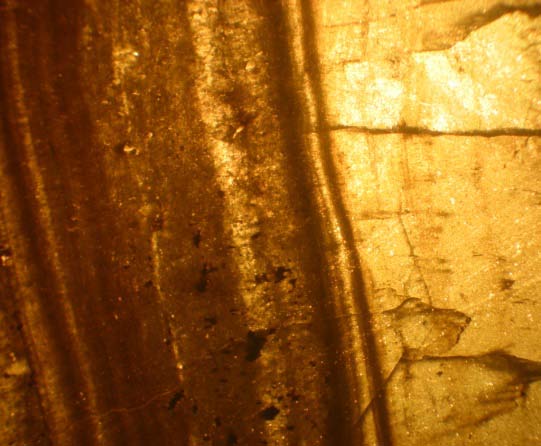
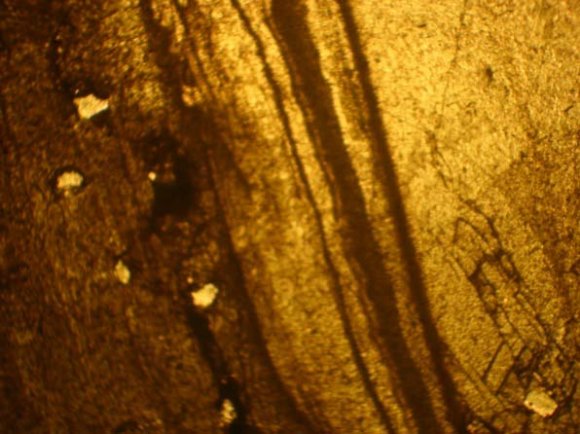
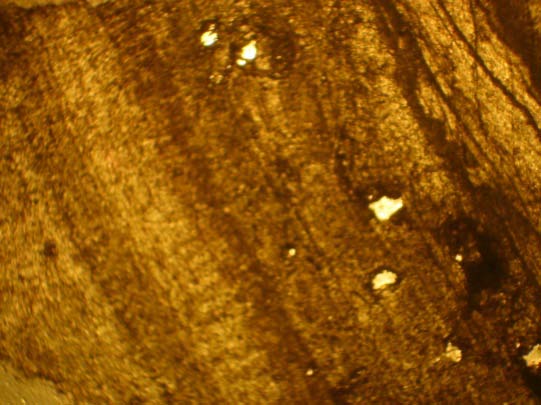
Petrography (Fig. 2) and X-ray diffraction (Fig. 3) indicate that the speleothems examined in this study are all calcite, but their fabrics vary from inclusion zoned to clear and featureless. Macroscopically, transverse sections of speleothem show mostly light brown calcite with pronounced fine-scale zonation. Microscopically, speleothem consists of elongate or columnar calcite crystals radiating from the speleothem's center.
Both kinds of inclusions define apparent zones that extend across calcite crystals and that can commonly be traced either perpendicular than parralel to the concentric circles growth all the way around the central canal. None of the edges of the columnar calcite crystals coincide with the growth zones defined by inclusions. Some patterns of inclusions in the outer areas have the form of euhedral calcite terminations, whereas others appear to follow growth zonations that, if continuous, would define large concentric circles around the central canal. The faster the growth rate, the warmer and/or wetter the climate is above the cave (Hennig 1983;Dreybrodt 1982).
Frist speleothem that we have obtained data on petrography, SEM and SEM-EDS is from Campo Braca.
The stalagmite seems to be completely formed by calcite crystal. The crystalline structure is between palisade calcite to columnar calcite. It is worth noting the straight parallel crystal boundaries between the long crystals. The calcite crystal have the c axes parallel to the cut of the thin section. This is true for all the samples examined. Detrital carbonate grains are also individuated and they can be evidence of a dry climate and can be used in paleoclimatology (Railsback et al., 1999). The cristalline concretization forms layers with different color bands. Although the color of the bands defining these layers is suggestive of iron oxide, SEM-EDS analyses reveals the presence of only Mg (not much) and Si, Fe and perhaps Al, suggesting the presence of a smectitic clay mineral. Layers in inclusionrich calcite defined by variation in size and abundance of inclusions are also present. Presence of absence of The samples are from limostone cretaceous caves outcropping on the southern Appenine (Fig. 1). The speleothems samples are from "Campo Braca" cave on S. Gregorio del Matese city council zone (Mt. Matese; Caserta); the entrance complex cave coordinates are lat. 41° 25' 03" and long. 1° 52' 54" and is 1130 mt. asl. From the frist horizontal corridor which is around 30 mt, the sample was taken. From the "Inghiottitoio del Trarro" ("Buco del Trarro"; Marina di Camerota), with coordinates of lat. 40° 01' 04" and long. 2° 54' 25", respectively. The entrance is 220 mt asl. The corridor is semi-horizontal with length of 82 mt and depth 18 mt. These samples are found at north and south of the Appenine length chain. The speleothem size ranges from 40 cm with diameter of 15 cm (Campo Braca) to more than 80 cm with 20-30 cm in diameter ("Buco del Trarro), from "Santa Barbara" cave in Bomerano, Agerola, just at middle distance between the previous sampling sites another sample was collected. The Santa Barbara cave is several hundred meters deep the cave is formed in limestone and on entrance there are outcrops of trasgressive deposits fromed by mostly sands with partly flowstone covering the deposits. Wachter and Hayes, 1985) at 75°C using a Kiel III online fluid inclusion in layers can give an estimate of the rate of precipitation of the calcite. Presence of fine red-brown layers in columnar calcite in a stalagmite during the last stages of crystallization which give rise to the accumulation of clay material. This is also shown from the SEM-EDS analyses.
4. Global Journal of Human Social Science
SEM image show columnar calcite in the stalagmite. However, SEM image have also shown the presence of equant calcite in the same stalagmite. SEM-EDS analyses have been done systematically for each layer. Following are shown two analyses which are respectively of calcite crystal and from a clay rich
5. V. Stable Isotope Discussion
The seepage water, upon entering a cave passage of lower CO 2 concentration (relative to the soil atmosphere), releases CO 2 and CaCO 3 deposition takes place (Holland et al., 1964). Because bicarbonate concentrations of karst ground waters are typically in the parts per thousand range, the d18O compositions of the water and the dissolved carbonate species are dominated by the water molecules themselves, which originated as meteoric precipitation. Therefore, the d 18 O values of speleothems are generally not significantly influenced by the bedrock isotopic composition (Harmon, 1979a). Speleothem d 13 C values, however, are significantly influenced by the isotopic composition of the bedrock, and the soil CO 2 . The latter is strongly related to the vegetation overlying the cave, and vegetation at the regional scale is strongly correlated to climate.
Where the calcite is deposited in equilibrium with the thermodynamic environment, the 18 O/ 16 O ratio in a speleothem may vary with the temperature of the cave or with the isotopic composition of the rainfall (itself a temperature-dependent variable).
When speleothems are deposited in isotopic equilibrium with their parent drip waters, two factors cause variations in calcite ?18O: 1) Variations in cave temperature, 2) Variations in ?18O of seepage water and meteoric water respectively, which depend on: a. Changes in the ?18O of the oceanic source region (ice volume effect), b. Changes in moisture sources or storm tracks, c. Variations in the proportion of precipitation (e.g., winter/summer precipitation), d. Air temperature, e. Amount of precipitation (amount effect), f. Evaporation in the epikarst and/or within the cave.
Where calcite has formed in oxygen isotopic equilibrium with ambient water, the isotopic fractionation between calcite and water, dc-w, is dependent on the temperature (O'Neill et al. For speleothems deposited under isotopic equilibrium conditions, oxygen isotopic variations reflect changes in the isotopic composition of meteoric water and can be linked to climate through understanding of the hydrologic cycle.
The 13 C/ 12 C ratio is believed to vary with the abundance of 13 C-depleted CO 2 in the soil in a similar manner. Both ratios may be distorted by kinetic processes, chiefly evaporation. I present data on Oxygen and carbon isotopes for all three speleothems (Fig. 4). In Campa Braca spleleothm, the Carbon and Oxygen isotopes are overlapping with the Soreq cave spelethems (Bar-Matthews et al., 1997) suggesting a sapropel event. However, the Oxygen isotopes tend through the Sapropel events for all three speleothems (Fig. 4). The 13 C/ 12 C suggest different vegetation between the three sites
6. VI. Conclusions
All the data presented suggest that in Campania in the past has occurred a sapropel event, with different climatic condition between North and South area. the future research is to point the time when these events have possibly been forming.
7. VII. Acknowledgement
This work was developed during my stay at Università degli Studi di Napoli "Federico II" during my post-doc (2004)(2005)(2006)(2007). Thanks to Giuseppe Rolandi for hosting in his office. The fund used for this work comes from my wage during the post-doc.
8. Global Journal of Human Social Science

![1975): 1000 ln dc-w = 2.78 *10 6 T 2 (K 2 ) *2.89 Where dc-w = (1000 + ? 18 Oc) / (1000 + ? 18 Ow) and ? 18 Oc and ? 18 Ow are the ? 18 O values of calcite and water, respectively and K is the equilibrium constant. Dorale et al. (1998) calculated temperatures of deposition of speleothems from their ? 18 O values using the following equation ? 18 Oc = (0.695T + 986.4)exp[2780/(273.15 + T) 2 ] -0.00289 -1000 where T is in °C.](https://socialscienceresearch.org/index.php/GJHSS/article/download/103001/version/103001/3-Petrography_html/43576/image-3.png)
| Samples | SiO2 Al2O3 MgO | FeO | ZnO | CaO | K2O | Na2O MnO | TiO2 | PbO | S | SrO | P2O5 | tot | |||
| CB 5ANL10 | 1,171 | 0,233 | 0,423 | 4,541 | 0 | 48,216 | 0 | 0,447 | 0,019 | 0,065 | 0 | 0,384 | 0 | 0 | 55,499 |
| CB 5A3 | 0,266 | 0,472 | 0,198 | 1,01 | 0 | 97,024 | 0 | 0,486 | 0,063 | 0,027 | 0 | 0,232 | 0,028 | 0,194 | 100 |
| CB S2A4D | 69,886 | 1,338 | 4,605 | 0,228 | 0,145 | 8,514 | 0,46 | 13,846 | 0,126 | 0,028 | 0,109 | 0,007 | 0,286 | 0,419 | 99,998 |