1. Introduction
angladesh is recognized as one of the worst affected countries of the world due to climate induced disasters. The disadvantageous geographical setting along with low and flat topography makes this country physically vulnerable to climate change. Moreover, various socio-economic factors like high population density; high levels of poverty; gender inequality; dependency on climate sensitive livelihoods sectors, especially agriculture, fishing, and hunting and gathering forest resources; lack of adaptation fund and other institutional insufficiency are triggering the vulnerabilities of people. The impacts of climate change are multifaceted, it is not static rather it is disproportionately distributed regardless of race, caste, ethnicity, sex and level of income, its impacts are more heavily felt by poor nations and communities. Climate change magnifies existing inequalities. The IPCC concluded: "Poor communities can be especially vulnerable, in particular, those concentrated in high-risk areas. They tend to have more limited adaptive capacities, and are more dependent on climatesensitive resources such as local water and food supplies" (IPCC 2007:9).
Author: Researchers, East West University, Dhaka, Bangladesh. e-mail: [email protected] Now-a-days, women and climatic risk is a much talked matter. The perception and impact of climate change is completely gender differentiated. Women are ever more vulnerable to the impact of climate change than men, because they have very limited access to financial resources, land, education, health services and in decision making process. All these insufficiencies make women vulnerable to climate induced disaster than men. Besides, a significant number of female headed households are found in coastal areas who are mostly depends on primary economic activities. Considering the vulnerability and inequality of women, it is a proposition that climate change adversely impacted on women's likelihoods and health.
2. a) Women and climate change
Climate change affects everyone. But, women are the most vulnerable to the impact of climate change, because they have limited access to resources that are required for preparedness and adaptation. UNFCCC (2005) reported that during natural disasters more women die than men because they are not warned, cannot swim or cannot leave the house alone.
Moreover, women are being affected in their multiple roles as food producers and providers, as guardians of health, care givers, and economic actors. As access to basic needs and natural resources, such as shelter, food, fertile land, water and fuel, becomes hampered, women's workload increases. Drought, deforestation and erratic rainfall cause women to work harder to secure resources and livelihoods. Depletion of natural resources and decreasing agricultural productivity may place additional burdens on women's health and reduce time for decision-making processes and income-generating activities. 1. To identify the impact of climate change on women 2. To analysis reasons behind those impacts and vulnerabilities 3. To recommend some specific measure to address the impacts.
3. b) Methodology
The study involves multistage analytical process of analysis. Both primary and secondary data on the impact of climate change on women have comprehensively been used in this study. The primary data was collected through focus group discussion and in-depth interviews with the women.
4. c) Sample size
This study was exclusively focused on female headed households, divorced, tiger widows, and widows (husband died from disasters or during fish collection). 6 FGD (10 women participated in each FGD) and 2 in-depth interviews were conducted in the study area. Purposive sampling was employed to select the respondents.
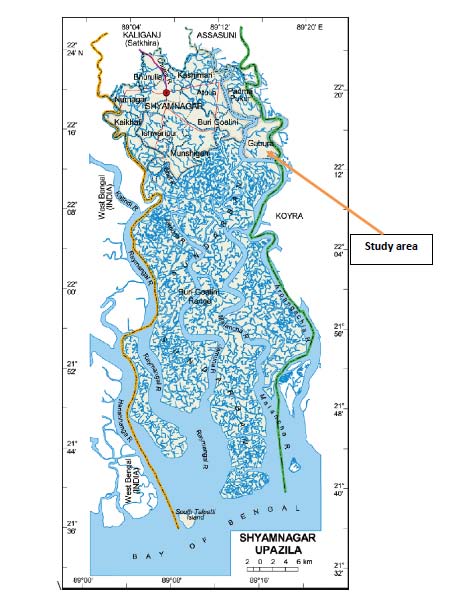
Heritage Site, and covers an area of 5747 km 2 . The main rivers are Morichap River, Kholpota River, Betna River, Rainmangal River, Hariabhanga River, Ichamoti River Betrabati River and Kalindi Jamuna River.
Gabura Union is under the constituency of Shyamnagor Upazila. The area of this Union is 33 km 2 . According to BBS, 38825 people are living in this village among them 19307 male and 19518 female (BBS, 2011). Around 70% of the people depends on fishing and the rest 30% on agriculture (25%) and others (5%).
It is one of the most extreme southern Unions of Bangladesh has exposed to Bay of Bengal through two rivers-Kholpetua and Kapatakkha.
Chakbara village is one of the villages of Gabura Union. The study was conducted in Chakbara village. This village was severe affected by the cyclone Sidr (2007) and Aila (2009). The Gher system is also prominent in this village. To fulfill the requirement of the study, the samples were drawn from this village.
5. d) Source of data
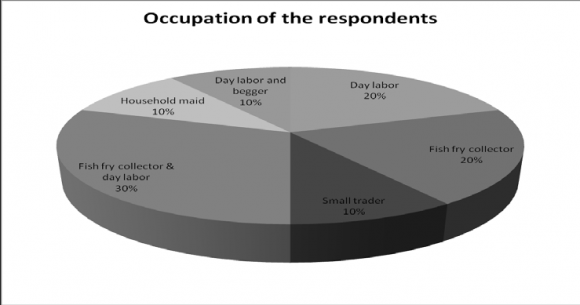
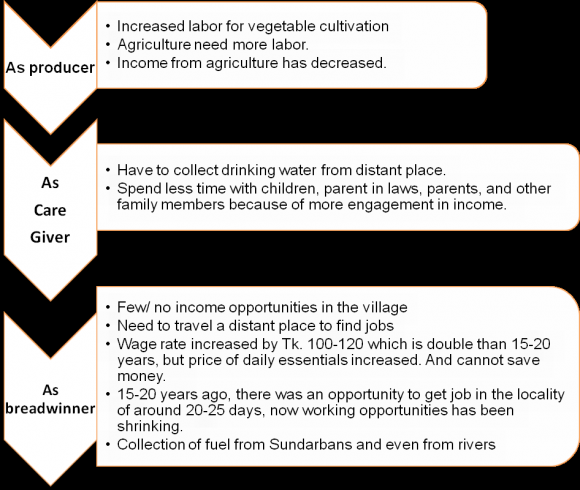
Focus Group Discussion (FGD) and interviews were conducted to collect qualitative information. Besides, secondary information were collected from various reports focusing on disaster and women; BBS, journals, books, newspaper, gender specific publications of GO, UN, INGO and NGO etc. The primary data was collected in the month of February. collection, small trade and household maid. Livelihoods of women in coastal area are extremely nature depended. It was hypothesized that the burden of women increased in manifolds. Women were asked to identify their burden on three broad categories like producers, caregivers and breadwinners. All the respondents were engaged in different income generating activities to feed their families.
6. II.
7. Discussion and Results
8. a) Occupation of the participants
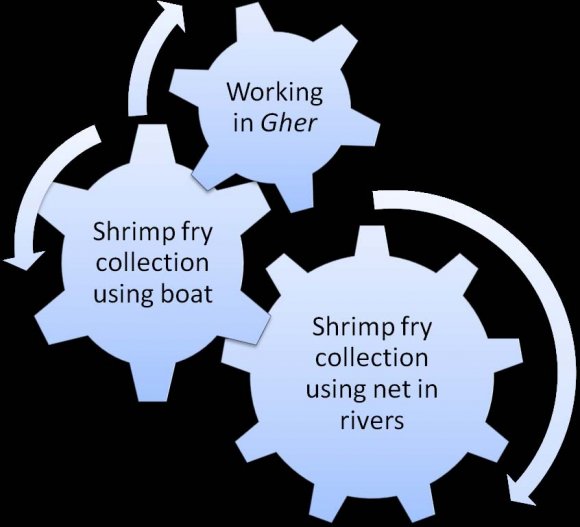
The participants of FGD were women and they engaged in different livelihoods like day labor, shrimp fry Fig. 3 : Triple burden of women d) The most vulnerable work for women Women in the discussions also asked to identify three most vulnerable works for women. All of them were agreed and prioritized the following works as most vulnerable for them. They ranked shrimp fry collection in river as top. To collect the shrimp fry they need to stay in saline water. Saline water is detrimental for health especially for reproductive health and often they are facing skin diseases.
9. Increased burden on women
Fig. 4 : Most vulnerable work for women e) The impacts climate change on the livelihoods and health of women Women participated in the discussion identified their vulnerabilities that fragile their livelihoods and health. The key issues are discussed in the following table 1
10. Crop production loss
Women, who control homestead-based livelihoods, lose income when crops are blown or washed away. Most of the homesteads are now fallow and unsuitable for cultivation. For this reason, they have to buy vegetable from the market with a high price. Thus expenditure increased in manifolds. And, finally women are facing chronic nutritional deficiency. Limited access to market Communication systems in Gabura union have collapsed after the cyclone Sidr and Ayla. Markets are located far away from their village, where women have very limited market access to buy or sell their goods. Women are forced to trade within the village or accept lower prices offered by male buyers from other areas. Loss of income, savings and employment Climate change affects every sector adversely. Sources of income especially for women have reduced. Less income opportunities leads to less earning which further hamper the food security of the family. The net loss in income leads to a loss in
11. Fragile condition
Women's vulnerability savings, thus making it even harder for households to cope with disasters (case story of Rizia Khatun is in box 2) Increase disease and sickness Frequency of sickness has increased. Women who are involved in fish fry collection, has to stay in saline water for long time. During menstruation period, fish fry collectors faced severe gynecologic diseases. Most of the cases these women needs to go to cities for having treatment, which is financial burden for them. There was very limited or no saline intrusion in agricultural land before 20-25 years and during that time women were engaged in agriculture and they had not experienced such health hazards. Now most of the agricultural land is employed for shrimp cultivation and as a result job market for women has been shrinking. Therefore, women are forced to involve in fish fry collection to maintain their families.
12. Social security
Women who engage in employment are facing social insecurity at their workplace and outside. They often fall prey to local miscreants (mastans). Besides, everybody neglects the social dignity of working women. Moreover, in cyclone shelter women have no separate facilities.
13. Box 1:
Moyna Khatun: Her homestead washed away by cyclone Ayla. After that she couldn't buy any land. She also lost her sewing machine at that time and it was her only earning source. Now she is living in her parents' house.
14. III. Conclusion and Recommendations a) Conclusion
Changes in climate variability directly affect agricultural production and female headed households. Although this study was conducted at a micro scale, the study found a significant relationship between climate change and women livelihoods who are dependent on natural resources. Women are playing different role in their families. In previous time women played only one role for their families as caregiver. Two other burdens have added with their role-producer and breadwinner. Many development interventions implemented in this area, but few of them can address women vulnerabilities, because the target oriented programs
15. b) Recommendations
In this study, the relationship of women vulnerability and impact of climate change has been mostly focus on outputs not the outcomes. However, access to service from different service providers is still far reaching for women. Therefore mainstreaming the gender in policies and development process is very urgent. examined on a micro scale. The following recommendations are based on the outcomes of this study:
? Conduct in depth gender specific vulnerability analysis in relation to climate change impact to unearth women's situation.
? Create an enabling environment for women's participation in climate change process, and raise women's voices at from micro level to macro level. ? Create gender-specific disaster reduction policies to address the effects of climate change in disasterprone areas. ? Promote women's empowerment through capacitybuilding before, during and after climate-related disasters, as well as their active involvement in disaster anticipation, early warning and prevention as part of their resilience building.
? Ensure that government policies and programs on human rights, women's rights and climate change are coherent and reinforce each other. ? Gender specific indicator need to be added in national policies on disaster and climate change to as a measure of gender gap.
Bibliography

| Fragile condition | Women's vulnerability |
| Housing and homestead | Disaster destroys houses. Homesteads are now unusable for vegetable production |
| because of salinity ingression (case story of Ms. Moyna Khatun is described in box | |
| 1). |