1. Introduction
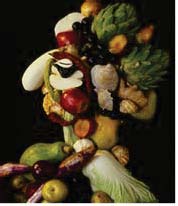
n September 2007 I conducted a survey with teaching experience in a class of 6th grade students. It was developed in the school where I worked as a teacher of Visual Arts in the city of Pelotas, RS, Brazil. I tried to understand the relationships established between youth identities, their creative expressions in the form of pictures -artistic works embodied in three-dimensional constructions. So, I prepared a work plan consisting of observation and analysis of reproductions of pictures of Giuseppe Archimboldo, and subsequent production of readings and / or three-dimensional plastic compositions with elements of nature or industrially produced, selected and collected by the students. The early work coincided with the beginning of spring and tried to combine the observation of the surrounding nature with representations proposed by Archimboldo. The photographs of the buildings and the records of students in the field notebook were used as elements of motivational research and reflection on the work of art as a pledge of curiosity and artistic creation in school.
Long ago that I liked the work of Archimboldo, and have observed that it produces interest and curiosity in students, promoting sync with these visual readers. Therefore, the selection of assumed knowledge and interest in work prior to the onset of labor. I realize, agreeing with Ferres (1996), that the more the teacher knows the object studied, the greater its ability to question and embrace the interpretations of students. So, too, the student will be able to pick and choose the images and interpret them. Thus, able to analyze other images of its surroundings: packaging, Web sites, comic characters, blogs, notebook covers, magazines, and other contemporary productions.
The initial reading of the works of Archimboldo was open and asked to manifest, expressing their ideas and feelings, then go deeper and bringing other formal or historical data. Elaborated from the suggestions Hernández (2000), questions about the image studied, using the knowledge that the students had and could express in confrontation with the knowledge of the teacher. The questions set out from simple questions like: "Why are we seeing this? Why the teacher chose to display the work students? "In continuation, I had to think about the production and placement of the artwork, asking:" Who legitimized this production as a work of art? Why it is seen by many people? "Or," Why the work is in museum, or the book available on the internet, and not somewhere else? "Ask also suggestions about what works could be displayed adjacent to the Archimboldo, according to their interests and / or personal tastes. Hernández (2000) suggests that an area of knowledge as Art should be questioned, so early we encourage a critical stance towards culture systems, so that young people are able to make their choices and recognize the importance of artistic productions as a historical and cultural distancing themselves from cultural hegemony.
I present below some data Archimboldo, a bit of its role in art history and formal characteristics of his work.
The Renaissance artist was born in 1527 in Milan, Italy and was a pupil of Leonardo da Vinci. For 25 years he was court painter, artisan and organizer of festivals of many emperors Italian 16th century. His work also included the making of pictures of the royal family. In his spare time working has created a style of painting that would separate him from other artists forever. It was then that he began making portraits of people, but not realistically, but compositions with figures of animals, plants and other natural objects, which combined, produce images of faces, as in optical illusion using only brushes and paints. Pumpkins, cucumbers, onions, plants, animals and objects populate his paintings, provoking the imagination of children and adults of all ages, in a kind of glue that makes mention of the genre of still life.
Although often known for using natural elements used Archimboldo use images of pots, vases and tools in the creation of their unusual figures. In his most famous series of portraits entitled "The Four Seasons" first used images of nature, which has plants characteristic of each season to compose human faces (KRIEGESKORTE, 2007).
From the distance of the visual images created by Archimboldo, you can view new figures, generating curiosity and to some extent strangeness. Exotic and proponent of illusory visual games and was long forgotten by historians, being rescued from the memory only at the beginning of the twentieth century, perhaps reflecting the interest that Surrealism had for him. By 1920, their representations about the unconscious symbolism of dreams and gained strength with the surrealist artists. How ensures Araújo (2007), "[o] dream, magic and playfulness of the screens and mannerist archimbolescas assumed key words and demiurgic arts now."
It's great the influence of the work of Archimboldo in advertising, design and the visual arts in general. Numerous readings and recreations of his works are available on the internet. I chose some that were presented to the students (Fig. 1 and 2). When I presented a work entitled "Water" (Fig. 2), which contains fish, shells and other marine animals, a rapid identification with the natural elements with which students live, the result of his experiences fishing in the region where they live and located school. Identities in Artistic Creationsan Approach to the Topic
The expressive forms of artistic processes would translate individualíssimos, denoting "forms of style, language forms, forms of condensation experiments, poetic forms" (OSTROWER, 1990, p.17). In these images merge at the same time, the particular and the general, the artist's vision and culture in which he lives, what he sees and realizes the viewer. Thus, the artist expressed through art, their individual experiences in the sociocultural context. However, while these shapes are particular when the viewer relates to them, it becomes also, or becomes part of the repertoire with whom they interact.
As pointed Ostrower, identity "[is] a process of unfolding,
[experienced] through continuous transformations and restructurings. It is a constant becoming absorbed by being "(1990, p.6). Thus, we believe that the individuality of a certain someone is not fixed nor is the result of a genetic programming, even if it contributes to the formation of the individual.
Similarly to the author, Dubar (1997, p.13) suggests that "identity is a product of successive socialization", builds up in childhood and is reconstructed throughout life. The identity is not built alone, depends on the inclinations and self-definitions of the subject and the approval or judgment of others.
Paul Klee revealed daily in your personal world. Through his writings, we are led to the interior of his personal and family life, to revive his artistic growth, identify your strong daily connection. For Klee (1990, p.207), individuality is a body because her live in "direct contact, elemental things of different kinds. When trying to separate them, the parties simply die. "
As it can be seen in the words of Dubar (1997), Klee (1990) and Ostrower (1990), identity is formed in the inter-subjective and objective relationships built (2000) shows that the experience itself is the result of a complex history of manufacturing identities, combining the truths embodied by the subject, the behavioral practices and forms of subjectivity that build their interiority.
Personal identities are being decentered, causing displacement and fragmentation, causing sometimes a loss of the "sense of self". This is due to structural changes that modern societies go from the end of the twentieth century. Hall (2005) presents us with the idea that decentration of individuals from both his place in the social and cultural world, as of themselves, constitute an identity crisis. And identity is questioned when in doubt, or ceases to be regarded as stable.
The postmodern subject does not have a fixed identity, essential or permanent. Identity is defined by history and culture, not by biology. The multiplicity of possible identities shows that the idea of unified and coherent identity is a fantasy, and that thought always have the same identity because it is "built a story about ourselves comfortable or comforting narrative of the self" (HALL, 2005, p .13).
2. III.
In the Students' Productions -
3. Reflections and Insights
The pedagogical allowed me to reflect on the youth identities and the relations between teachers and students in school contexts. I realize that through Art can awaken in students a willingness to experience and learn to express their desire to be, live and learn, contributing to the process of identity formation.
We know the difficulties encountered by teachers of Visual Arts in schools without physical spaces and materials amenable to use in the classroom. That was part of my personal experience as a teacher in public school, but as a professional challenge, I tried to extrapolate the limits imposed by the organization itself and the space of the classroom, which collaborated for the immobilization of the creative process.
The buildings proposed by the students used the internal and external spaces of the classroom and the spring weather with its liveliness and joy that contributed to the experience was produced identically. The pleasant temperature provided that students were willing paved courtyard on the ground, place where the majority headed. Some, few, worked within the classroom using the classes and the floor.
From the study, analysis and observation works Archimboldo, I proposed that would create threedimensional plastic compositions with elements of nature in order to produce portraits. These creations could be self-portraits or portraits of others, such as friends, colleagues, family. The work would be done next week, therefore, should be organized in advance. I booked a lesson time for them to plan the activity and the materials chosen.
They brought objects, food and materials of their family as well as elements of nature with which they live daily. Decided to do group work. Caught my attention the interest and participation of students in the activity, dividing into groups and choosing the materials to be used (Fig. 3).
With group work, the processes of identity construction are experienced in inter-relationships. Together, through the different languages, our worlds are created (personal and social). Maturana (1998) suggests that the world we all see is a world that we create with others. This inner world is made up of thoughts, concepts, mental representations, symbols and perceptions of self and others.
The self-perception (self-perception) is related to the reflectivity, ie, with the ability to be aware of ourselves. The group experience allows each participant, perceive themselves as individuals, while watching another. Getting to know us better, we have more chances to see the outside A Thus, we may think: "How free is the smile of Mona Lisa? What we have to do with this book? Why is she still fascinates us? "The Mona Lisa is so engaging and empathetic because produces questions about her figure; questions that are not part of the work, but belong to all subjects. The Mona Lisa, Leonardo da Vinci's work, already used by the media to exhaustion became our (all) Mona Lisa, which can be reproduced at any time, produced in series, turning eg, model bags, clothes and other articles. All the same, in various textures and materials. If, before the figure of the artist, author was marked by formal characteristics, in most cases clearly perceptible and full of personality today emerge mass, it is difficult to identify its source. Currently it is increasingly difficult to place where or who did certain work considering only artistic forms present in it, because the cultural references globalized influence producers and consumers. All have access to different cultures besides our own, identifying ourselves with them or not, and that will produce our identity permeated by an impersonal style, consider the multiple influences that we receive. Lenir de Miranda, the book-to-artist "Autobiography of us all" says the work also evokes the autobiography of the receiver, as proposed by the artist. So, she explains that this involvement occurs "[...] a confession, delivery, the elements of the code. [...] All bits mean for both parties, author and recipient. For the meaning of words and images is not in words and images, but the people in their circumstances "(MIRANDA, 1994, p.7).
our idiosyncrasies through the inter-relationships we have with others and with ourselves.
It could be observed through creative work, characteristics that identify young people as belonging to that context. As the place is a fishing region, in addition to vegetables, fruits and culinary products, brought shells, fish scales, sand, establishing links with its surroundings and appreciating the materiality dispersed in the environment (Fig. 4 and 5).
I realized that in a way, were doing a recreation and/or reinterpretation of forms of Archimboldo, because beyond the three-dimensionality involved, sought to work with plans built from the very materiality, as in the case of sand. I asked if they used to play with these materials in their day-to-day. They said "yes, but do in school is better and different, we are happy to work in groups." Then, from a read two-dimensional images was significantly possible to extrapolate creatively built-dimensional pictures (Fig. 5, 6 and 7).
Similarly to what can be said in relation to the production of Archimboldo, we can say that the creations of the students there are incompatibilities, but interaction between what can be seen in your environment and what is imagined by them.
As stated Araújo (2007), in relation to the work of Archimboldo, the elements that participate in their compositions allow different associations with the bodily senses.
The animals, plants, other objects and collages that make up the portraits are elements instigators of the five senses, as well as metaphors of possible sensations: light, high, low, heavy, rough etc.. How charade, collages leave only understand the interaction of signs, which are isolated and decontextualized banal and only in the union, produce meaning (ARAÚJO, 2007).
Reading images becomes significant when we establish relations between the object and reading our experiences of player, as proposed Pillar, stating that "our view is not naive, he is committed to our past, from our experiences with our time and place, with our reference" (1999, p.16).
Thus, we must be mindful of the everyday experiences of the students and also the familiarity of these with art, establishing a close relationship with their immediate environment. Contemporary studies in Rereading is a topic discussed in the reading of images, and I find difficult to understand by teachers and students. Some teachers present works of art to students "copy", understanding that the and like the original, best, and call this type of work rereading so misguided. Rereading requires a process of creation, make personal transformation based on a visual reference, which should be studied and debated by students and teacher. 6 : Tridimensional Portraits -Group 2 7 : Tridimensional Portraits -Group 2 Other possibilities of construction were used by the students. From the picture Archimboldo, "Portrait of a man with reversible fruits" (1590), young people felt mobilized to create their portraits convertible, ie, changing the position shapes and using them in a manner different from that usually placed outside, realized that produce new images (Images 11 and 12).
Similarly, this situation can show us that we are in constant training, rebuilding and recreating our identity, because we are humans in different ways.
Regarding the presence of identity characteristics in their work, I noticed that several students used parts of their clothing to compose pictures, like a cap (Fig. 8).
School materials that are part of your relationship with the daily studies, participated in the construction of parts of faces blended foods and fruits (Fig. 9). This process of collecting and mounting faces sometimes is surprising the viewer -"what do I see it? Are scissors, pots, pens? "This was a phrase uttered by the school secretary on a visit to our classroom. Thus, we can relate the constructions made by the students with the work of Archimboldo, especially in relation to the perception that is always drifting and "out of place", is fickle because the screens are too. Both the look, as the reader can, in this game, compose parts, joining fragments, attach images to assemble the puzzle. Arcimboldo screens, thus become "[...] compositions socially acceptable offer a clue, so that its inside and between the gaps interrogative other images arise, which, however, do not appear clearly legible because are virulent and elusive" (ARAÚJO, 2007).
I realize, in the compositions made with everyday objects such as pens, scissors, rulers and cap, personal involvement with the work, that the student intends to leave a part of themselves present in the composition as part of artistic creation and enabling an understanding of yourself and your identity.
After, in rereading these new images created from pre-existing elements, we realize how much we need "[...] understand [it] must decode, and only decoded without understanding, reading does not happen" (PILLAR, 1999, p.11). The author shows us that the reading of images, conjugate sensitivities and cognition, as we are capturing and understanding data coming from the object, its "formal features, chromatic, topological, and player information, their knowledge about the object, its influences, their imagination. So reading depends on what's in front and behind our eyes "(p. 12).
Other possibilities of construction were used by the students. From the picture Archimboldo, "Portrait of a man with reversible fruits" (1590), young people felt mobilized to create their portraits convertible, changing the position shapes and using them in a manner different from that usually placed outside, realized that produce new images (Images 10 and 11). Similarly, this situation can show us that we are in constant training, rebuilding and recreating our identity, because we are humans in different ways.
4. Conclusion
The discovery of unusual and new relationships between seemingly different things broadens our vision of being human, it is this experience that we recreate every day. Know themselves, grow, discover their potential and realize it is an internal necessity. It's something so deep, so deep in the bowels of the being, the person would not even know to explain what it is, but it feels that exists and is seeking him all the time and in many different ways, in order to identify themselves in identifying their potential (OSTROWER, 1990, p.6).
The materials used were loaded with subjectivity. Questioned them about the use of food in the buildings, which could lead to a waste of resources. Most said they asked the mother to bring, and that some foods were already with the expiry date. Anyway, I worried, but I realized that for them there was no difference between a pencil or a potato, or they were using the material as if it were the artistic use, and it was! Those materials all had a history: the beans, onion and lemon. The beans, the aunt had given; onion and lemon were grown in the garden that had at home, according to testimony from a student. Producing portraits full of appeals to sensory touch and smell, recreated with elements of your everyday curious figures, exotic and inquisitive, referring shapes created by Archimboldo.
In order to understand children and teenagers need to dive into your daily life, the apparent routine experienced by all of us, where they weave their existential projects, transforming its place in social reality. "We can therefore say [...] that the everyday is a kind of existential workshop where teens prove their creative potential, create new ways of being in the world, new forms of solidarity and social representation [. multifaceted meanings, subjectivities, experiences juveniles.
The identities are equivalent to a set of representations and images of themselves. To enhance the expression of these representations must focus on the internal time of youth, which correspond to the processes of growth and maturation, which pass. We know that the development of a person "never occurs linearly. The process is dynamic and occurs at multiple levels, which interact and influence each other. And in each phase can reveal new facets. Thus the personality will be setting up more clearly the extent to figure itself forces and new ways to meet the challenges and opportunities of life, its conflicts and its riches. These developments, the increasing complexity of life experiences not disrupts the coherence of the person. Rather, it can be said that the more the individual (be indivisible) is able to differentiate itself, the more it is structured in its inner coherence" (OSTROWER, 1990, p.7).
In early adolescence, students show a keen sensitivity to art, concerned with representations involving expressiveness, balance, individual style and composition. Creativity happens in multiple cultural possibilities experienced by them and is realized in artistic forms. At the same time, they must overcome the strong criticism of themselves, which can later block their artistic expression. During adolescence, the young are developing critical thinking skills assessed. "Precisely for this reason, it can take a much more critical view of their own work, comparing it unfavorably with the highly skilled individuals who perform" (GARDNER,1999, p.184).
Thus, for the teacher to stimulate the young to which he himself recognizes its potential as a possibility of conquering it does not know, and want to know, building its identity. We must say that the appreciation of the young and their participation in the process of teaching and learning enables him to understand that it is one of the protagonists of the educational process with their creative and intellectual development.