1. Introduction
paces without northerly orientations have an impact on the energy behaviour of a building. For sustainable development, the adverse impacts of energy production and consumption can be mitigated either by reducing consumption, or by increasing the use of renewable or clean energy sources [1]. Bioclimatic design of buildings is one strategy for sustainable development, as it contributes to reducing energy consumption and therefore, ultimately, air pollution and greenhouse gas (GHG) emissions from conventional energy generation. Bioclimatic design involves the application of energy conservation techniques in building construction, and the use of renewable energy such as solar energy and the utilisation of clean fossil fuel technologies.
? They have reduced availability of daylight,
? Heating in winter due to solar gain will also be reduced, and ? For temperate (mesothermal) climates in summer, solar gain will add to the cooling load.
For buildings with these attributes, to achieve the same energy performance as buildings that benefit from a good orientation and passive solar energy design, air-conditioning/heating is required, thus increasing the total power consumption. To improve the energy performance of a room without a north-facing façade, environmentally sensitive design strategies for lighting, ventilation, cooling or heating can be used depending on the location of the space. Zenithal openings horizontally or vertically glazed, light pipes, light shelves [2], tubular skylights [3] or sun ducts [4] can be used to meet lighting requirements.
To improve the thermal performance, different strategies for indirectly gained solar heat, either through the ceiling or floor, are commonly used (e.g., roof ponds or rock beds). For ventilation, natural forces and passive systems such as solar chimneys can induce air movement or wind towers can have a major beneficial impact on ventilation [5]. Most systems are designed only for one purpose (e.g., lighting, heating or ventilation), and the overall energy performance can potentially be improved in combination with other systems [6]. For example, light pipes or light tubes can be combined with some passive heating strategies (e.g., sun spaces or thermal storage mass on roofs), or solar chimneys for natural ventilation and cooling in warm climates can be combined with day-lighting systems to reduce heat gains, thereby achieving better comfort levels. Skylight, roof monitors and clerestory roof In the design or refurbishment of buildings to reduce energy consumption, the implementation of passive solar and day-lighting systems may not respond as expected since not all spaces might have a northfacing façade. Spaces without a northerly orientation impact on the energy behaviour of a building in three ways:
windows represent a combination of thermal, daylighting and natural ventilation systems, whereas operable windows are required for natural ventilation. There are several types of spaces that may not possess a suitable northerly aspect or exposure, depending on the location, orientation or connection of that space to the exterior:
? Rooms facing south, east or west.
? In between spaces such as hallways, staircases and attics.
? Spaces where adjacent buildings obstruct northfacing windows.
? Spaces that have problems in lighting, heating, and cooling performance because of poor building design.
The present paper aims with energy using and energy saving technologies in farming, horticulture, livestock production, crop conservation, crop storage, underfloor heating, root zone warming, air knives, supplementary lighting, and energy efficient technologies available to farmers and growers. Examples include slurry treatment, dehumidification, horticultural lighting, and grain drying, environmental control for healthy livestock and heat recovery in combined heat, power and renewable energy sources. Monitoring projects on farms and nurseries, evaluate the costs and performance of new technologies. Computerised design programmes for calculating heating and ventilation requirements in livestock buildings, grain drying systems or lighting in horticultural units, e.g., Venturi aeration of farm waste and disinfection of horticultural waste solutions. Typical applications: making parlour ventilation and fly control, calf pens, poultry houses, pig and sheep units, potato stores, greenhouses, and packing sheds.
The information technology in renewable energy brings with it a set of tools, expertise, in sight and support that may prove invaluable. Specially tools expertise and support in the areas of data and information quality, knowledge management, information dissemination, electronic publishing, networking, data acquisition, management, and control of complex systems, and group-ware. Effective application of these tools give even small and mid-size organisations the ability to manage their products, disseminate their ideas, discover knowledge they require, find project partners, manage projects, acquire data, process and manipulate that data, work on that data with colleagues around the world, lobby politicians, publish results and sell. The technologies required realising an information platform of the scope and nature. Development a technology platform would contain the necessary tools and building blocks with which such an ambitious information management environment could be realised. Very specific require-ements within which any such technology platform had to be developed were set right at project inception. These included:
? Modular, extensible architecture.
? Tools for rapid module construction.
? Uniform interface/functionality across modules.
? Full multimedia support.
? High interaction levels.
? Strong information ordering functions.
? Feature-rich application framework.
? Web-based, and fully searchable.
? Sensitivity to future technology trends.
A primary goal of the initiative was to realise, over time, a high level of acceptance and trust from the user community. Several attributes of any information system that could lead to such a level of acceptance were identified. These include:
? Global participation.
? Quality through peer review.
? Author-oriented system.
? Association with the society.
? Broad spectrum of services.
? Easy access to information.
? Good marketing.
For proper rural development the following must be considered:
? Analyse the key potentials and constraints on development of rural energy. ? Assess the socio-technical information needs for decision-makers and planners in rural development.
? Utilise number of techniques and models supporting planning rural energy.
? Design, import and interpret difference types of surveys to collect relevant information and analyse them to be an input to planners. The unavailability and the acute shortages of the conventional energy supply (petroleum and electricity) to rural people forced them to use alternatives available energy sources like biomass. This situation caused serious environmental degradation beside the poor unsatisfactory services of some basic needs such as:
? Food security. ? Water supply. ? Health care. ? Communication.In order to raise rural living standards, the per capita energy availability must be increased, through better utilisation of the local available energy resources. It is necessary that a vigorous programme for renewable
2. Global Journal of Human Social Science
Volume XIII Issue IW I Version I
( D D D D ) 2 44Year 2013 B energies should be set up (the challenge is to provide a framework enabling markets to evolve along a path that favours environmentally sustainable products and transactions). The use of renewable energy sources is a fundamental factor for a responsible energy policy in the future. Taking into account the sustainable character of the majority of renewable energy technologies, they are able to preserve resources and to provide security, diversity of energy supply and services, virtually without environmental impact. A reliable strategy has potential benefits for research and technology development:
? It contributes to the development of new solar applications, expanding their use and offering to enterprise ways to improve their competitiveness, productivity and their position in the market.
? It stimulates the renewable energy market by improving reliability, durability, efficiency, and competitiveness.
? Dissemination of the appropriate information will raise public awareness on environmental problems and at the save time will emphasise on the role of renewable energy technologies as a reliable, clean and environmentally friendly solution, thus enhancing its social acceptance.
? Will contribute to the improvement of the quality of the life by promoting an environmentally clean and innovative technology.
? Will, via collaboration among partners from different countries and regions, allow the establishment of continuing working relations, create new links, improve ways of communications and remove technical and non-technical barriers.
With environmental protection posing as the number one global problem, man has no choice but to reduce his energy consumption. One way to accomplish this is to resort to passive and low-energy systems to maintain thermal comfort in buildings. The conventional and modern designs of wind towers can successfully be used in hot arid regions to maintain thermal comfort (with or without the use of ceiling fans) during all hours of the cooling season, or a fraction of it. Climatic design is one of the best approaches to reduce the energy cost in buildings. Proper design is the first step of defence against the stress of the climate. Buildings should be designed according to the climate of the site, reducing the need for mechanical heating or cooling. Hence maximum natural energy can be used for creating a pleasant environment inside the built envelope. Technology and industry progress in the last decade diffused electronic and informatics' devices in many human activities, and also in building construction. The utilisation and operating opportunities components, increase the reduction of heat losses by varying the thermal insulation, optimise the lighting distribution with louver screens and operate mechanical ventilation for coolness in indoor spaces. In addition to these parameters the intelligent envelope can act for security control and became an important part of the building domotic revolution. Application of simple passive cooling measure is effective in reducing the cooling load of buildings in hot and humid climates. Forty-three percent reductions can be achieved using a combination of well-established technologies such as glazing, shading, insulation, and natural ventilation. More advanced passive cooling techniques such as roof pond, dynamic insulation, and evaporative water jacket need to be considered more closely. The building sector is a major consumer of both energy and materials worldwide, and that consumption is increasing.
Most industrialised countries are in addition becoming more and more dependent on external supplies of conventional energy carriers, i.e., fossil fuels. Energy for heating and cooling can be replaced by new renewable energy sources. New renewable energy sources, however, are usually not economically feasible compared with the traditional carriers. In order to achieve the major changes needed to alleviate the environmental impacts of the building sector, it is necessary to change and develop both the processes in the industry itself, and to build a favourable framework to overcome the present economic, regulatory and institutional barriers. This article describes various designs of low-energy buildings. It also, outlines the effect of dense urban building nature on energy consumption, and its contribution to climate change. Measure, which would help to save energy in buildings, is also presented.
3. II. Methods of Expressing Concentration
The methods of expressing the concentration of a constituent of a liquid or gas are: 1) Mass/volume: The mass of solute per unit volume of solution (in water chemistry). This is analogous to weight per unit volume, typically, mg/L = ppm (parts per million).
2) Mass/mass or weight/weight: The mass of a solute in a given mass of solution, typically, mg/kg or ppm (parts per million).
If the density of a solution = ? = mass of solution/volume of solution (kg/L) and, concentration of a constituent in mg/L = CA1 = mass of constituent/volume of solution (mg/L), and, concentration of a constituent in ppm = CA2 = mass of constituent/mass of solution (mg/kg). Then rearranging, ? = CA1/CA2.
If ? = 1kg/L; then CA1 = CA2,(1)( D D D D )i.e., the concentration of a constituent in ppm mg/kg = concentration of a constituent in mg/L. For most applications in water and wastewater environments, ? = 1kg/L. For applications in the air environment, Eq. ( 1) does not hold. The use of mg/L is most common in water applications as the volume of the solution is usually determined as well as the mass of the solute. The unit ppm is typically used in sludges or sediments. To prove the portable of transmutation of pollutants, experimental investigations may be conducted to bombard C or CO 2 or CH 4 or other air pollutants by accelerated alpha particles in a lowpressure vacuum tube in a similar condition of ionosphere. Heating them with gamma radiation can accelerate the alpha particles. The results of such experimental investigation may prove the probable transmutation of pollutants and self-sustaining equilibrium of the global environment [6].
4. III.
5. Particles
Particle contamination of evaporative cooling loops can be created by an entry, make-up water, and corrosion by-products and precipitated mineral development. According to the ASHARE guidelines, when legionella are present in aquatic environment, there are multiple factors that control the risk of infection such as:
? Conditions favourable for amplification of the organism
? A mechanism of dissemination? Inoculation of the organism at a site where it is capable of causing infection
? Bacterial strain-specific virulence factors
6. ? The susceptibility of the host
Table 1 representing of one billion particles in a range of sizes, shows that even a relatively small number of particles 10-75 microns in size can represent a very large volume of particles. 3). The coefficient of performance (COP) is the ratio between useful energy acquired and energy applied and can be expressed as:
COP = Hu/Ha (3)Hu is the useful energy acquired (Btu)
Ha is the energy applied (Btu)
V.
7. Energy Efficient Water Cooler
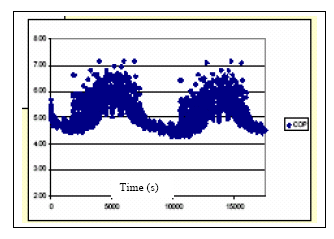
It is observed that modified water cooler with the facility to use of waste water along with the tap water for condenser cooling performs better in comparison to conventional water cooler. Almost 44% COP improvement is observed due to reduction in power consumption (Figure 1). Typical results comparing COP and power consumed are shown in Table 4. Table 5 Energy consumption and corresponding expenses occurred. 7 gives the recommended practices to ensure that efficiency does not deterioration with operating period. The beginning of pump deterioration starts with balance operating point (BP) deviating away from the best efficiency point (BEP) resulting in creation of unbalanced forces and vibrations (Figure 2). Table 8 gives the requirements for choice of pumps. The heating or cooling of a space to maintain thermal comfort is a highly energy intensive process accounting for as much as 60-70% of total energy use in non-industrial buildings. Of this, approximately 30-50% is lost through ventilation and air infiltration. However, estimation of energy impact of ventilation relies on detailed knowledge about air change rate and the difference in enthalpy between the incoming and outgoing air streams. In practice, this is a difficult exercise to undertake since there is much uncertainty about the value of these parameters [7]. As a result, a suitable datum from which strategic planning for improving the energy efficiency of ventilation can be developed has proved difficult to establish [8]. Efforts to overcome these difficulties are progressing in the following two ways:
? Identifying ventilation rates in a representative cross section of buildings.
? The energy impact of air change in both commercial and domestic buildings.
8. Global Journal of Human Social Science
Volume XIII Issue IW I Version I
( D D D D ) 2 48Year 2013
9. B
The challenge before many cities today is to support large numbers of people while limiting their impact on the natural environment. Buildings in a modern society are significant users of energy and materials and, hence, energy conservation in buildings plays an important role in urban environmental sustainability. A challenging task for architects and other building professionals, therefore, is to design and promote low energy buildings in a cost effective and environmentally responsive way. Passive and low energy architecture has been proposed and investigated in different locations around the world, and design guides and handbooks have been produced for promoting energy efficient buildings.
10. Range of applicability of minimum efficiency
The minimum efficiency must be applicable for a change in total head of + 10% and -25%.
Testing of the pump Pump must be tested and witnessed by owner personnel.
Seal life Seal life of 24 months from date of commissioning.
11. Bearing life
Bearing life of 36 months from date of commissioning. Mean time between failure (MTBF) = [Total time period x number of failures in the time period]
Guarantee MTB may be specified as 40,000 hours for the impeller and motor.
12. Performance guarantee at site
The vendor must demonstrate the energy efficiency through measurement performance guarantee test (PG test).
VI.
13. Natural Ventilation
Generally, buildings should be designed with controllable natural ventilation. A very high range of natural ventilation rates is necessary so that the heat transfer rate between inside and outside can be selected to suit conditions [9]. The ventilation rates required to control summertime temperatures are very much higher than these required to control pollution or odour. Any natural ventilation system that can control summer temperatures can readily provide adequate ventilation to control levels of odour and carbon dioxide production in a building. Theoretically, it is not possible to achieve heat transfer without momentum transfer and loss of pressure. Such ideas work well for small buildings.
14. VII.
15. Mechanical Ventilation
Most of the medium and large size buildings are ventilated by mechanical systems designed to bring in outside air, filter it, supply it to the occupants and then exhaust an approximately equal amount of stale air. Ideally, these systems should be based on criteria that can be established at the design stage. To return afterwards in attempts to mitigate problems may lead to considerable expense and energy waste, and may not be entirely successful [10]. The key factors that must be included in the design of ventilation systems are: code requirement and other regulations or standards (e.g., fire), ventilation strategy and systems sizing, climate and weather variations, air distribution, diffuser location and local ventilation, ease of operation and maintenance and impact of system on occupants (e.g., acoustically). These factors differ for various building types and occupancy patterns. For example, in office buildings, pollutants tend to come from sources such as occupancy, office equipment, and automobile fumes. Occupant pollutants typically include metabolic carbon dioxide emission, odours and sometimes smoking. When occupants (and not smoking) are the prime source. Carbon dioxide acts as a surrogate and can be used to cost-effectively modulate the ventilation, forming what is known as a demand controlled ventilation system. Generally, contaminant sources are varied but, often, well-defined and limiting values are often determined by occupational standards. It may mean achieving zero energy requirements for a house or reduced energy consumption in an office building. However, a major goal of low energy building projects and studies is usually to minimize the amount of externally purchased energy, such as electricity and fuel gas. Sometimes the target may focus on the energy costs or a particular form of energy input to the building. Passive solar systems for space heating and cooling, as well as passive cooling techniques can significantly contribute to energy saving in the building sector when used in combination with conventional systems for heating, cooling, ventilation and lighting. The overall thermal behaviour of the building is dependent on the alternatives and interventions made on the building's shell. Passive ventilation systems share the use of renewable energy to provide ventilation with infiltration. But unlike air leakage and open windows, passive ventilation systems are designed to provide specific amounts of ventilation to minimise both energy liabilities due to excessive ventilation and periods of poor air quality due to under-ventilation [11]. However, the most common passive ventilation system is the passive stack, which is normally used to extract air from kitchen and bathrooms. In this method, prevailing wind and temperature differences are used to drive airflow through a vertical shaft. Various stack designs can be used to control or enhance the performance, based on local climate. However, careful design is required to avoid backdraughting and to insure proper mean rates. Although there is significant experience with this approach in Europe, it has been rarely used in North America [12]. Well-designed passive ventilation systems can be used to provide whole-building ventilation as well as local exhaust. Some efforts are currently underway to develop passive ventilation systems that incorporate heat recovery to minimise the need for conditioning the ventilation air [13]. These approaches aim towards a fully renewable ventilation system in that it requires no non-renewable resources for either providing the ventilation air or conditioning it. Table 9 shows natural ventilation vs mechanical ventilation. stack effect is:
Qstack = Cd*A*[2gh (Ti-To)/Ti] 1/2(4)Where:
Qstack is the volume of ventilation rate (m 3 /s) Cd is a discharge coefficient (0.65)
A is a free area of inlet opening ( ), which equals area of outlet opening g is the acceleration due to gravity (9.8 m/s 2 ) h is the vertical distance between inlet and outlet midpoints (m) Ti is an average temperature of indoor air (K), note However, as building design needs to consider requirements and constraints, such as architectural functions, indoor environmental conditions, and economic effectiveness, a pragmatic goal of low energy building is also to achieve the highest energy efficiency, which requires the lowest possible need for energy within the economic limits of reason. Therefore, since many complicated factors and phenomena influence energy consumption in buildings, it is not easy to define low energy building precisely or to measure and compare the levels of building energy performance. The loose fit between form and performance in architectural design also makes quantitative analysis of building energy use more difficult. Reduced capital, space and running costs compared to conventional air conditioning. Potential for integrated day-to-day and smoke control as well as hybrid natural and mechanical ventilation systems.
Potential for integrated day-to-day and smoke control as well as hybrid natural and mechanical ventilation systems. Custom solutions for all types of buildings. Total support from design, installation, through to service and maintenance.
Total support from design, installation, through to service and maintenance.
16. Energy-efficient and cost-effective
A particularly important aspect of mechanical ventilation is having heat recovery, which allows incoming air to be warmed by outgoing air through a heat exchanger, therefore avoiding heat loss through the ventilation system.
17. VIII. efrigeration
If temperature of hot gas is too high, the tendency of coil is to steam. Also, as the air temperature goes, its relative humidity drops. This leads to increased evaporation of surface water. It also, adds to refrigeration load if it is a cold storage or if the freezers are in the open area then it leads to fog/mist formation. Warmer temperatures will not necessarily improve defrost efficiency. This is because most of the defrost heat comes from latent heat of hot gas, rather than sensible heat (Table 10). After the corrective actions taken by Montreal protocol and subsequent Kyoto protocol, in recent years, the consumption of potential greenhouse gases has increased, whist at the same time the consumption of CFCs, HCFCs and other substances, which are depleting the ozone layer, is approaching zero.
Refrigerants are identified by number, preceded by the letter ''R'' designation has been established by ASHRAE and is used throughout the industry. Common refrigerants are listed in along with their chemical name and the ODP. The prefix ''CFC' refers to the family of refrigerants containing chlorine, fluorine and carbon. Compounds that also contain hydrogen precede the abbreviation with the letter ''H'' to signify an increased deterioration potential before reaching the preceded with an ''H'' as in 'HFC''.
-134a R-134a CH 2 FCF 3 0 1300 HFC-407C R-407C CH 2 F 2 , CF 3 CHF 2 , CH 2 FCF 3 0 1526 HFC-410A R-410A CH 2 F 2 , CHF 2 CF 3 0 1725The input data required are the following:
? Thermal gains related data: solar protection is assumed good, thermal gains can be varied and the user specifies the occupancy period.
? Building fabric data: glazing ratio can be any value while thermal mass can be varied at three levels.
? Ventilation data: infiltration, day ventilation and night ventilation can be specified as necessary.
? Weather data: solar data are fixed but temperature is user specified for seven days although temperature profiles need not be the same for all days. The weather data are specified in the form of maximum and minimum temperature for each day and hourly values are calculated by sinusoidal fitting.
However, a primary strategy for cooling buildings without mechanical intervention in hot humid climates is to promote natural ventilation. To control the energy used for the cooling of buildings in hot-arid regions with ambient air temperatures during the hottest period between 42 to 47 o C, passive cooling approaches should be implemented [14]. A solar chimney that employs convective currents to draw air out of the building could be used. By creating a hot zone with an exterior outlet, air can be drawn into the house, ventilating the structure as well as the occupants. Since solar energy in such a region is immense, the hot zone created with a black metal sheet on the glazing element can draw hotter air at a slightly higher speed [15]. Applications of solar chimneys in buildings were limited to external walls. Integrating a solar chimney with an evaporatively cooled cavity could result in a better cooling effect. However, this should be applied with care since water sources are limited [16]. Average room and ambient air temperatures are 23 and 27 o C respectively. Air velocity required to achieve thermal comfort in the room should reach a maximum of 0.3 m/s [17].
18. IX. Air Pollutants and Transmutation
Controlling the pollution of the present civilisation is in an increasing concern. More importance is given to control global carbon dioxide, which is considered to be the main factor of green house effect. Though the complete experimental result on the fact is yet to be debated, the immense heat, temperature and turbulence of nuclear explosion oxidising the atmospheric nitrogen into nitric oxide, are considered to be similarly responsible for depletion of ozone layer [18]. At present, more importance is given for plantation to reduce the level of global carbon dioxide. The plantation over the whole earth surface may control only 50% of carbon dioxide disposed to atmosphere and its greenhouse effect. There are, also, explosions in the ozone layer time to time to add to the problem. Irrespective of the relative importance of each factor, the ozone layer protects us from harmful cosmic radiations and it is believed that the depletion of ozone layer increases the threat of outer radiations to human habitation if environmental pollution is not controlled or there is no possibility of self-sustainable stability in nature [19].
The presence of ionosphere in the outer-sphere is most probably for ionic dissociation of the gases of the outer-sphere in the presence of low pressure and cosmic radiation [20]. Moreover the ionosphere contains charged helium ions (alpha particle). Therefore, it may 12 summarises the overall impact of the three refrigerants with respect to R-22 performance. It is based on information from system tests. There is high potential for significant material and labour savings for air conditioning systems with R -410 A refrigerant Table 13).
be concluded that the explosion in the ozone and transmission of radiations through it are the possible effects of transmutation of pollutants with exothermic reaction (emission of radiations) [21]. The existence of a black hole in the space, which is found in the photo camera of astrologist, is still unexplored. This black hole may be an effect of transmutation process with absorption of heat energy (endothermic reaction). The idea of transmutation of pollutants has been proposed for one or more of the following reasons:
? The experimental results support the transmutation of materials.
? To search the sinks of the remaining carbon dioxide not absorbed by plants or seawater.
? To find out the possible causes of explosion in the ozone layer other than the depletion of ozone layer.
? To investigate the possibilities of the self-sustaining stability of global environment.
To prove the portable of transmutation of pollutants, experimental investigations may be conducted to bombard C or CO 2 or CH 4 or other air pollutants by accelerated alpha particles in a lowpressure vacuum tube in a similar condition of ionosphere. Heating them with gamma radiation can accelerate the alpha particles. The results of such experimental investigation may prove the probable transmutation of pollutants and self-sustaining equilibrium of the global environment [22].
X.
19. Energy and Environment
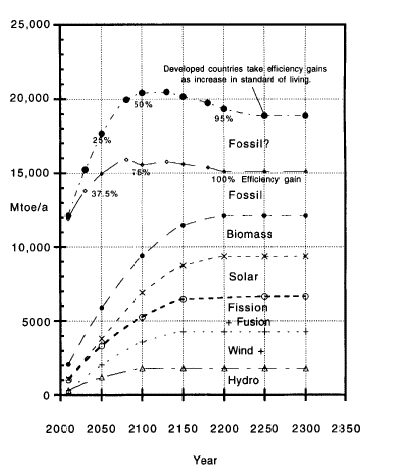
Today, renewable energy is some 20% of the world's annual energy use of about 9 x 10 9 tonnes of oil equivalent (Mtoe/a; 1 toe = 42 GJ) [23]. Fossil fuels account for the bulk; about 80% of the energy use. In the future, it is postulated that these roles will change as energy demand rises and cheap oil and gas are depleted; even without consideration of global warming effects. The changes will be driven mainly by the developing areas, which have relatively less of the fossil fuel reserves, but have a substantial potential to deploy renewable energies [24]. A substantial potential is believed to exist in the world for renewable energy sources. This is estimated as 4900 Mtoe/a for biomass, 780 Mtoe/a (electric) for hydropower, and 4540 Mtoe/a (electric) for wind-power [25]. Roughly half of these energy resources are in developing countries. The rest of the energy will have to be supplied by fossil, solar, geothermal and nuclear (fission and fusion) sources. An example distribution of world energy sources is shown in Figure 3.
They are campaigning for sustainable development, which has been defined as development, which meets present needs without compromising the ability of future generation to meet their needs [26]. It is, therefore, essential that energy efficiency improvements and all energy sources, particularly renewables, are developed and deployed rapidly in order to ensure that population stabilisation, with a decent standard of living for all, is realised. There is a need to move towards a sustainable energy policy with the objectives of environmental protection, sound natural resource management and energy security [27]. Opportunities exist for the increased development of renewable energy and energy efficiency through regulation, changes to institutional and economic arrangements, and through liberalisation of the energy market, which offers the potential for the development of energy service companies and a market for green electricity. Friends of the Earth have been one of the leading environmental groups campaigning in support of renewable energy and energy efficiency over the last two decades.
Industry's use of fossil fuels has been blamed for our warming climate. When coal, gas and oil are burnt, they release harmful gases, which trap heat in the atmosphere and cause global warming. However, there has been an ongoing debate on this subject, as scientists have struggled to distinguish between changes, which are human induced, and those, which could be put down to natural climate variability. Industrialised countries have the highest emission levels, and must shoulder the greatest responsibility for global warming. However, action must also be taken by developing countries to avoid future increases in emission levels as their economies develop and population grows. Human activities that emit carbon dioxide (CO 2 ), the most significant contributor to potential climate change, occur primarily from fossil fuel production. Consequently, efforts to control CO 2 emissions could have serious, negative consequences for economic growth, employment, investment, trade and the standard of living of individuals everywhere. Scientifically, it is difficult to predict the relationship between global temperature and greenhouse gas concentrations. The climate system contains many processes that will change if warming occurs. Critical processes include heat transfer by winds and currents, the hydrological cycle involving evaporation, precipitation, runoff and groundwater and the formation of clouds, snow, and ice, all of which display enormous natural variability. The equipment and infrastructure for energy supply and use are designed with long lifetimes, and the premature turnover of capital stock involves significant costs. Economic benefits occur if capital stock is replaced with more efficient equipment in step with its normal replacement cycle. Likewise, if opportunities to reduce future emissions are taken in a timely manner, they should be less costly. Such flexible approaches would allow society to take account of evolving scientific and technological knowledge, and to gain experience in designing policies to address climate change.
XI.
20. Renewable Energy
The energy conservation scenarios include rational use of energy policies in all economy sectors and use of combined heat and power systems, which are able to add to energy savings from the autonomous power plants. Electricity from renewable energy sources is by definition the environmental green product. Hence, a renewable energy certificate system is an essential basis for all policy systems, independent of the renewable energy support scheme. It is, therefore, important that all parties involved support the renewable energy certificate system in place. The potential of the most important forms of renewable energy, such as solar, wind, biomass, and geothermal energies, is shown in Table 14. Existing renewable energy technologies could play a significant mitigating role, but the economic and political climate will have to change first. Climate change is real. It is happening now, and greenhouse gases produced by human activities are significantly contributing to it. The predicted global temperature increase of between 1.5 and 4.5 degrees C could lead to potentially catastrophic environmental impacts. In order to meet challenges, the future energy policies should put more emphasis on developing the potential of energy sources, which should form the foundation of future global energy structure [28]. The concept of an integrated renewable energy farm (IREF) is a farming system model with optional energetic autonomy, which includes food production and if possible, energy exports. Energy production and consumption at the IREF have to be environmentally friendly, sustainable and eventually based mainly on renewable energy sources. A combination of different possibilities exists for non-polluting energy production, such as modern wind and solar electricity production, as well as the production of energy from biomass. An IREF system based largely on renewable energy sources would seek to optimise energetic autonomy and an ecologically semi-closed system while also providing socio-economic viability and giving due consideration to the newest concept of landscape and bio-diversity management. Ideally, it would promote the integration of different renewable energies and rural development, as well as contributing to the reduction of greenhouse gas emission as shown in Table 15. The overall objective is that the IREF concept be successfully introduced into agricultural production systems, which have to be completely sustainable, taking into account the following influential factors [29][30]:
? Impact, influence and needs of climate, soil and crops.
? Ratio of required food/bio-fuel production.
? Input/output requirement for cultivation, energy balance and output/input ratio.
? Equipment choices (wind, solar, biomass generation and conversion technology).
21. Conclusions
Many cities around the world are facing the problem of increasing urban density and energy demand. As cities represent a significant source of growth in global energy demand, their energy use, associated environmental impacts, and demand for transport services create great pressure to global energy resources. Low energy design of urban environment and buildings in densely populated areas requires consideration of a wide range of factors, including urban setting, transport planning, energy system design, and architectural and engineering details. It is found that densification of towns could have both positive and negative effects on the total energy demand. With suitable urban and building design details, population should and could be accommodated with minimum worsening of the environmental quality. Energy efficiency brings health, productivity, safety, comfort and savings to homeowners, as well as local and global environmental benefits. The use of renewable energy resources could play an important role in this context, especially with regard to responsible and sustainable development. It represents an excellent opportunity to offer a higher standard of living to local people and will save local and regional resources. Implementation of greenhouses offers a chance for maintenance and repair services. It is expected that the pace of implementation will increase and the quality of work improve in addition to building the capacity of the private and district staff in contracting procedures. The financial accountability is important and should be made transparent.
components. Applied Thermal Engineering, 27, 1708-1714.

| Total | ||
| volume | ||
| (Cm 3 ) | ||
| 5 | 212.5 | 14.58 |
| 3 | 212.5 | 3.11 |
| 1 | 212.5 | 0.11 |
| 0.45 | 212.5 | 0.0089 |
| Sub-total | 850 | 17.83 |
| 10 | 37.5 | 21.30 |
| 25 | 37.5 | 303.16 |
| 50 | 37.5 | 2459.70 |
| 75 | 37.5 | 8260.72 |
| Sub-total | 150 | 11044.88 |
| Capacity of cold storage | 5000 Mt |
| Number of chambers and capacity | 4 x 1250 Mt |
| Size of cold storage | 21.00 m x 16.00 m x |
| chambers | 13.70 m (L x W x H) |
| Ventilation requirements | 2-6 air changes per day |
| Volume of cold storage | 4603 m 3 or 162400 ft 3 |
| Fresh air required for CA | 677 cfm |
| Total fresh air required for | |
| chambers |
| PCMs | Type | Melting point ( o C) | L atent heat (kJ/kg) | |
| 45% | Ca | Mixture | 25 | 130 |
| (NO 3 ) 2 .6H 2 O+55% | ||||
| Zn(NO 3 ) 2 .6H 2 O | ||||
| 66.6% | Mixture | 25 | 127 | |
| CaCl 2 .6H 2 O+33.3 | ||||
| % MgCl 2 .6H 2 O | ||||
| Octadecane | + | Eutectic | 25.5-27 | 204 |
| docosane | ||||
| Mn (NO 3 )+6H 2 O | hydrates Salt | 25.5 | 126 | |
| Octadecane | + | Eutectic | 25.8-26 | 174 |
| heneicosane | ||||
| Lactic acid | Fatty acid | 26 | 184 | |
| 34% myristic acid | Organic | 26 | 148 | |
| + 66% capric acid | ||||
| 1-Dodecanol | Organic | 26 | 200 | |
| 48% Cacl 2 +4.3% | Mixture | 26.8 | 188 | |
| NaCl+0.4 | ||||
| KCl+47.3%H 2 O | ||||
| 86.6% capric acid | Mixture | 26.8 | 160 | |
| + 13.4% stearate | ||||
| acid | ||||
| 50% CH3CONH2 | Eutectic | 27 | ||
| + 50% NH 2 CONH 2 | ||||
| Item | without use of waste water | Water cooled condenser with use of waste water | |
| COP | 2.5274 | 3.2248 | 3.6278 |
| Power consumed (kW) | 0.52 | 0.3541 | 0.3254 |
| Item | Per day | Per day | Per month | Per month | Per year | Per year |
| Energy | Expenditure | Energy | Expenditure | Energy | Expenditure | |
| (W) | ($) | (W) | ($) | (W) | ($) | |
| 4.6 | 19.32 | 138 | 743.4 | 1656 | 8920.8 | |
| 3.94 | 16.55 | 118.2 | 658.26 | 1418.4 | 7899.12 |
| Air cooled | |
| condenser | |
| Water cooler | |
| system | |
| Conventional | |
| water cooler | |
| with air | |
| cooled condenser | D D D ) |
| Modified | |
| water cooler | |
| with water | |
| cooled | |
| condenser |
| Electric rating | Motor efficiency | Pump | Overall | efficiency | Margin in active |
| (kW) | (%) | efficiency (%) | (pump+motor)(%) | power (%) | |
| <10 | 90 | 80 | 72 | 20 | |
| 10-20 | 92 | 85 | 78 | 15 | |
| 20-30 | 93 | 85 | 79 | 15 | |
| 30-50 | 94 | 85 | 80 | 15 | |
| 50-100 | 95 | 85 | 81 | 10 | |
| >100 | 96 | 85 | 62 | 10 | |
| Particular | Details |
| Number of hours clocked, time between repairs, frequency of | |
| Timber | repairs must be recorded. |
| This information in itself is a good diagnostic tool. | |
| Can be used as a basis for life cycle costing in future. | |
| Condition monitoring | Bearing and winding temperatures and bearing vibrations are diagnostic in predicting failures. |
| Periodic shaft alignment | Radial shaft alignment must be below 0.06 mm. Angular shaft alignment must be below 0.5 o C. |
| Impeller and casing wear ring clearance measurement | Must be measured when the impeller is opened. It must not be over 0.0025 mm beyond factory setting. Typical factory clearance is 0.20-0.24 mm. |
| Particular | Details |
| The duty point of the pump must be specified | |
| Duty point | by providing the suction head (pressure, |
| velocity, elevation) and discharge head | |
| (pressure, velocity, elevation) based on actual | |
| measurements and not on assumed data. | |
| BEP flow rate must coincide with duty point or | |
| Best efficiency point (BEP) | balance point flow rate. The balance point is the flow rate point at which the pressure rise of |
| the pump coincides with the pressure drop of | |
| the circuit. | |
| Minimum efficiency | Minimum efficiency must be specified as per guidance values. |
| Effective solution when building | ||
| geometry | prevents | natural |
| ventilation solution or scheme | ||
| design requires set ventilation rate. | ||
| Temperature ( o C) Pressure (Bar) Latent (kJ/kg) heat | ||
| 4 | 4 | 1240 |
| 10 | 5 | 1220 |
| 16 | 6 | 1200 |
| 21 | 8 | 1180 |
| D D D D ) B | ||||
| ( | ||||
| R Number | Chemical type | ODP | Similar to | comments |
| Rr-11 | CFC | 1.00 | 11 | |
| R-12 | CFC | 1.00 | 12 | |
| R-22 | HCFC | 0.05 | 22 | |
| R-123 | HCFC | 0.02 | 123 | |
| R-134a | HFC | 0.00 | Single | |
| R-401a | HCFC | 0.05 | R-12 | 22, 152a, 124 |
| R-402b | HCFC | 0.02 | R-12 | 125, 290, 22 |
| R-404a | HFC | 0.00 | R-502 | 125, 143a, 134a |
| R-500 | CFC | 0.74 | R-502 | 12, 115 |
| R-502 | HCFC | 0.28 | ||
| R-507 | HFC | 0.00 | R-502 | 125, 143a |
| R-410A | HFC | 0.00 | R-22 | 125, 32 |
| R-407C | HFC | 0.00 | R-22 | R32, 125, 134a |
| Efficient effect (%) relative to R-22 | R-134a R-407C R-410A | ||
| Thermodynamics | 3 | -4 | -7 |
| Compressor | -3 | -1 | 5 |
| Heat exchanger | -6 | -2 | 2 |
| Lines | -2 | 0 | 2 |
| Total (net) | -9 | -7 | 5 |
| Substance | R-number | Chemical formula | ODP value | GWP value |
| HCFC-22 | R-22 | CHF2Cl | 0.005 1700 | |
| HFC | ||||
| Year 2013 | ||
| 2 54 | ||
| Volume XIII Issue IW I Version I | ||
| D D D D ) | ||
| ( | ||
| Global Journal of Human Social Science | technology Solar | Productive end-uses and commercial activities Lighting, water pumping, radio, TV, battery charging, refrigerators, cookers, Dryers, cold stores for vegetables and fruits, water desalination, heaters, |
| baking, etc. | ||
| Wind | Pumping water, grinding and provision of power for small industries | |
| Hydro | Lighting, battery charging, food processing, irrigation, heating, cooling, cooking, etc. | |
| Biomass | Sugar processing, food processing, water pumping, domestic use, power Machinery, weaving, harvesting, sowing, etc. | |
| Kerosene | Lighting, ignition fires, cooking, etc. | |
| Dry cell batteries | Lighting, small appliances | |
| Diesel | Water pumping, irrigation, lighting, food processing, electricity generation, |
| Climatic Region | Energy source | ||||
| Northern | Solar 200 m 2 | 7 | 15 | ||
| and Central | Wind 100 kW | 100 | - | 60 | 12 |
| Europe | Biomass | 100 | 105 | ||
| South | Solar 250 m 2 | 12.7 | 40 | ||
| Europe | Wind 100 kW | 100 | - | 36 | 48 |
| Biomass | 70 | 65 | |||
| Northern | Solar 300 m 2 | 21 | 90 | ||
| Africa | Wind 100 kW | 75 | - | 14 | 1.2 |
| Sahara | Biomass | 25 | 29 | ||
| Equatorial | Solar 200 m 2 | 18.2 | 37.5 | ||
| Region | Wind 100 kW | 45 | - | 45 | |
| Biomass | 70 | 80 | |||
| XII. |