1. Introduction
uring the first two centuries of the Common Era, the coinage at the Roman Empire's provinces had a substantial increase. Siria and Judaea, for example, had at least thirty two cities with coinage at the Julio-Claudian period (44 BCE -69 CE), number that became that number rose to forty seven at the Antoninian period (138-192 CE). Among those cities was Tel Dor, an independent coastal settlement that coined for the majority of imperial times.
The iconographic representations in Tel Dor's coins, even though without many type variations, give us precious information about identitary and cultural aspects of the city, and are also a reflection of how the Roman Empire handled coinage in the eastern provinces. Through the analysis of Dor coin's imagesmostly with religious meanings -, we can begin to understand how was the relationship between locals and Romans, and how the previous cultural heritage of the city had an important role in it.
2. II.
3. Identity in the Roman Province's Coins
In Antiquity, coins didn't work just as value measures or commercial tools. They also hold symbolisms and carried messages (Harl 2017: 311). "Coins with their legends (inscriptions) and types (images) communicated many different types of messages, be they political, religious, cultural, or social" (Harl 2017: 312).
At the Roman Empire the communicative character of coins was very clear since they spread news (for example, of the ascension of a new emperor), and also cultural values (Harl 2017: 316). Therewithal, coins could become identitary symbols, or, according to Fergus Millar, would be "the most deliberate of all symbols of public identity" (Millar 1993: 230).
For this reason, provincial coinage is an extremely rich and multifaceted object study. To make their analysis easier, provincial Roman coins can be divided into four groups: client king coins -which circulated inside those king's territories; coins with provincial matters; koinon coins -coined in the name of a federation of cities (koina); and civic coins, that showed inscriptions and images of important public figures -the most common kind of provincial coinage. As the majority of provincial coins didn't possess any value signs, that was determined by the coin's size, weight or iconographic representations. Besides that, most of the bronze civic coins circulated locally, 1 as excavations have shown (Heuchert 2005: 30 -31).
The two first centuries of Common Era saw an increase in civic and koinon coinages, but the explanations for this increase are not totally clear. One hypothesis is that the bigger number of civic coins reflected the grown prosperity of the cities' elites, or even that an increasingly number of elites and cities began to see coinage as potential expression of their civic pride. The growth of coinage also could indicate a crescent urbanization and monetization of cities (Heuchert 2005: 40).
4. "
Modern numismatists have divided the coinage of the Roman empire into two main categories, those minted centrally and those minted in the provinces. All the gold and much of the silver in circulation throughout the empire was made centrally at Rome, as was-after about AD 45-all the bronze coinage for the western empire." (Burnett 2005: 171-172). 2 With a few exceptions, like Jewish Revolt coins, coined by the rebellious Jews.
Howsoever, coins -and what was represented in them -were a reflex of political choices of those who were in power, indicating speech modes accepted in imperial terms. 2 The very existence of coinage in specific cities depended on Roman acceptance. Such factors, at first sight, seem to indicate that the political hegemony precluded that provincial identitary diversity found its voice through coinage. However, the motifs accepted by Rome were exactly what enabled provincial identities to be perceived (Williamson 2005: 24). Especially in the case of the Eastern provinces, where most part of the cities were headed by a local aristocracy magistrate which responded to the provincial governor and to the emperor, which delegated certain coinage freedom to those cities. 3 Therefore, the real meanings of the symbols used by the communities are much more nuanced and complex than the "outsiders" can imagine. In the case of provincial and imperial coinage, many of the same or similar symbols are used in different cities, so it is important to identify the authorities responsible for the coinage to discover their different meanings (Butcher 2005: 147). Furthermore, the custom, strengthened Thereby, "the images can thus be seen as public and official expressions of civic identity as constructed by local aristocracies" (Heuchert 2005: 40). Nevertheless, coin motifs were not related just to the elites, the identity expressed in them were also shared by all cities' inhabitants.
In this context, identity can be understood as a "socio-psychological term, defined loosely as 'concepts of belonging' and is made up of a series of overlapping domains -language, material culture, and the histories that people tell of themselves" (Williamson 2005: 20). It is also an object built in some historical contexts, based on subjective rather than objectives criteria (Howego 2005: 1). As already pointed out, coins were an important identitary symbol, especially because their formulation implicated the choice of public representations and categories.
However, those representations were only meaningful because they were understood in certain ways by inhabitants of the cities. Its importance did not lie in transmitting information to foreigners. In other words, people were the ones who attributed meanings to monetary symbols, so that the same symbol could have different meanings in different places (Butcher 2005: 144; 146). It was in those specificities of meanings that identities resided. In numismatic analyses, however, we can only understand symbols, often shared by different communities. On the other hand, the subjective meanings of those symbols, which formed the sense of identity of the communities, are more puzzling to be identified -both by us and by individuals in antiquity that were part of distinct communities (Butcher 2005: 146).
"If coin types were an expression of identity, be it that of individuals, groups, or whole communities, then it is less likely that they were intended primarily to represent the public face of that community among other communities, deploying a simple symbolism of stereotypes and caricatures for outside consumption, and that instead they were chosen to represent the community to itself, or individuals to themselves, etc., so that the symbols affirm rather than provide information" (Butcher 2005: 147). 3 Coins produced in the eastern provinces and those produced in the western provinces differed mainly because in the east the minting was distinctly different from that made in Rome, with different sizes, representations, and even languages (usually the inscriptions were in Greek, not Latin). In the west, there was a greater need to emulate the coins produced in Rome (Burnett 2005: 177-178).
during Augustus' time, of representing the emperor or some member of the domus Augusta on the obverse 4 of coins, influenced the choice of the image that would be represented on the reverse. 5 III.
5. Tel Dor's Coins
Coins help us to clarify the process of mental and cultural integration in provincial cities, which is clearer in the case of elites, who sought to demonstrate the strengthening of their civic identity, and at the same time their belonging to the Imperium Romanum, using coinage as a stabilizing element of that relationship (Weiss 2005: 68).
6. a) A Brief History of the City's Coinage
The city of Tel Dor has a past of varied occupations before the arrival of the Romans in 63 BCE. In the 13th century BCE, Dor was part of Canaanite territory, and in the 12th century BCE it was dominated by the Sikil, one of the Sea Peoples. The city was also one of King Solomon's administrative centers, and later became the capital of the Assyrian province of Duro after the Assyrians took over the region. During the Achaemenid period, it belonged to the Sidonians. In the third century BCE, Dor came under the Seleucids, then the Ptolemies, during which there was a brief minting of coins in the city. During the Hasmonean period, the city was incorporated into the kingdom of the Jews by Alexander Janeus, and was subsequently annexed to the province of Syria when the Romans dominated the region through Pompey. Roman rule inaugurated a long period of coinage in the city (Meshorer 1995: 355).
Despite the minting carried out in the Ptolemaic period, which followed the pattern of royal Hellenistic coins, without much local autonomy, it was during the Roman period that the coins of Dor came to represent the city's identity more vehemently. Along with the portraits of emperors and other Roman symbols, the coins carried local images, which were identity symbols recognized by the community. The arrival of the Romans created a civic need for the minting of quasiautonomous coins in Dor, probably influenced by the fact that the city was not ruled by a local king, but directly by the Roman authorities. Furthermore, Dor was the first city in northern Palestine to mint Roman coins, of diverse values, since the first year of Pompey's arrival in the region (Motta 2015: 30; 35). After Pompey's arrival, quasi-autonomous coins were dated "year 1". Coins of Mark Antony and Cleopatra, from the year 19 and 31, were also found in the city. From approximately the reign of Augustus to Vespasian and Titus all the coins from Dor began to portray the emperor. A large number of coins were minted during the First Jewish Revolt, as were in other cities that sided with the Romans in the conflict. Under Domitian and Nerva, coins stopped being minted in the city, but the practice returned under Trajan, when it was the height of minting in Dor, due to the emperor's monetary policy in Syria. Minting continued during the reigns of Hadrian and Antoninus Pius, but coins from the periods of Marcus Aurelius, Lucius Verus and Commodus were not found. Only under Septimius Severus the coins are proven to be produced again in the city, bearing the heads of several members of the Severian family. Minting in Tel Dor is believed to have ended at the end of the Caracalla government, as no later coins were found in the city (Motta 2015: 35-36 andMeshorer 1995: 355;359).
The repertoire of symbols represented on the Tel Dor coins varies, for the most part, between images of the gods Tyche-Astarte and Doros, maritime symbols and imperial representations -usually highlighted on the obverse. For this reason, Ya'akov Meshorer characterizes it as limited and without variations, with dates and the distribution of inscriptions being the main differences between the coins, which could then be divided into two groups -"quasi-autonomous" coins that carried images on the obverse of maritime symbols, Tyche or Doros, and coins depicting the bust of the emperor on the obverse (Meshorer 1995: 355).
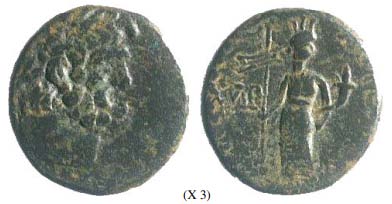
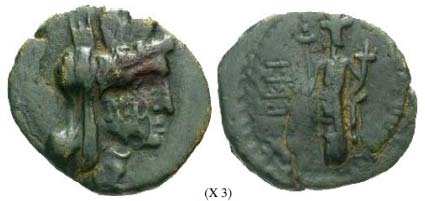
To analyze the identity expressions observed in the city's coinages, we selected a few coins that represent the themes mentioned, which are the most recurrent: Coins 4 and 7 (Fig. 4 and 7) depict a bearded male figure on its reverse, while coin 1 (Fig. 1) depicts the same figure on the obverse. The figure is identified as Doros, although that identification does not appear in writing. The association with Doros is made mainly because of the reference in the writings of Claudius Iolaus. 6 It was in the Hellenistic period that Tel Dor began to be called Dora or Doros, in reference to Doros, son of Poseidon, who was then credited as being its founder.
Without that reference, the image could be associated with Poseidon or Zeus. According to Rebecca Martin, the explanation for such ambiguity is that the city's inhabitants would know who was actually being represented on the coins, because of his importance in constituting Dor's identity (Nitschke et al. 2011: 150). 7 The goddess Tyche-Astarte (Fortune to the Romans) is also depicted on many Dor coins, usually with a cornucopia in her hands. On coins 1, 2, 3 and 6 (Fig. 1, 2, 3 and 6) she is depicted on the reverse, standing on coins 1, 2 and 3, and wearing a crown of turrets on coin 6, where only her bust appears. On coin 2, her crowned bust is also depicted on the obverse. She is an example of syncretism, as she is a mixture of Astarte -the Phoenician goddess of fertility, sexuality and war -with the Greek goddess Tyche, who was the In fact, Dor was seen as a Phoenician city that had been founded by a Greek hero, through an ethnographic "word game". The association with Doros also contributed to the increase of the city's prestige, as it was related to a Greek god (Nitschke et al. 2011: 150). The cult of Doros was the main one in the city in the Hellenistic period, and also in the Roman period (Porto 2007: 122). Doros is mentioned in several sources in two different ways. As a son of Poseidon, and as a son of Helen -most popular lineage. Because of that, his definition of being the son of Poseidon, at the founding of Dor, is somewhat abstruse. 6 Phoenikika, book 3. 7 "Alexander the Great and the Hellenistic rulers who succeeded him sought to undertake a policy of 'syncretism' as a mean to gain the loyalty of native populations. They turned cities into poleis and legitimized the conquest and rule of the Greeks. Myths of the founding of cities by Greek gods or heroes were invented. The foundation of coastal cities in Judea/Palestine was related to Doros, Heracles, Dionysius and Ascalos" (Porto 2007: 217).
goddess of luck and possibility, and also commonly associated with coastal cities because of her maritime character (Meshorer 1995: 360). In archaic Greece, Tyche was considered the daughter of the god Ocean, being revered by sailors -which associated her with fate and luck. "The Greeks believed that each person and place had its own Tyche. (...) Each polis had its own Tyche as a protector and a divine guide" (Porto 2007: 214). Therefore, the peoples who were conquered by the Greeks identified Tyche in some local deity -Astarte, for example, in the case of Tel Dor and other cities with Phoenician influence in the Syro-Palestine region. She not only protected the cities, but the individual lives of the inhabitants.
The cult of Tyche-Astarte continued during the Roman period in Dor, as "the Roman conquest of the region did not diminish the Greek mastery of language and culture. Romans 'identified' their gods with the Greek gods" (Porto 2007: 217). Her representation on coins of coastal cities, such as Dor, is usually associated with marine elements -such as shells, triton, anchors, ships, rudders, aphlaston, 8 Finally, the representation of emperors, when associated with Tyche or Doros, evoked the perception of majesty and authority, which the population of Dor had previously associated with deities. It was a language that locals knew, and it was also the reason etc. -in order to demonstrate how the sea was "the main source of subsistence, of the well-being and the economic and political grandeur of coastal cities" (Porto 2007: 219), which does not occur in cities that do not have direct contact with the sea. Thus, we noticed that the attributes related to Tyche in the coins varied, depending on the location and identity of the cities (Porto 2007: 222). Some maritime symbols also feature prominently on Dor coins, revealing the importance of economic activity related to the sea, provided by the port (Porto 2007: 122). In one of the exemplified coins (Fig. 5), we can see the representation of a galley -a commonly used type of ship in the Mediterranean -on its reverse. The galley depicted with the aphlaston, as on the coin, was an important symbol of naval strength. In Dor, this symbol could be a reference to Pompey's victories, which started the new civic era that brought the minting of coins upon the city (Motta 2015: 64).
why the imperial cult quickly spread across the Orient, as it easily connected with the myths of gods and heroes of the previously established Hellenistic tradition (Motta 2015: 46). On coins 3, 4, 5, 6 and 7 (Fig. 3, 4, 5, 6 and 7), we see the portraits of the emperors Vespasian, Trajan and Hadrian on the obverse. It is interesting to note that Trajan's coins (Fig. 4, 5 and 6) have Tyche-Astarte, Doros and the galley on the reverse, relating them to all the main identity symbols of Dor.
7. b) Analysis within Identitary Context
When analyzing Dor's coins, we can see that they are not just ancient artifacts, but symbols of the city's inhabitants' cultural self-understanding, and the means by which Dor built its identity. However, as Dor was constituted by different ethnic contacts, due to their diverse occupations, it is important to identify which cultural characteristics are reflected on the coins. For example, Dor's culture and identity in the Hellenistic period were too heterogeneous -language and religion were Phoenician as well as Greek -probably being perceived as hybrid by the townspeople themselves. Already in the Roman period, the Greek-Phoenician identity character of the city remained, but now with the concept of Romanitas also permeating its characteristics (Motta 2015: 26;29). "The citizens of Dora, therefore, could have easily considered themselves both Greek and Roman, as demonstrated by the persistence of the Greek language and local religious traditions side by side with Roman traditions" (Motta 2015: 29).
This cultural hibridism is clear on the coins, which mix imperial portraits and symbols with a variety of identity signs recognized by the community (Motta 2015: 30). The vast majority of these symbols were religious in nature -Tyche-Astarte, Doros, and even the emperors -which is explained by the fact that religion, especially polytheistic ones, was the most common way in which identities were expressed on coins. The explanation for this is the opening for the expression of localisms that polytheism enabled (Howgego 2005: 2), which is clear in the case of Tyche, for example, a Greek goddess who was related to several local deities from different places. The goddess was a common representation on the coins of the cities in the region, which can give the impression of being a "generic" image. However, communities could perceive their identity both in common or generic symbols and in singular symbols. Indeed, while common symbols represented community identities, unusual symbols were likely to refer to the interests of particular groups or individuals, or to specific occasions (Butcher 2005: 149).
For Kevin Butcher (2005: 153), identity is not perceptible only by monetary types or symbols themselves. It is also necessary to understand how they operated in the communities. Symbols could provide a link between individuals with different interests and understandings, but they weren't exactly the identity of those individuals. Furthermore, coins did not represent universal trends in the Roman Empire, but were, in fact, a social process that Roman authorities could control and manipulate (Butcher 2005: 153). Even the eastern provinces, which had a supposed freedom of coinage, depended on the emperor's endorsement to produce coins -as in the case of Dor, whose coining was interrupted during the reign of several emperors. This because, in addition to the economic and identity aspect, the currency had also an intrinsic political character. Not all places at all times minted coins. The choice, or lack thereof, of the minting locations is also relevant. The same goes for the choice of symbols that represent cultural identity (Burnett 2005: 180).
IV.
8. Final Considerations
The coin is an object of study that provides reflections and answers about the most diverse spheres of life in the Roman Empire. Even if we pay attention only to the identity sphere, the information obtained will be multiple. In this essay we explored some of them.
The knowledge of those responsible for minting, for example, is an element that helps to elucidate the meaning behind the iconographic choices of coins. Generally, those responsible were the elite of the cities, which, in turn, had their own interests in the choice of images. However, more important than recognizing those responsible for the coinage, is knowing the symbols represented. Those symbols could be repeated in different cities, but what really connected them to the identities of those communities was the intrinsic meaning they had for them. It was the inhabitants who gave meaning to those representations, not the other way around.
Within the imperial context, those representations should also refer to the emperor. More than that, they should show the imperial connection with provincial cities. That happened, for example, through the association of some local god with the emperor, by choosing the obverse or reverse of coins. It is also important to point out that even the cities that had a certain freedom of coinage only did so because it was, in some way, interesting to the empire. It was always Rome that allowed or disallowed coinage in cities.
But the representation of local gods and symbols, even if alongside imperial symbols, could also indicate that communities -or elites, specifically -did not seek to indiscriminately embrace only those symbols that were universally associated with the Roman empire. They also sought to reiterate, or even permanently remind themselves of their own identities. Even so, it is often difficult to discern the boundaries between local identities and Roman identity, or even if there was such thing.
Volume XXI Issue III Version I 45 ( )