1. Introduction
he area of marketing to children has received much public health attention in recent years. The study presented a paper on food choices concerning television (TV) advertising targeted to children. This study also represents the ways of promoting their product and influenced the child. There is a wide-ranging debate over the role of the food and advertising industries, how they influence food choice, and the extent that this interacts with personal choice. Children's food promotion is dominated by television advertising. When children like a commercial, the chance that they also like the brand and ask their T parents to buy the brand are greatly enhanced (Moniek Buijzen and Patti M. Valkenburgn, 2002). There is plenty of evidence that children notice and enjoy food promotion. It showed that promotion is just one part of the complex process of advertising and that measuring its effects on children's behavior. The research examined possible effects on what children know about food, their food preferences, their actual food behavior, and their health outcomes. The increase in childhood obesity is gaining the full attention of health care professionals, health policy experts, children's advocates, and parents (Anderson and Butcher, 2006). The aggressive marketing and advertising of high caloric food products targeting children have been identified by the World Health Organization (2003) as a probable causative factor contributing to the epidemic of childhood obesity. (Randy and Aaron Brewster, 2007). Food advertising affects food choices and influences dietary habits. Food and beverage advertisements should not exploit children's inexperience or credulity. Messages that encourage unhealthy dietary practices or physical inactivity should be discouraged, and positive, healthy messages encouraged. Governments should work with consumer groups and with the industry (including the advertising sector) to develop appropriate approaches to deal with the marketing of food to children (Sonia, 2005).
2. II.
3. Literature Review
Advertising is often studied within a framework that identifies advertising appeals as basically either rational or emotional (Solomon, 2004). Rational advertising stems from traditional information processing models emphasizing that a consumer is believed to make logical and rational decisions about products, primarily by showing product benefits such as product quality, value, or performance (Albers-Miller and Stafford, 1999). Advertisements extolling the characteristics of a food product such as taste/flavor (e.g., chocolaty, fruity, sweet) or texture (e.g., crunchy, crisp) are examples of logical appeals. These appeals are also referred to as informational, utilitarian, or product quality appeals (Randy and Aaron Brewster, 2007). Countries differ in their approach to the regulation of television advertising. Some rely solely on statutory regulations (i.e., those enshrined in-laws or statutes, or rules designed to fill in the details of the broad concepts mandated by legislation); others preferring self-regulation (i.e., rules put in place by a self-regulatory system whereby industry actively participates in, and is responsible for, its regulation). In many cases, both forms of rules coexist. The principle underlying many regulations is that advertising should not be deceitful or misleading. Most national regulations recognize children as a special group in need of special consideration and stipulate that advertising should not be harmful or exploitative of their credulity (Dr. Corinna Hawkes, 2004).
Nutrition during childhood and adolescence is essential for growth and development, health, and wellbeing. Further, eating behaviors are established during childhood track into adulthood and contribute to longterm health and chronic disease risk. Numerous studies have consistently documented that dietary intake patterns of American children and adolescents are poor and do not meet national dietary goals (Mary Story and Simone French, 2004).
Children themselves have been found to believe that alcohol advertising can cause alcohol consumption (Barrie, Anders, and Maria, 2009).
Hitchings & Moynihan (1998) found that 9 to 10year-old English children could recall seeing adverts in the past two weeks in seven different food product categories. It confirms that in both developed and developing countries: (i) there is a great deal of food promotion to children, particularly in the form of television advertising; (ii) this is typically for highly processed, energy-dense, unhealthy products with evocative branding; and (iii) that children recall, enjoy and engage with this advertising. Thus it is clear that children worldwide are being exposed to an unhealthy diet through food promotion. (Gerard, Laura, Kathryn, Martine, and Stephen, 2006).
Children in early childhood usually prefer familiar contexts and non-threatening fantasy animals, while children in middle childhood like to watch more adventurous and fast-paced media content and more complicated, socially-oriented characters (Valkenburg and Cantor, 2000).
Less saturated fat; more fruits and vegetables; attractive food labeling; and incentives for the marketing and production of healthier products. In working with advertising, media, and entertainment partners, there is a need to stress the importance of clear and unambiguous messages to children and youths. Global 'health and nutrition literacy' requires a vast increase in attention and resources (Caraher, M., Landon, J. & Dalmeny, K. 2006).
The prominent emotional appeals used in food advertisements (e.g., fun or happiness, play, fantasy or imagination, social enhancement) strongly appeal to children's needs, desires, and early developmental stages. As such, they are vulnerable to these messages. Child health care professionals can teach parents and children to understand the appeals used in food advertising and why children are targeted aggressively by food companies. Parents aware of these appeals are better equipped to discuss television commercials with their children and teach them to be wise consumers of television and other media advertising (Hindin, T.J., Contento I.R, Gussow, and J.D. 2004).
4. a) The Rationale of the study
Currently, in Bangladesh, child health is a concerning issue. However, there is no current study on this topic. That is why we tried to find out the role of the food and television advertising, how they influence food choice, and the extent that this interacts with personal choice.
5. b) Objectives of the study
By conducting this research, we attempted to determine the nature and extent of how Bangladeshi TV channel food and beverage advertising influence children's food choices. The specific objectives are: ? To examine the children's understanding of advertising. ? To investigate the content of advertising to children. ? To inquire about the effect of advertising on food choice. ? To find out how children play an active role in food choices in families. ? To explore the consequences of food or beverage been chosen by children and how it becomes harmful for them.
c) The Methodology of the study Both secondary and primary data are collected for conducting the research work.
6. d) Data Collection
Primary data is collected through questionnaire surveys to discover the impact of food and beverage advertising on children's food choices. Both closed and open-ended questions are used in the questionnaire. The questionnaire is finalized after proper pretesting. The language of the questionnaire is simple and easily understood.
Secondary data is collected from content analysis and proper literature review. Secondary sources are related books, journals, magazines, research papers, other publications, and websites, and advertisements.
7. Research Questions
We selected six closed-ended questions and one open-ended question for the survey. IV.
8. Selection of Samples
The samples for the questionnaire are selected through random sampling. The samples are taken from Bangladeshi TV channels advertisements for content analysis. For the questionnaire survey, respondents are randomly selected from all over the country. We have chosen random sampling with an age group of 20-50. The respondents were 100. The questionnaire was distributed online and in person. There were seven questions, among which six are multiple-choice questions, and the one is open-ended question. The survey helped us to find out the impact of different types of TV advertising on children's food choices.
V.
9. Data Analysis and Interpretation
Data analysis and interpretation are carried by the above research objectives. Data analysis includes analysis, editing, classifying, and tabulating the collected data. However, because of the nature of the study, analysis and interpretation are descriptive.
10. a) Conceptual Content Analysis
Conceptual analysis is a technique that treats concepts as classes of objects, events, properties, or relationships. This method involves precisely defining the meaning of a given concept by identifying and specifying the conditions under which any phenomenon is (or could be) classified under the notion in question. Fourteen food-based Bangladeshi TV channel advertising of the years 2015-2019 were taken and analyzed. Content analysis founded on the following parameters Food Presentation, dialogues, Music, Artist/Model, Appearance of kids, unusual sound effect, Animation, target audience.
These advertisements are telecasting on all most every Bangladeshi TV channel. All of these advertisements persuade children's food choices and influences dietary habits. We found that children are interested in taking food and beverage items after enjoying these advertisements.
The following advertisements have a significant influence on food and beverage consumption.
Any Time Doodles: Three boys are failing simultaneously in calculating, balling, and singing because of hunger, and they call their mother. At this moment, their mother gives them Any Time Doodles. At last, the advertisement shows that when they eat it, they become successful.
11. Bloop Ice Cream:
In this advertisement, one lady lost her things. She asks her mother about it. But her mother cannot tell about that. At this moment, the lady's younger sister comes from school and takes a Bloop Ice Cream from the refrigerator and says her elder sister always to take Bloop Ice Cream when lost something. She listens to her sister and starts to take Bloop Ice Cream and, at last, found her lost things.
Choco Bean: In this advertisement, two children (one is a boy, and another is a girl) are sitting in a park. They do not talk to one another. But when they take Choco bean, they become friends.
Cocobis Chocolate Filled Biscuit: In this advertisement, children dreamed that after consumption of Cocobis Chocolate Filled Biscuit, they would become gigantic. And animal, plant, vehicle everything would become little than those children who have taken Cocobis Chocolate Filled Biscuit. There is another attraction for children, and it is a free toy as gift.
Complan: In this advertisement, one child acting as a tiger with his father. When his mother calls him for taking milk, he says, `tiger never drinks milk.' After listening to this mother add a new flavor of Complan with milk. Then the boy is attracted to the added taste of Complan and comes secretly and drinks the glass of milk. After that, his mother tells him, you say a tiger never drinks milk, so why you took it? Then he answered if the taste is appeasement tiger drinks it. Not only the boy, the advertisement shows that his father is also taking Complan because of taste.
Fresh Full Cream Milk Powder: It is the story of a boy. When he was a child, his father dreamed that he would be a cricketer. But he lost his father. Then his mother entangled the dream of his father. The boy started to journey to fulfill his mother's dream. At last, he can complete his mother's desire. The boy is no one; he is a great cricketer Tamim Iqbal. The advertiser shows that they always besides these children with Fresh Full Cream Milk Powder.
Frutika Junior Juice: After finishing school, a mother comes to take her child. The mother asks her child, did he any mischief at the school. He said that he could only read in school and did not have any naughtiness. But after eating the Frutika Junior Juice, he was honestly a quote. He said he could not read. Sagar could have been able to read. He scratched the chalk on the Sagar's bench. The Advertisement means that after taking Frutika Junior Juice, every child tells the truth. Horlicks: One girl sends the football on the net though she is confronting a crucial situations, boys are jumping in the pond, some boys are trying to act as like as senior, some boys are competing for riding bicycles, some are practicing band, and they uploaded these adventurous activities in Google. Their mother serves them Horlicks, and she says that it is very essential for their growth and taller, sharper and stronger.
12. Krackers King Chips:
There are many kids who participate in this advertisement. In this particular advertisement, one boy is acting as king and the rest of others courtier. The king wants some special inventions from the researcher. And the researcher gives him Krackers King Chips. When the king and courtier are taking it, they lost in a fantasy kingdom.
Meridian Chicken Chips: From the beginning of this advertisement, everybody is running to catch of cock. But No one can. At the last moment, one child comes and tells, do not run behind the cock. If you want to take taste real chicken, take Meridian Chicken Chips. After knowing this, everybody starts to take Meridian Chicken Chips. Mr. Noodles: Two kids (one is a boy, and another is a girl) are swinging. The girl is vexing the boy calling 'chicken'. But when the girl provides her tiffin (chicken flavor Mr. Noodles), the boy forgets everything, and becomes happy. Pran Chocochoco: There are many children who participate in this advertisement. And they divided into two parties. One is the groom's side, and another one is the bride's side. The advertiser shows that the children of the bride side are busy preparing food, and Pran Chocochoco is the main ingredient of every kind of food. The last scene is everyone is satisfied to take these items. Pran Lollipop: One child play hides and seeks with his mother in this advertisement. But after showing Pran Lollipop, he comes back automatically to his mother.
13. Pran Magic Cup Lichi:
In this advertisement, one child (girl) consumed Pran Magic Cup Lichi. After taking this item, she becomes a magician, and another child (boy) saw it. He also started to take Pran Magic Cup Lichi and becomes a magician.
Thus we found that TV advertising builds an anticipatory mind setup that influences the children heavily, so they decide to take that food and beverage.
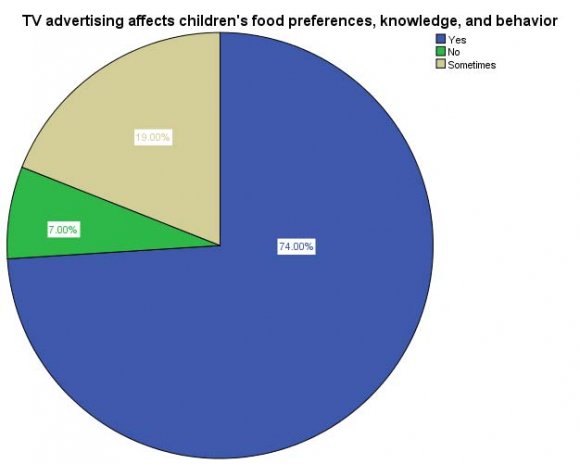
14. b) Statistical Analysis TV advertising affects children's food preferences, knowledge, and behavior
The pie chart delineates that 74 percent of parents believe there is a great impact on food promotion by TV advertising on children's food preferences, knowledge, and behavior. At the same time, 19 percent assume it may sometimes, and only 7 percent regard there is no effect of TV advertisements on children's food preferences, knowledge, and behavior.
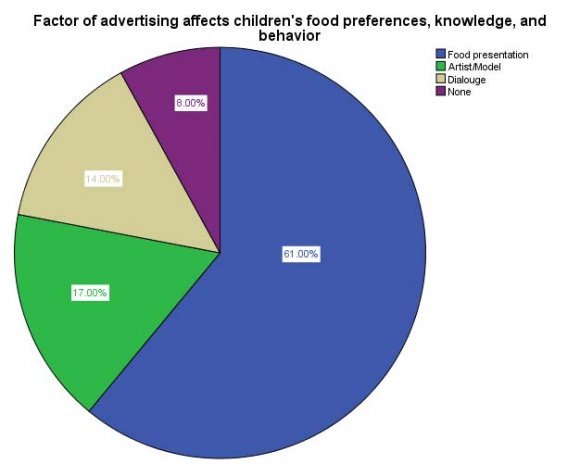
15. Factors of advertising affect children's food preferences, knowledge, and behavior
The chart illustrates the 61 percent of respondents confide that the factors of TV advertising which attract the children most are food presentation. The second highest majority trust artist or model enthrall in this case which shows the 17 percent. While 14 percent strongly conceive dialogue is the main factor. And 8 percent of parents suppose that the mentioned three factors do not allure the children.
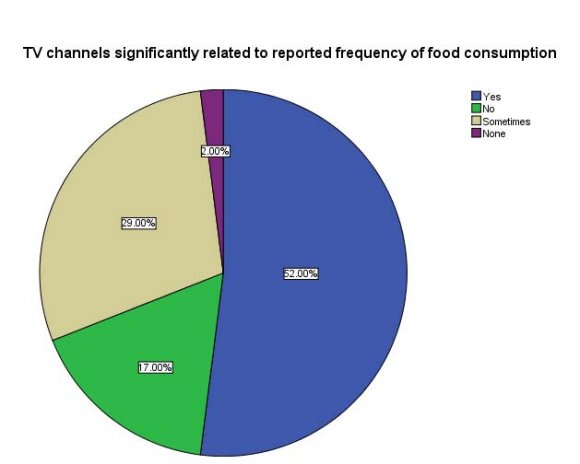
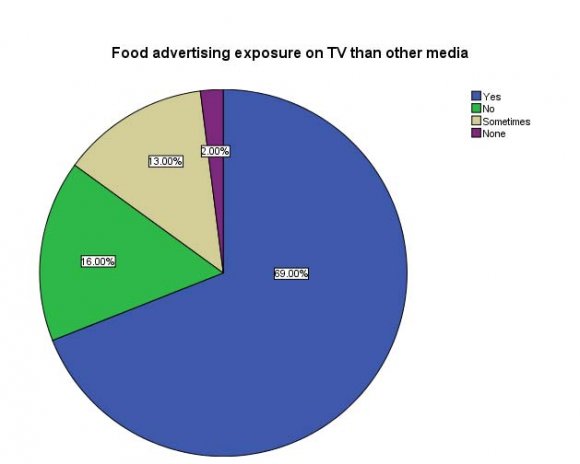
Greater reported exposure to food and beverage advertising on TV channels significantly related to reported frequency of food consumption Figure 3 The pie chart depicts greater reported exposure to food and beverage advertising on TV channels significantly related to the reported frequency of food consumption that is agreed by 52 percent of respondents. Twenty-nine percent guardians impose; sometimes children are influenced by greater reported exposure. But in this same question, 17 percent of people decide children are not convinced by exposure to food and beverage advertising on TV channels. Only 2 percent of respondents deny all of the mentioned alternatives. Consumption of some types of food and beverage more significantly related to food advertising exposure on TV than other media
The consumption of some types of food and beverage more significantly related to food advertising exposure on TV than other media, and 69 percent of parents admit this statement. But 16 percent confess that other media decoy the children's food choices. As well as 13 percent of people think that sometimes TV channels cope with other media. Rest of the respondents, which shows that only 2 percent presume the narrated alternatives are not valid with this question.
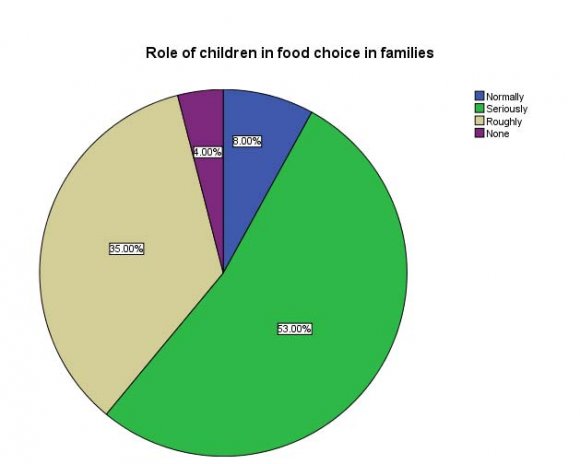
16. Children play an active role in food choice in families
The pie chart represents 53 percent of respondents agree that children seriously play a significant role in their food choice in families. Thirty-five percent believe this proportion is rough. And parents support children play their role normally and sometimes inactive at 8 percent and 4 percent, respectively.
17. Figure 6
This chart displays that 61 percent of parents perceive advertisers make a profit by using children's food and beverage choices. At the same time, 18 percent do not admit this view. But 17 percent of people agree that sometimes advertisers use children's sentiment for gaining profit. Only 4 percent of respondents do no choose any position.
18. VI.
19. Pediatricians Opinion
In this method, we conducted interviews with three pediatricians, and we got their views on the research topic. They answered the open-ended question. They believe that foods and beverages promoted by TV advertisements not always protein enriched. That is why it may hamper psychic development and reduce the creativity of children. As a result, they are suffering from many kinds of malnutrition diseases such as obesity, anemia, a dental problem, skin infection, throat pain, pneumonia, diarrhea, diabetes, and so on. This type of promotion also leads to addiction. As a consequence, children are reluctant to take a balanced diet in their daily routine. Obesity problems may cause diabetes and heart diseases in the future.
20. VII.
21. Limitation of the Study
The size of the sample has to be reduced because of the paucity of time and required budget. It is a significant limitation of our current research. We consider the issue in evaluating the consequence of the study. Another abridgement is there is no research evidence about this study in Bangladesh. That is why we did not get expected much more support from the previous analysis. Apart from examining many times, there are some limitations in the question paper so the respondent could not ascertain those questions. In some cases, these reasons make the analysis difficult.
22. VIII.
23. Conclusion
The findings from this study provide guidance for child health care professionals and other child advocates in designing measures that counter food advertising messages directed at children. Food promotion is affecting, particularly on children's preferences, purchase behavior, and consumption, and this sentiment is used by TV advertisers to make a profit. We tried to present the evidence which proved that advertising affects food choice and influences dietary habits. From the overall study, we found that food and beverage advertising on Bangladeshi TV channels influence children's food choices. And it always becomes harmful to the physical and psychological development of children.
IX.
24. Recommendations
1. The replication of the research would be possible with a comparatively large sample size. 2. It would be investigated that nowadays why other media compete with Bangladeshi TV channels. 3. It would be explored why advertisers use emotional appeals in commercials aimed at teenagers. 4. The budget should be increased for further research. 5. Further research might be on why there is no regulatory framework for the promotion of TV advertising.
Year 2020
Volume XX Issue XVI Version I ( A )