1. Introduction
t's well known that school principal's leadership is an important factor related to school's outcomes (Sammons, 2008;Leithwood, 2009;Alves & Franco, 2008, among others). But how school principals can make a difference inside their schools? How can their actions, decisions, and relationships impact school teachers' job quality and their students' learning? This study tries to answer those questions. It is part of a larger research which intended to deepen the understanding about if and how school leadership could affect two important school factors: teachers' job satisfaction and students' learning. Through a quantitative approach, this research designed questionnaires with specific items to access the information about school leadership as perceived by school teachers. The study intended to analyze which aspects related to principals' job (leadership, relationship, management, etc) could be associated to two important school outcomes: teachers' job satisfaction and students' proficiency. The theoretical and methodological contributes of this paper pretends to collaborate with the discussion about the importance of public schools in minimizing the social effects on students' academic trajectory.
2. a) Some Context
Brazil has a decentralized educational system spread over its 27 states and their municipalities. In 2017, Brazil had almost 34 million school-age children attending approximately 183,000 elementary and secondary schools (MEC/INEP, 2017). The publicschool system is responsible for more than 80% of the elementary and secondary school.
In our educational system, as well as in other Brazilian areas, deep historical social inequalities can be found. The school educational system has been getting, in the last few years, special attention amongst the other social challenges in our country. Since the 1990's it has been guaranteed that almost all children (97%) have access to elementary school. Nevertheless, many of them do not reach high school. The number of students with access to high school and even college has increased in the last 20 years, but very slowly compared to other countries, as Andrade (2012) points out: Despite this intense grow observed in higher education, the rate of youth access is still restricted -19% of people between 18 and 24 years old (PNAD, 2009). When we compare the Brazilian situation with other countries better developed, we see that the Higher Education access, in 1997, had reached 45% of 18 to 21 years old ones in USA and 69% in South Korea. (p. 18)
So, despite the goal of having almost all children with access to elementary school, the Brazilian educational system faces the challenge of retaining them and delivering a high-quality education. At the end of elementary school Trying to contribute on this field, this study was developed in municipal public schools in Rio de Janeiro. As have been well noticed, Rio struggles with economical, security and social problems that increased in the last years. Despite of being one of the most important cities in our country, the results for this municipal school system are alarming (just 49% of the 5 th grade students and 19% of 9 th students learned the Math's basic level . Many studies in Educational Sociology are trying to explain and find solutions for the educational inequalities, specially looking for the school factors that can minimize the social economic impacts on students' learning. In Brazil, this challenge is urgent, considering our delay in providing that our students could read and solve math problems when finishing elementary school.
3. 3
4. II.
5. Theoretical Framework
). Also, we have one of the higher indexes of school lateness (33% students with more than 2 years of school delay). The municipal school system of Rio de Janeiro included 996 elementary public schools, spread across a beautiful but complex city, with 483,073 students entitled to progress on their academic experience. The principals of these public schools struggle with providing good quality academic learning in a challenging social context. This study tries to better understand how it can be possible.
Extensive national and international research in sociology of education indicates that, if the family background has a significant weight in determining the student's academic performance, some intra-school factors could minimize this effect of students' social background, stimulating efficiency and equity in the educational offer (Brooke & Soares, 2008;Sammons, 2008;Franco et al., 2007;Medeiros, 2007;Brandão et al., 2008). Sammons (2008), as well as Alves and Franco (2008) point out some of these intra-school factors, including efficient pedagogical actions focused on learning, teacher training and remuneration, school infrastructure, monitoring the academic progress of students, among others.
School principalship -often identified with the leadership skills of school principals -is a relevant school factor of effectiveness, regarding which Sammons (2008) makes the following consideration:
Almost every school effectiveness study shows leadership as a key factor both in junior schools and high schools. Gray (1990) says that "the importance of the Principal's leadership is one of the clearest messages from research into school effectiveness '. [...] the study of the literature shows that three characteristics were found to be frequently associated with successful leadership: strong purpose, involvement of other employees in the decisionmaking process, and professional authority in the processes of teaching and learning. (p. 351-352).
School leadership has been raising increasing interest in the academic studies of the educational field and has gained prominence in the current educational policies. In our review of articles published between 2010 and 2017 in four important national and international educational journals 4 , we found 44 papers that explored the relationship between the school principal tasks and the teachers work 5 The variance in the students learning results, related to the principalship, is usually linked to the combination of maintaining a good school climate (suitable to learning) and building a collective perception among the other school agentscharacteristics of effective schools, as identified in . Leithwood, the most frequently author cited in those articles, underscores the attention paid to the topic: School leadership is currently receiving unprecedented attention. The agenda of educational reform, in its ongoing evolution, seems to have grasped that the role of leadership is in itself an important goal for reform and, at the same time, a vehicle for other things to happen. (p. 17).
Although Leithwood highlights the influence of practice in the classroom as being the most relevant school factor that can influence students' academic results, he states that 'school leaders also influence student learning, but it is more indirectly' (ob. cit., p. 20). Leithwood stresses that even though school leadership only accounts for between 3% and 5% of learning variance between students from different schools, it accounts for a quarter of total variance when variables such as students' social origins are controlled, and only intra-school factors are analyzed (2009, p. 23). So, considering the findings in his huge literature review in this subject, we can consider that principals' work is the second most important factor -inside the school -that influence students' outcomes.
Soares (2007) also highlights the importance of school management: 'inside the school there are two important processes interacting to produce student performance: school management and teaching' (Soares, 2007, p. 153). According to the results of his research, Soares points out that the school principal's job includes guaranteeing the school's functioning in a way 'that its existing resources can be used to meet the learning needs of the students' (ibid.).
6. Year 2019
Volume XIX Issue I Version I ( G ) literature. Sammons (2008, p. 351) considers that the impact of school management in the improvement of academic results is not direct, but it involves real work behind the scenes, seeking to ensure the development of other key features recognized as essential for school effectiveness. Among them she points out: shared objectives and visions, learning environment, positive incentives, family-school partnership, learning-oriented organization and monitoring of students' academic progress.
Ogawa and Bossert (1995) analyzed the comprehension of leadership from different perspectives that influenced the school climate studies.
It's interesting to note that the focus is on the principals' work and there the leadership assumes different variations, both in its form and its substance (op. cit., p. 239). But Brunet (1992, p. 128) cautions against generalizing the results since the 'the leadership style just indicates one of the possible dimensions of the climate [organizational]'.
Boyd et al. ( 2011), however dedicated special attention to the contextual/relational factors inside the school, and their impacts on teachers' decision of stay or leave the school. The factor administration (which, in the authors' study involves the relationship with the school leadership team) was an important predictor in the teachers' decision of keep working in the school, as well as the lack of support from the school leadership team was pointed as an aspect that influenced the teachers' decision to leave the school.
Thoonem et al. ( 2011), in their turn, analyses the impact of school leadership practices, school organizational conditions, and motivational factors (including personal relationships) in school teachers' practices.
Considering the principals' leadership as an important factor to school improvement, the study here presented aimed to identify how the principals' work can be effective to schools' outcomes. Trying to understand that, it was investigated some possible variables that could be related with the teachers' satisfaction in their job (as a proxy of the improvement in teachers' job) and with students' results in Math tests (as a proxy of the improvement in academic quality). The methodological procedures to reach that are described in the next section.
7. III.
8. Material and Methods
As the aim of this study was to understand how leadership, relationship, and management, (i.e. aspects of school principals' leadership) could be associated to teachers' job satisfaction and students' proficiency, a quantitative survey-based study was designed.
The quantitative studies about school leadership in Brazil are normally limited by the available data: the principals and teachers' responses to the contextual questionnaire of Prova Brasil 6 , but they have some limitations 7 Therefore, the study here presented used data provided from two different sources: the first one was the results of the survey mentioned above, that was applied to school principals and teachers in 2014. It was used a stratified sample (n= 42) of municipal public schools in Rio de Janeiro that attend all grades of elementary school (N= 163) . These limitations challenged our research group to design a special survey trying to deep access the information about school leadership and school climate. Inspired by our studies and by the literature review, this study designed new correlated instruments to access principals and teachers' perceptions about these concepts. The questionnaires were tested to verify their confidence level to measure our constructs.
9. 8
. The questionnaires applied were answered by 45 principals and principal assistants and 394 teachers. In some schools the survey didn't receive an expressive number of teachers' answers, reason why this study considered the results collected in 27 schools where it was found a representative number of respondents (211 teachers, in total). So, we worked with a sample of 27 schools, that was confirmed tested as representative of their universe (N= 163). The questionnaires were applied both online (through surveymonkey.com) and in paper 9 The second source of data used in this study was provided by Prova Brasil/2013. The Social Economic Status -SES variable was designed with the information provided by students' questionnaires about their social background (in average per school). We considered the parents' academic background as a . In this study, I used teachers' answers to our questionnaires to build indexes of their perceptions about school leadership and school climate. 6 Prova Brasil is a large-scale assessment (Mathematics and Language skills tests) applied every two years to students in the 5th and 9th grades of the elementary school, in all Brazilian public schools. The assessment includes contextual questionnaires applied to principals, teachers and students of the classes being evaluated. 7 To know more about this assessment and the limitations of the contextual questionnaires, see AUTHOR, 2015 and 2018; FRANCO, 2001. 8 According to Brazilian educational laws, the municipal educational systems are responsible for organizing and offering the kindergarten schools (attending children from 4 to 5 years old) and the elementary school (6 to 14 years old students). The municipal public schools in Rio de Janeiro differ in their organization: some of them offer only kindergarten, others offer kindergarten plus the first term of elementary school, others offer all the elementary school, some of them offer just the first or the second terms of the elementary school, etc. We can find different arrangements in all the municipal school units in the city of Rio de Janeiro, reason why the actual government are trying to reorder all the system. In this study, we chose to apply the survey in those units that were serving in 2014 all 9 grades of elementary school, trying to access a larger number of teachers and trying to figure out the complexities of leading a huge school. 9 To have a detailed description of the survey's methodology and challenges, see Author (2015; 2018). ). The information about students' academic results was also provided by Prova Brasil/2013. We considered the Math tests' results of 5 th grade students (in average per school) considering that this subject reflects the school academic improvement more than the Language one -which is still much dependent of family backgrounds, as highlighted Rutter et al. (2008).
The data provided of those different sources were than organized in two databases -Schools (with the data provided by Prova Brasil: SES and Math Proficiency in average per school) and Teachers (With the data collect in our survey).
To analyze the data, we used factor analysis with teachers' answers to build indexes that synthetized a group of answers linked to the constructs to be tested. Factor analysis allow the estimation of latent variables rather than only measured variables, improving validity and reliability (Brown 2006). For this study, the main indexes were "Leadership recognition (by teachers)", "Teachers' Perception of school climate" and "Teachers' job satisfaction". The first one synthesized the teachers' perception about their principal (or principal team) leadership and included items like "the school management team is known as an effective team" among others. The second index included items related to discipline and relationships. The third index included questions in a concordance scale, as "I feel happy working at this school" and "If I could I would transfer to another school", among others. These indexes are completed described in the table below. In my school the leadership team is recognized for their good job (0,796); The leadership team has an encouraging and solidarity attitude with teachers (0,933); The school principal value and encourage the teachers' job (0,930). KMO:0,668 ? de Conbrach: 0,866
10. Perception of School Climate (by teachers)
How do you evaluate the following aspects in your school: Students discipline/behavior (0,767); The relationship of students and their teachers (0,909); The relationship of teachers and their students (0,842); The relationship between students and school's employees (0,847). After checking the confidence level of these indices to synthetize the items (validity and reliability), which enabled us to synthesize teachers' perceptions about the three themes, the indices were aggregated in average by school. So, each one of the 27 schools in our sample had their indices, expressing the perceptions of their teachers in average. The aggregated indices were then merged to the Schools Database.
The study intended to analyze which aspects related to principals' job (leadership, relationship, management, etc) could be associated to two important school outcomes: teachers' job satisfaction and students' proficiency. Trying to better understand the possible relationships between the variables created, two groups of linear regressions were developed, having the variables "Index of Teachers' job satisfaction" and "Students results in Math test (5 th grade)" as dependent variables. I am here considering the teachers' satisfaction in working in their schools as a proxy of their quality of work and the 5 th grade students' results in Math test as a proxy of school academic achievement.
The first group of linear regression model was trying to understand what can be associated with "Teachers' job satisfaction" and its control variable was the "Teachers' age" (percentage of teachers older than 40, per school), considering the studies that showed the relationship between teachers' age/experience and their satisfaction in working at their schools (as showed, for example, by Cunha, 2015).
The second group of linear regressions asks: what can be associated with the variation in "Students results in Math test -5th grade"? Its control variable was the SES (percentage, per school, of students which at least one parent finished high school). This control variable was chosen considering that the social background has the major influence in students' outcomes (Alves, 2008;Soares &Andrade, 2006 and and that it can be measured by the parents' formal educational level (Hasembalg & Silva, 2000).
11. Validity and reliability
The tables below summarize the variables used in each model. IV.
12. Results
After statistical analyses of the data, some associations were found to explain the variance of the dependent variables tested in each model. This paper highlights the significant and positive association between the Index "Teachers' Perception about School Climate" with the both dependent variables, as discussed below.
Considering the collinearity among all the variables and the size of the sample as technical limitations for an analysis of the indexes' simultaneous effects, we considered their individual associations with the dependent variable, in each model. As a result, we have different models introducing each index with the control variable (stepwise method, on SPSS). The Final Model, on the two groups of regression, presents the index "Teachers' Perception of School Climate" as the one which better adjusted to the models, amplifying its power to explain the variation of the dependent variable in each group.
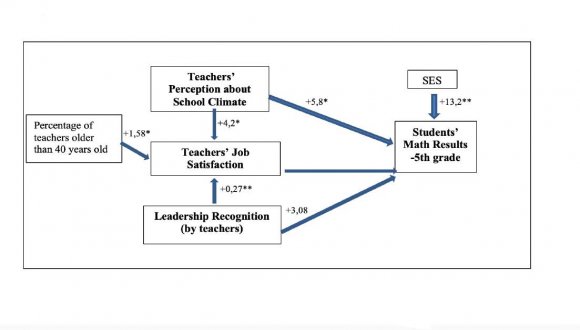
In the first group, which was measuring what could affect the teacher's satisfaction in working at that school, the index "Teachers' Perception about School Climate" had a coefficient b= 0.27 (sig < 0.01) in the variation of the dependent variable (r² = 0.46). It was the most important index measured to explain the variation on the teachers' job satisfaction and the only one that stayed in the Final Model, as showed in the table below: It can be inferred of this result that teachers are more satisfied working at schools where they perceive a better academic and relational climate. These results corroborate common sense: teachers are more satisfied working in those schools where they find a good climate to teach. They also work happier where they recognize and legitimate their principals.
In the second group, testing what could be related with the students' academic results, we found that the Index "Teachers' Perception about School Climate" had a coefficient b= 5,8 (sig < 0.05) in the variation of the variable "Students' results in Math test (5 th grade)" (r² = 0.59). It was again the most important index measured to explain the variation on the students' results (average per school) and the only one that stayed in the Final Model, as showed in the table below: As showed in the data above, the students' academic results tend to be improved more in that schools were teachers perceive a good climate to teach. And it is important to note that, in this sample, the index "Teachers' Perception of School Climate" had the power of minimize the SES effect on the academic results, an important goal when we think about school inequalities. Furthermore, the "Teachers' job satisfaction" also had a significant association with students' outcomes: b= 4,2 (sig < 0.05, r² = 0,56). These results point out to a direct and an indirect effect of the index "Teachers' Perception of School Climate" on students' Mathematics proficiency, as shown in the figure below that synthesizes the findings:
13. Discussion
This study tried to better understand how school leadership could affect two important school outcomes: the teachers' job satisfaction (as a proxy of teachers' work quality) and the students' academic results. Considering the hypothesis that the relationships built inside the school, between principals (or principal team) and teachers could affect these outcomes, it was developed a survey specially designed to capture information about these relationships.
Even considering the limitations of working with a small sample, the statistic findings of this study contribute to better understand how and through which ways principal's leadership can be related to schools' outcomes.
The results presented above confirmed that the teachers work more satisfied and students had better Math results on those schools where teachers reported a better perception about their school climate (which is also associated with principals' tasks). This finding corroborates the study developed by Shapira-Lishinsky and Tsemach (2014, p.676-677) about the association of an authentic leadership with organizational factors, among them, teachers' satisfaction on their work.
Considered at the study here presented as one of the dimensions in school climate, the index developed and tested deserves attention. In our previews tests this index was correlated with other ones related to school management and leadership, indicating that care about school climate should be one of the school principals' aim. Indeed, Urick and Bowers (2014) pointed out this priority: 'In more recent studies, leadership behaviors that contribute to a creation of a school climate have been found to have an increased influence on teacher and student outcomes compared to managerial tasks' (p.98)
In the present study, the data allowed us to infer that working in a school where faculty recognizes and legitimates the effectiveness of the school leadership team and perceive a good school climate is positively significant to teachers' feeling of belonging and, consequently, to their satisfaction and retention at the school. Considering the decentralized orientation to choose school principals in Brazilian school systems, we would like to highlight the importance of democratic practices to provide school principal's positions to build a sense of his/her recognition by school faculty (Author et al, 2013;Mendonça, 2001).
The findings also indicate that the teachers' feelings of job satisfaction are related with better academic results, probably because satisfied teachers are more engaged on their students' learning. Some studies investigated the evidence of relations between the teachers' work and the students' outcomes (an important review of this topic was made by Torrecilla, 2008). Some of them pointed out how the teachers' level of satisfaction on their job (including stability) could affect their students' learning (Hulpia et al., 2011;Thoonem et al. 2011;Price, 2012).
The Index "Leadership Recognition" also related positively with students results, although not significantly. Sammons (2008) and Alves & Franco (2008) considered the school management/leadership as an important school effectiveness key-factor. In fact, they pointed out the indirect effect of the principals' work on school academic results, and the findings presented in this study reinforce this assumption. The leadership factor of effectiveness can work through the teachers' recognition and through principals' work in maintaining a good school climate. Other studies investigated how the principals' leadership could improve the students' learning, highlighting the role of the school principal in this matter (Bruggencate et Regarding the public schools of Rio de Janeiro in our sample, it is important that principals become leaders and work for the construction and maintenance of a good school climate.
Although these results are not representative of all Brazilian or Rio de Janeiro's schools and cannot be generalized, they offer important clues for understanding school leadership amidst the complex social and educational challenges faced by public school systems. Finally, the study contributes to school leadership research field in two ways: offering a new and tested survey instrument (to be applied in larger samples and different contexts) and mapping suitable schools to deeply investigate those findings, through a qualitative approach, which can be reached in future studies.
| Index | Items and factorial charges |
| Leadership | |
| recognition | |
| (by teachers) |
| Variables | Minimum Maximum | Mean | Std. Deviation | |
| DEPENDENT | ||||
| Index of Teachers' Job Satisfaction | -1.07 | .80 | .0045 | .51447 |
| INDEPENDENT | ||||
| Percentage of teachers older than 40 years old | .20 | .86 | .5964 | .15613 |
| Index of Leadership Recognition (by teachers) | -2.48 | 1.34 | 0.0 | 1.0 |
| Index of Teachers' Perception about School Climate | -1.63 | 1.77 | 0.0 | 1.0 |
| Source: Elaborated with data provided by Prova Brasil 2013 and Survey 2014. | ||||
| Variables | Minimum Maximum | Mean | Std. Deviation | |
| DEPENDENT | ||||
| Students' Math Results -5th grade (in average) | 175.60 | 251.83 | 219.47 | 18.06 |
| INDEPENDENTS | ||||
| SES (percentage, per school, of students which | -2.05 | 1.79 | 0.0 | 1.0 |
| at least one parent finished high school) | ||||
| Index of Leadership Recognition (by teachers) | -2.48 | 1.34 | 0.0 | 1.0 |
| Index of Teachers' Perception about School | -1.63 | 1.77 | 0.0 | 1.0 |
| Climate | ||||
| Index of Teachers' Job Satisfaction | -2.09 | 1.55 | 0.0 | 1.0 |
| Model 1 | Model 2 | Model 3 | Final Model | |
| Constant | -0.963* | -0.734* | -0.734* | -0.734* |
| Percentage of teachers older than 40 | 1.58* | 1.17* | 1.21* | 1.15* |
| years old | ||||
| Index of Leadership Recognition (by | 0.27** | |||
| teachers) | ||||
| Index of Teachers' Perception about | 0.27** | 0.27** | ||
| School Climate | ||||
| R² Adjusted | 0.20 | 0.45 | 0.46 | 0.46 |
| * = sig < 0.05 | ||||
| ** = sig < 0.01 | ||||
| Source: Elaborated with data provided by Prova Brasil 2013 and Survey 2014. | ||||
| Model 1 | Model 2 | Model 3 | Model 4 | Final Model | |
| Constant | 219.47** | 219.47** | 219.47** | 219.47** | 219.47** |
| SES (percentage, per school, of | 13.2** | 13.3** | 10.9** | 12.8** | 10.9** |
| students which at least one parent | |||||
| finished high school) | |||||
| Index of Leadership Recognition | 3.08 | ||||
| (by teachers) | |||||
| Index of Teachers' Perception about | 5.8* | 5.8* | |||
| School Climate | |||||
| Index of Teachers' Job Satisfaction | 4.2* | ||||
| R² Adjusted | 0.52 | 0.53 | 0.59 | 0.56 | 0.59 |
| = sig < 0.05 |