1. Introduction
eneral elections in Nigeria have been characteristically marred with massive rigging, ballot snatching, and purloin of outright violence, with that of 2007 adjudged the most violent in recent times, especially given the number of death resulting from post-electoral conflict (Araba and Briamah 2015). However, with the concession of flaws by the victor, in an electoral process that brought him to power, former President Umaru Musa Yar'Adua sets the pedestal that would rekindle the hope of the masses that, indeed, it is possible to exercise one's political right and opinion through the ballot in the near future and have it count. True to expectations, the 2011 general election, albeit its shortcomings, serves as a lunch-pad and adjudged as a significant leap from previous elections, except of course, the exceptionally argued June 12, 1993 annulled polls (Eliagwu 2014;European Union 2015).
The March 28 th 2015 General Elections in Nigeria is the fifth election of the Fourth Republic; it is historic and unique for several reasons. For the first time in Nigeria's recent political history an incumbent president was voted out office and the acclaimed Author: The University of Sheffield. e-mail: [email protected] largest political party in Africa -the People's Democratic Party (PDP) -that has hitherto held sway for 16 years was booted out by an alliance of opposition parties under the banner of All Progressive Congress (APC). It is also the first time the defeated candidate in a general election would publicly congratulate the winner as a show of sportsmanship and faith in the polls. However, while so much has been written about the election, with a preponderance of it applauding its successes, only a handful has called for an examination of the role of institutions in the conduct and determination of democratic outcome.
The role of electoral institution in Nigeria has been the subject of contention over time. From the Electoral Commission of Nigeria (ECN) of 1959 to the Federal Electoral Commission (FEC) of 1960; the Federal Electoral Commission (FEDECO) of 1978 to the National Electoral Commission (NEC) of 1987; and, the National Electoral Commission of Nigeria (NECON) of 1995 to the Independent National Electoral Commission (INEC) of 1998 and still subsisting, the tale is all the same: credible elections with questionable processes and outcomes leading to contestations, allegations and counter-allegations, and sometimes violent conflicts. The frequent change of nomenclature however does not appears to amount to change in attitude, as recent political activities (and processes) has continued to marvel observers (Aribisala 2015;Zaggi 2015).
This paper therefore critically examine the 2015 General Election as a process, not an event, in the democratic life of Nigeria with a view of highlighting the role of institutions in (un)making democratic progress. Specifically, it focuses on the activities of the electoral umpire, INEC, in the course of Continuous Voters' Registration (CVR) exercise, accreditation, and distribution of Permanent Voter's Cards (PVCs) as overture to, and determinant of, the character and outcome of the election. The paper is organised into four sections following this introduction. The first situates the paper within systems theory and highlights the methods of analysis; the second conceptualises election as a process-in-practice as opposed to event; the third examines the electioneering processes of voters' registration, accreditation, and distribution of PVCs, and concludes with a call on the imperative of substantive democracy recognising its goal as well as burden and responsibilities.
2. II. Theoretical Framework and Method of Analysis
This study is anchored within systems theory which draws heavily from the biological understanding of human as a complex unit; made of inter-independent parts, interrelating and cooperating with each other, in order to function as a harmonious whole. Extrapolated to the social sciences, systems analysis postulates that the social world is a system and, as such, is made up of inter-independent parts interacting and interrelating with each other to ensure the effective functioning of society or a sub-system thereof.
The idea of understanding the social world as a social organism of some sorts dates back to classical African antiquity, wherein social harmony is held to be contingent upon the effective functioning of the various units; from the individual, family, through to community, as well as a delicate balance between nature and culture. Thus society is considered a social organism, or organisation, if you will. For instance, the North African scholar and statesman Ibn Khaldûn (1332-1406), in his magnum opus titled: The Muqqadimah (1377) espoused the concept 'Asabiyyah', to explain the rise and fall of political systems and institutions as the presence or absence of cohesion, as the case may be, in the functioning of the parts that make up society (Martin 2012;Halim et al. 2012). This is however appropriated and elaborated in biological sciences to explain the ensemble of cells, grouping of tissues, and cooperation among organs to function as a comprehensive whole, that is, the human being as a system. Nevertheless, in Western social sciences, David Easton (1965) is credited as the first to introduce it to social analysis. For him:
A system is composed of elements or parts (subsystems), that function as a whole; in other words, there is an organic unity and interdependence between component parts of a system such that any change in one part, causes a change in the other parts and by extension, the entire system (Udu 2015: 100).
It is imperative to emphasise that, as a system, the health and well-being of the whole is contingent on the health and well-being of its independent parts. Thus understood, systems theory is evoked to highlight the importance of the integrity of the various independent but related activities and processes (i.e. voters' registration, accreditation, and distribution of PVCs) in the determination of the independence, impartiality, and credibility of the whole (i.e. the election). In other words, anomaly in any -voters' registration exercise, accreditation, and distribution of PVCs -is tantamount to abnormality in the election as a process.
It is in the context of the foregoing Mahatma Gandhi's admonition; if we take scrupulous care of the means, the end will take care of itself, becomes instructive. In political theorization, election is seen as a means to enthroning democracy as well as certifying it. This however does not in any way suggests democracy as an end in itself; rather it means to an end -that end being, the improvement of the living condition of the people. It nonetheless suggests that, in the quest for democracy as the immediate or short term goal, election as a means is invaluable as the end it espouses -that is, the long term goal.
3. a) Methods
The paper adopts content analytical approach to examine data predominantly derived from secondary sources. The paper however combines both primary and secondary data. Primary data derives from semistructured interviews of INEC's staff, political analysts and scholars. Secondary data derives mainly from INEC's official documents/publications, and other texts such as scholarly writings, media articles, journals, newspapers, magazines as well as reports by election observers and media commentaries. This body of text is then examined and analysed, and forms the basis of this paper.
4. III. Conceptualising Election as a
Process-in-Practice
The general consensus among scholars on election is that it is a process of choosing and selecting leaders through a system assumed to be fair and open to all qualified adult members of society (Huntington 1991;Anifowose 2007;Nwolise 2007). This way Araba and Braimah (2015: 53) opine that "the credibility and legitimacy accorded an election victory is determined by the extent to which the process is free and fair" (cf. Bagura 2008; Bogaards 2007). Election has become an acceptable means of selecting and changing political leaders because it is generally assumed to provide equal opportunities to citizens to vote and be voted for, notwithstanding constitutional restrictions (Udu 2015). What this means is that political leaders are to be chosen by the people, via a system presumably offering both the electorates and contestants unhindered access to choose and be chosen respectively, as well as doing so within the context of a level playing ground for all. Thus ensuring level handedness of the various activities and processes is the burden of the democratic process, and the extent to which, individually and collectively, they are adjudged as balanced is the extent to which the legitimate transfer of political power is said to be democratic (Akindele 2011;Obiyan and Afolabi 2013).
The importance of this process as an integral part of liberal democratic tradition, which is unrestrained participation, in any form, of all qualified adult members is the definitive character of democratic system. Also, this process imbues the system with the power to confer and transfer legitimacy from the people (the governed) to their elected representatives (the governors) (Osumah and Aghemelo 2010). The point is that to occasion barrier of any sort to mass participation or to a section of it thereof, is to set the process against itself and this, in itself, is an anathema to democracy or representative government. Araba and Braimah (2015: 50) put this into perspective as follows:
An election itself is a procedure by which the electorate, or part of it, choose the people who hold public office and exercise some degree of control over the elected officials. It is the process by which the people select and control their representatives.
The implication of this is that without election, there can be no representative government.
To skew this process invariably means the government emanating from it is automatically illegitimate to the extent that it does not derive its mandate from the consent of the people. Put differently, a process that undermines the right of a people to choose/select their representatives invariably undermine their power to exercise control over those representatives, since they have little or no say on who emerges or how they emerge. Conversely, elected representatives conduct themselves with little or no sense of responsibility to the people once they are convinced their mandate is not derived from the people, but rather obtained from a skewed process. The implication is that every step in the process of selecting representatives' matters in a democratic society, and as Samuel Huntington (1991) asserts that election is of "greater importance in all democratic regimes" to the extent that it, indeed, forms the core of democratic identity so that it is almost impossible to talk about democracy without election. For him, A political system is democratic to the extent that its most powerful decision-makers are selected through fair, honest and periodic elections in which candidates freely compete for votes, and in which virtually all the adult population is eligible to vote (Huntington 1991: 661). Huntington maintains that this process of selection must be characteristic in showing lack of favouritism and even-handed in the manner by which such selection procedure and its related activities are carried out. Hence it is not sufficient for election to be periodic if its procedures are not devoid of personal, parochial, and institutional bias. More so, the overall character of an election is the cumulative expression of the different interrelated processes leading up to it (Akindele 2011; Obiyan and Afolabi 2013; Ugbudian 2015). It is in this sense Ugbudian (2015) argues election is a systematic way of coordinating the various activities culminating into the selection of political representatives. He describes election as "a systematic way of managing the process [es] of electing the few that will govern in the interest of the larger population" (2015: 4). It is systematic because it brings together or combines interrelated activities such as registration of political parties, registration and validation of voters/ electorates, delineation and demarcation of electoral constituencies, assigning and allocation of polling units, distribution of electoral materials, and the selection, collation and announcement of voting results.
Therefore, it is the expression of election as a process, not an event, which is of importance here. Consequently, election, properly understood, is the combination of processes leading to the election of political representatives. Beginning from the point of lifting ban on political activities (in societies emerging from monarchical or tyrannical regimes) or the announcement of commencement of political calendar, registration of political parties, delineation of electoral constituencies, registration and validation of voters, as well as the often neglected (seemingly insignificant) incidence/activities underscoring each of these, often overlapping, phase, and culminating into actual voting, collation and announcement of results. Thus beyond the abstract notion of process, election is a series of practical processes which is personified as voting, and culminate with the announcement of results and declaration of winner(s).
A closer look at election as a major plank in democratic process reveals three broad categories of distinct but inextricably linked activities: preparing the grounds and the enabling environment for equitable participation of all, as well as establishing the grand rules of the game; organisation, mobilisation and coordination of the participants; and the adjudication, regulation, legislating, and presiding over these processes. In fact there are three set of interrelated activities making up an election. This is in accord with Akindele's (2011) assertion that elections are not simply the events that occur on Election Day; rather it is the totality of activities and events before, during, and after voting. Obiyan and Afolabi (2013) and Ugbudian (2015) corroborate this by noting that elections are series of activities leading to voting as a selection process. Thus in studying election as a system, one ought to examine how the opportunities provided for at each of these stages are truly competitive. However, to lump these activities together and treating them as a single monolithic process or single event can only be done at the theoretical and practical peril of the society concerned.
Furthermore, while election is almost generally accepted as a legitimate process or means through which citizens of a country elect and select their representatives in government, the institutional making/workings of this means is often neglected and the fact that, this means can be usurped institutionally to render the entire process illegitimate is something that has been conspicuously absent in political analysis on democracy (Udu 2015; Zaggi 2015). For instance, Adejumobi aptly observes that election "is the Kernel of political accountability and means of ensuring reciprocity and exchange between the governors and the governed" (1993: 31, emphasis not in original). The point here is to draw attention to the common refrain, that is, to limit political accountability to results emanating from a presumably 'free, fair and credible, process to a binary relationship between the governed and governors alone. Whereas accountability in political system is not, and cannot, be limited to outcomes alone but also the processes leading to that outcome. It is a check along the way and not simply at the end of the road: from the provision of conditions for registration of political associations to the registration of parties and voters, as well as distribution of voting and electoral materials, it is important to emphasize equity to ensure no individual, section, or groups of individuals are systematically prevented/excluded from exercising their inalienable right to self-determination.
However, while Nigeria's 2015 General Election offers so much to unpack and learn of the dynamics of democratization process in sub-Saharan Africa, this paper critically examines the often-neglected fact that election, far from an event, is a process involving and requiring preparations, calculations and permutations. In fact, as a trend it requires checks and accountability all the way through, not only on the conducts of participants but also on the part of the institutions involved. As the cumulative of processes that bespeaks integrity at every point in that process. It is the contention here that the 'certification' of an election cannot be adjudged on the basis of the 'event' it culminates into without cognizance of the trends and processes that lead to such 'event' including, especially, the activities of its manager or umpire.
Thus W. J. M. Mackenzie's (1954) assertion that elections are "rituals of choice" wherein the individual as a chooser, through a social contract, confers political authority on public officers as chosen, to decide and act on her/his behalf on policy matters, espouses certain conditions to ensure that expression of 'choice' is not scuttled in practice:
i.
An independent judiciary to interpret electoral law; ii.
An honest, competent, non-partisan administration to run [manage] elections; iii.
A developed system of political parties, well organized to put their policies, traditions and teams of candidates before the elections as alternatives between which to choose; and, iv.
A general acceptance throughout the political community of certain rather than vague rules of the game which limits the struggle for power because of some unspoken sentiments that if the rules are not observed more or less faithfully, the games itself will disappear (Mackenzie 1954(Mackenzie [1986]]: 56).
Whereas the second and third conditions apply to the subject matter of this paper, the paper emphasizes the existence of "an honest, competent, non-partisan administration to run elections" as the basic premise of this paper, and the basis on which Nigeria's 2015 general election is interrogated.
5. IV. Electioneering Processes, Voting and Patterns
In Nigeria, the Independent National Electoral Commission (INEC) is saddled with the responsibility to run and manage elections and in so doing, it is expected to uphold the ideals of accountability, impartiality, transparency and responsiveness at all times and in relations to all parties involved. The 1999 Constitution mandated the INEC to organise, undertake, supervise the processes of electioneering, as well as register and monitor the conduct of political parties to facilitate smooth process of participation and selection of political representatives throughout the Federation.
To this end some have clamoured for the complete insulation of the electoral umpire from partisan politics, especially as it has to do with the appointment of its chair (Udu 2015; Eliagwu 2014). The goal is to render it as independent as possible, as well as ensure its neutrality and impartiality in conduct. Although, this was part of the contentions of the Political Reform Panel of 2010, the extent to which this has been achieved remains a subject for further debate. Larry Udu (2015) however opines the history of electioneering management in Nigeria has been fraught with limitations on all sides. He observes:
In reality, there are empirical evidences over the years, that the INEC has not been fully autonomous and non-partisan; neither does it appear to be sufficiently empowered to carry out its assigned duties and responsibilities impartially. However, in the 2015 General Elections in Nigeria, despite some pockets of irregularities evidenced in late arrival or availability of electoral materials, falsification of election results in some areas, failure of the Card Reader Machines and collusion with politicians and security personnel to subvert the process, the outcome of the 2015 general election has been generally accepted to be transparent and indeed, an improvement on past elections in the country (Udu 2015: 96). Larry Udu's suspicion was right as previous electoral rounds have been characterised by anomaly of varying kinds. He however acquiesced to 'pockets of irregularities', which nonetheless makes the 2015 general elections a triumph over past ones. Widespread cases of misnomer were reported in relation to delivery and distribution of voter's card across the country, especially in the south (Zaggi 2015; Aribisala 2015). Lamenting on the lopsidedness resulting from continuous voters' registration (CVR) and permanent voters' card (PVC) distribution exercises, the Daily Trust Newspaper of January 1 st 2015 observes that "looking at the whole two exercises of PVCs distribution and the CVR, analysts say that some state had enjoyed certain advantages over others". The paper further notes that:
For instance, the 10 states in the first phase have had about seven months within which their voters could go to INEC's local government offices to pick up their cards, while those cards disappeared got captured in the new register within same period. But for the states that fell under the second phase, their voters had barely a month to queue up or walk to INEC offices in various local governments to collect their PVCs, after the initial three days for the distribution" (Daily Trust 2015).
Alluding to hitches and constraints, the INEC's chief, Attahiru Jega observes: I regret to say that there have been delays in the production of the PVCs for many reasons. But we are doing our best. We should have finished the distribution and the CVR by the end of October, but now our hope is that by the middle of December, we should be able to do that (Ibid). Similarly, Kayode Idowu, Chief Press Secretary to Jega, notes that they are having serious challenges with the distribution of PVCs as well as its production, but however reiterates the assurance of sorting it out. Nevertheless, up to the point of voting, several national dailies reported of electorates unable to get their cards (Vanguard 2015;Daily Trust 2015). Hassan Zaggi (2015: 18) in a media article titled: "Transparency but flawed presidential election", captured the spirit of the election as follows: Some of the noticeable faults of the presidential elections, as observed on the day of the election at the polling units monitored, include: late arrival of electoral materials; malfunctioning of Card Readers; insufficient and, in some cases, none availability of electoral materials; overcrowding in polling units, and voting throughout the night which exposed the voters to high risks. Those many faults according to findings, have ended up disenfranchising many voters in many parts of the country.
In view of the foregoing, there were disenchantments on the issues of disenfranchisement of the general population and seemingly lopsidedness in the distribution/collection of voters' card that appears more or less tilted in favour of a section of the population -individual, party, and or region. This corroborates Larry Udu's (2015) contention that over the years elections in Nigeria has been fraught with incredible and unsatisfactory performance by the umpires, performing below expectation. He asserts that "[e]vidently, successive electoral commissions in the country have been either pro-ruling party or engaged in the manipulation of election results in favour of the highest bidding contestant" (2015: 101). In the case of 2015 general election, the processes rather than results appears more contentious. A careful observation of the table above reveals a very strange trend; more than half the registered voters in almost all the (regions) states, including the FCT, were not accredited. Out of a total of 67, 422, 005 registered voters, only 31, 746, 490 were accredited for voting. 1 fledgling democracy struggling to spread its reach as far as possible. However, while this can be given several interpretations, two reasons might suffice: first, it can be interpreted as outright disenfranchisement of the populace; and second, it can be interpreted as a corrective measure to the burgeoning allegations of inflated voter's register with names of non-existing humans or 'fake humans', of which the INEC might have uprooted. The latter has been hailed as the result of innovativeness of the INEC's chairman, Attahiru Jega's introduction of Card Readers and improvement of the voter's register ( Nevertheless, while this 'halving' of the electorates appears 'universal' and cuts across the federation, it is difficult to admit same on the distribution and collection of PVCs. There were allegations and counter-allegations that certain regions of the country were 'favoured' to the detriment of others.
6. Source: INEC/Author
The table above shows a highly disproportionate distribution/collection rate, first among the political zones, and then, between the north and south. Specifically, the North (central, east and west) is averaged at 86.4% as against the South's (east, south and west) 75.6%, with the South-West and South-South recording the lowest. Also, notice how two zones in the south fall below 75% distribution rate, with the highest being South-East at 88.1%. Conversely, the lowest distribution rate in the north is North-Central's 79.6% and the highest being North-West with 91.0%.
In addition, whereas the North had over ten million registered voters above the South, the former's distribution rate was way higher or, rather, faster than the latter's. Though, this has been explained to be partially due to 'difficult terrain' in parts of the southsouth, especially in the core Niger Delta (Alfred 2015), there is however dearth of plausible explanation of how the North, specifically the war-torn North-East with IDPs was able to achieve such high distribution/collection rate compared to other zones. In an article titled: "How Jega Executed Jonathan's Fall", Femi Aribisala Moreover, even if it is admitted for the sake of argument that, internal displacement and the presence of IDPs was not an issue and that, the fact of their assemblage of IDPs in one place makes it easier for the distribution/collection of PVCs, the situation still begs for answers. Firstly, the figures still does not seem to add up. The estimated figure of IDPs across Nigeria, at that point, stood at 3.3 million (SDN 2015). Secondly, this estimated figure includes both adults and children, most of who are below the voting age of 18. Thirdly, and more important, there is the difficulty of ascertaining the identities and demographics of IDPs to have been able to facilitate such speedy allocation, collation, assembling, and distribution of PVCs in comparison to the other zones.
Conversely, in the South, with the absence of insecurity threats there was low distribution/collection rate allegedly due to unavailability of cards. On several occasions, people who reported earlier at collection centres were told their cards cannot be located. In fact, the cards were yet to arrive (Aribisala 2015; Zaggi 2015; Udu 2015). This was not peculiar to the South though; it however created serious issues such as congestion and overcrowding at most Collection Centres in the South. This ultimately made collection difficult albeit limited time frame, and electorates resorting to desperate means to get their cards. In the South-South region field reports were almost unanimous:
[T]ime is not the determining factor for a significant number of those yet to collect their PVCs in the Niger Delta. Registered voters report[ed] that their cards are still not available at their local distribution centres, many are resorting to desperate tactics to secure their democratic right (SDN 2015a). Despite limited time frame for collection, the PVCs, in most cases, is expressly unavailable. Distribution figure/process from the election umpire continues to baffle observers, as SDN notes, the "validity of statistics on the distribution have been brought into question by numerous reports circulating the country" (SDN 2015b: 1). Similarly, Udu (2015: 104) describes the electoral process as "most outrageous", lamenting a situation whereby "the figures recorded in the North-West [alone], where 17.6 million registrations took place and 15.1 million PVCs collection was recorded, much more than the entire South-East and South-South combined." For the records: the North-West is the home of the opposition candidate Muhammadu Buhari and APC's stronghold, while the South-South is the home of incumbent President Goodluck Jonathan and, alongside the South-East, PDP's stronghold. This corroborates Aribisala's (2015) assertion that when the INEC failed to teleguide the electioneering process through dubious creation of 29,000 additional polling units; allocating 21,000 and 8,000 of these to the North and South respectively, it resorted to an alternative and rather 'sophisticated' means -the skewed distribution of PVCs in favour of the North.
7. Graph 1: Electoral Trend across the Geopolitical Zones
Source: Author. The amount of PVCs distributed is computed as hundred percent in each of the geopolitical zones, and the percentages of PVC distributed and voter's turnout is calculated against it.
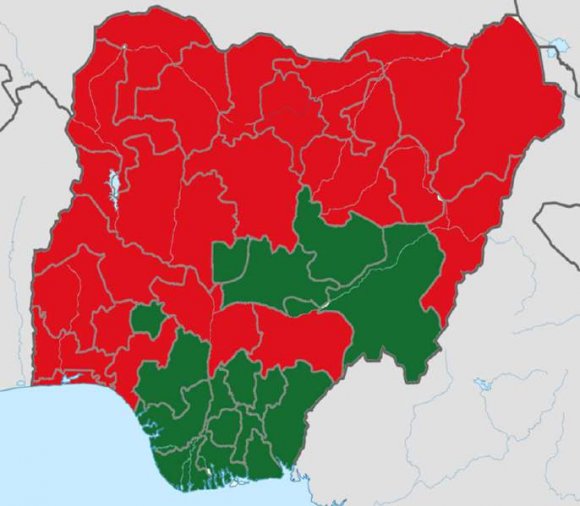
It is important to note that while the South-South has the highest voter's turnout; it also has one of the least collection rates, second only to the South-Westthis explains the unusual pattern in the graph above. This is important for several reasons. First, the South-South in particular, with high voter's turnout but low PVCs collected, is the region of the then incumbent president and doubles as the stronghold of the then ruling party -the PDP, as noted above. Thus the high rate of voter's turnout can be interpreted as efforts to retain political power in the zone. Second, the South-East, another stronghold of the PDP, voted massively for the party even though it was systematically disenfranchised, and with limited PVCs distributed. Larry Udu, concurring with Aribisala (2015), shows how the voting strength of the South-East was slashed from "5 million in 2011 to only 2.6 million in 2015 presidential election", whereas those of the North and South-West remained relatively stable (Udu 2015: 104). Third, there is an unusual 'coincidence' of the South-West having the lowest PVCs distributed in the South; it is a stronghold of the opposition party -APC -and a 'contested' ground for both the APC and PDP. However, The South-West however voted massively for the APC, with the exception of Ekiti state, which is a PDP- Conversely, the North-West, in particular, with the highest rate of PVCs distributed and one of the highest voters' turnouts, is the region of the opposition candidate, Muhammadu Buhari, and doubles as a stronghold and the major source of the party's bulk vote. Thus like in the South-South, the high rate of turnout in the North-West can be interpreted as desire to capture political power from the former. Second, the North-East, another region with both high PVCs distribution rate and second highest voters' turnout, is largely sympathetic to the opposition candidate and his party, the APC. It is however important to point out there were initial insinuations that elections will be boycotted in parts of the North-East, specifically in states affected by the Boko Haram insurgency such as Borno, Yobe and Bauchi, but this was later clarified by the INEC and elections peacefully conducted. Third, the North-Central has the lowest PVCs distribution in the North. This is significant because the North-Central, more or less like the South-West, was more of a 'middle-ground' or a noman's-land; equally populated by Christians and Muslims; and less predictable even among political analysts (Udu 2015).
Furthermore, what this means is that these zones -North-Central and, South-West to some extentwere highly unpredictable as far as 2015 Presidential election is concern, and as such less susceptible to manoeuvre. What is, however, troubling is what appears like a pattern or coincidence of some sort: the strongholds of the opposition APC with unparallel rate of PVCs distribution while the incumbent PDP's stronghold has the lowest. Also, worthy of note, is how the voter's turnout in the zones with the least PVCs, particularly the South (south and east), appears to compensate for its low PVC's collected, by relatively high turnouts. Moreover the turnout of voters in these zones (South-South and North-West) speaks of the commitments of each to determine the outcome of the election. The implication of all these, like Aribisala (2015) and Udu (2015) aptly assert is that the electoral process was systematically teleguided in favour of the North. The South was largely disenfranchised through voters' registration, restrained from voting through deliberate delayed and skewed distribution of PVC, and severely impaired by the preponderance of Card Reader failures (Zaggi 2015; Aribisala 2015; Udu 2015).
8. V. Conclusion
Though previous elections have been marred by irregularities, they stand a better chance of passing as 'election-in-progress' as opposed to 'electoral reversal'. The former applies to the 2007 and 2011 while the latter is the case of 2015 general elections, because in the former there were clear admission of irregularities while in the case of the latter, the simulacra of 'credible, free and fair' obscures the whole process and eschews the possibility of improving on it. Though the 2015 general elections has been largely popularised as an improvement on previous ones, such improvement can at best be considered quantitative rather than qualitative of substantive since it falls short of other aspects of the electioneering process that account for the credibility of election. Therefore, while credible, free and fair election is a requisite for the triumph of democracy, an independent and impartial administration legislating and adjudicating over the electioneering processes is a prerequisite for credible election. The whole cannot be construed and subsumed for the part even as the parts are invaluable; for every step along the path to democratic consolidation matters.
While it is obvious it is not the duty of electoral umpire to compel active participation in the voting process, it is, however, her sole responsibility to ensure that no individual, groups, or region is deprived in the course of exercising this civic and political right, be it for strategic, logistic, and or sentimental reason(s). Also, it is her sole responsibility to assuage the suspicion ofor, indeed, skewing the processes of constituency delineation, voters' registration, accreditation, and distribution of electoral materials. Disenfranchisement of such large proportion of the population, either by error, omission or commission, cannot be excused for experimentation with 'new voting technologies'. The noble path is for the INEC to admit, if indeed they were error or omission, and lay bare its shortcomings for possible corrections to be made in subsequent rounds, regardless of the declaration by outsiders of a 'free, fair and credible' election.
In the end, the point is to highlight that the people's confidence in the system is not misplaced, but more so to build confidence in the people as well as the institutions. However, of more importance is understanding that institutions do not operate themselves; rather they are run by humans. Institutions on their own do not make democracy; it is people that do. There can't be democracy without democrats. Yet, as Plato tried to direct our attention to, in what would appears to be the most incisive critique of, often misinterpreted as apprehension for, democracy: the fear of antidemocratic forces -individuals, policies and institutions, parading as democrats. Political institutions and, indeed, "government is more than a piece of machinery, its essence is ultimately determined by the quality of the men and women who compose it" (Ebenstein 2002: 10). Thus one of the greatest threats to democracy and democratization in the twentieth century will not come from authoritarian rulers or result from authoritarian reversals; rather it would be the failure of democrats to realize that apart from rights and liberties they enjoy, they are equally imbued with duties to translate political practices into economic gains for the people and responsibilities to be vigilant, at all times, of the workings of such practices and processes (Ake 2012;Kukah 2015).
| Political Zone | Registered Voters | Accredited Voters | Vote Cast/ Turnout | Valid Votes Cast | Total Invalid Votes |
| North-Central | 9,620,455 | 4,294,232 | 3,970,835 | 3,852,278 118,557 | |
| North-East | 8,933,630 | 4,023,354 | 3,783,920 | 3,672,348 111,572 | |
| North-West | 17,570,066 | 9,499,304 | 8,747,921 | 8,505,577 242,344 | |
| South-East | 7,513,031 | 3,060,093 | 2,815,348 | 2,724,654 | 90,694 |
| South-South | 9,413,630 | 5,552,925 | 5,258,597 | 5,168,330 | 90,267 |
| South-West | 13,484,620 | 4,972,526 | 4,539,447 | 4,362,572 176,875 | |
| FCT Abuja | 886,573 | 344,056 | 316,015 | 306,805 | 9,210 |
| Total | 67,422,005 | 31,746,490 29,432,083 28,587,564 844,519 | |||
| Source: INEC | |||||
| Political Zone | Registered Voters | Distributed/ Collected PVCs | Accredited Voters | Vote Cast/ Turnout | % of PVCs | % of Voter's Turnout |
| North-Central | 9,620,455 | 7,661,576 | 4,294,232 | 3,970,835 | 79.6 | 92.4 |
| North-East | 8,933,630 | 7,922,444 | 4,023,354 | 3,783,920 | 88.6 | 94.0 |
| North-West | 17,570,066 | 15,999,398 | 9,499,304 | 8,747,921 | 91.0 | 92.0 |
| South-East | 7,513,031 | 6,621,541 | 3,060,093 | 2,815,348 | 88.1 | 92.0 |
| South-South | 9,413,630 | 6,624,301 | 5,552,925 | 5,258,597 | 70.3 | 94.6 |
| South-West | 13,484,620 | 9,250,041 | 4,972,526 | 4,539,447 | 68.5 | 91.2 |
| FCT Abuja | 886,573 | 569,109 | 344,056 | 316,015 | 64.1 | 91.8 |
| Total | 67,422,005 | 56,460,968 | 31,746,490 | 29,432,083 | 92.7 (Av. 92.5) |